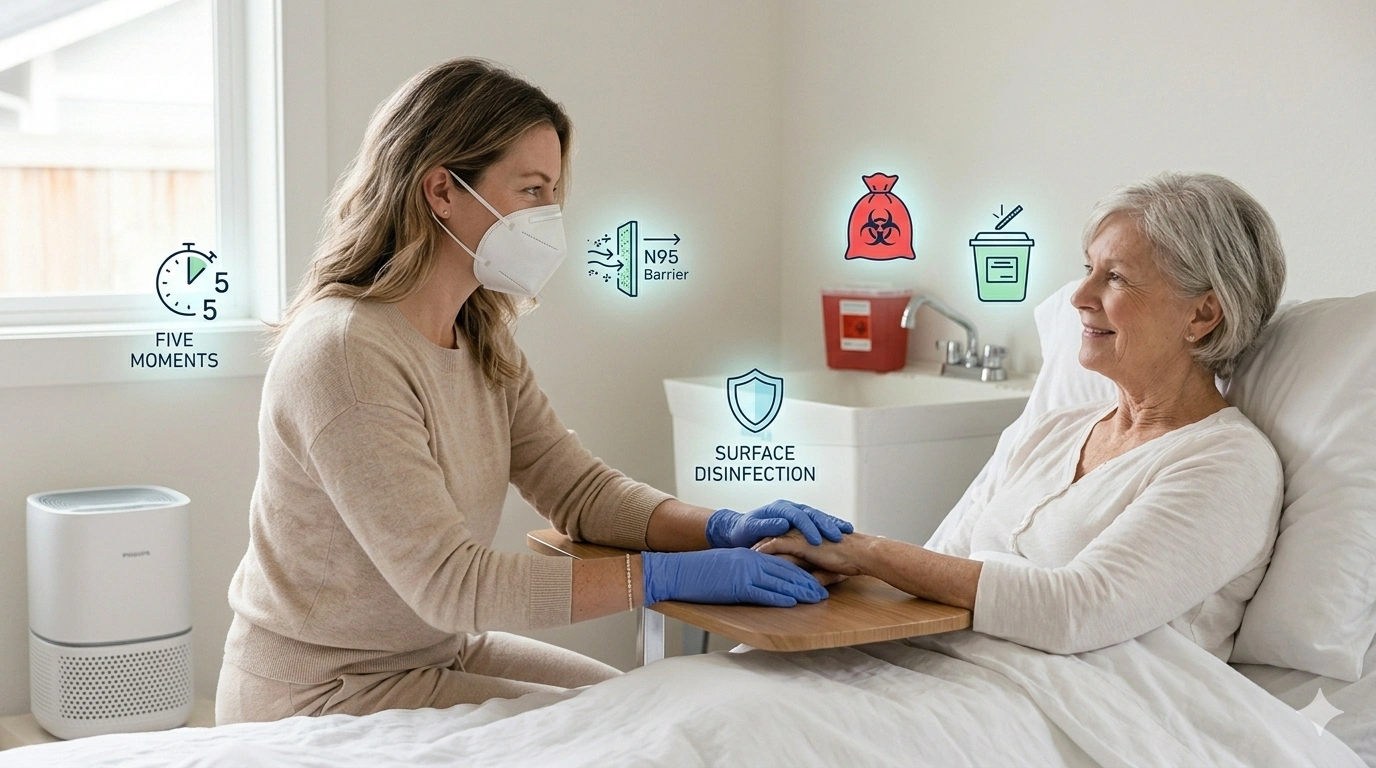

Providing care for a family member—whether an aging parent, a recovering patient, or someone with a chronic illness—transforms your home into a frontline medical environment. In this setting, infection control isn’t just a “good habit”; it is a vital safety protocol. Caregivers are the primary defense against Healthcare-Associated Infections (HAIs), which can easily manifest at home if cross-contamination occurs.
To maintain a safe environment for both the caregiver and the care recipient, you must adopt professional clinical standards adapted for the domestic space. Here are the ten essential pillars of home care hygiene and infection control.
1. The “Five Moments” for Hand Hygiene
In clinical settings, the World Health Organization (WHO) emphasizes “Five Moments” for hand hygiene. For a home caregiver, these moments are the anchor of infection control:
- Before touching the patient.
- Before a clean or aseptic procedure (e.g., dressing a wound or administering meds).
- After body fluid exposure risk.
- After touching the patient.
- After touching the patient’s immediate surroundings (bedrails, bedside table).
The Tool: Use a medical-grade hand sanitizer with at least 70% alcohol for quick transitions, but always use soap and water if hands are visibly soiled.
2. Personal Protective Equipment (PPE) Literacy
PPE is not just for hospitals. Using it correctly at home prevents the caregiver from becoming a “vector” (a carrier) who moves germs from the patient’s room to the kitchen or other family members.
- Gloves: Wear disposable, non-latex gloves whenever there is a risk of contact with blood or body fluids. Crucial: Change gloves between different tasks on the same person to avoid moving bacteria from one part of the body to another.
- Aprons/Gowns: If you are assisting with bathing or wound care, a simple plastic apron can prevent your clothing from becoming a reservoir for pathogens.
3. Medical Waste Management and Sharps Safety
Standard kitchen trash bins are insufficient for medical waste. Used bandages, incontinence products, or soiled tissues require a dedicated disposal system.
- The Red Bag Rule: Place heavily soiled items in a separate, leak-proof plastic bag before putting them in the main trash.
- Sharps Containers: If the care recipient requires injections (e.g., insulin), never throw needles in the regular trash. Use a puncture-proof “Sharps” container. This protects you, your family, and waste management workers from needle-stick injuries and bloodborne pathogens.
4. Aseptic Technique for Wound and Device Care
If the person you are caring for has a surgical incision, a pressure sore, or a catheter, these are direct gateways for infection.
- The Sterile Field: When changing a dressing, create a “clean zone” on a sanitized tray. Do not touch the side of the bandage that will contact the skin.
- Catheter Care: Always keep the drainage bag below the level of the bladder to prevent the backflow of urine, which is a leading cause of Urinary Tract Infections (UTIs).
5. High-Frequency Disinfection of the “Patient Zone”
The area within three feet of the patient is the “Hot Zone” for germs. Pathogens can survive on hard surfaces for days or even weeks.
- The Targets: Bedrails, TV remotes, over-bed tables, and call buttons.
- The Routine: Wipe these down at least twice daily with a hospital-grade disinfectant. If the person has a gastrointestinal illness (like C. diff), use a bleach-based cleaner, as standard alcohol wipes may not kill the spores.
6. Laundry Hygiene for Bio-Sullied Linens
Bed sheets and clothing belonging to a sick person should be handled with “low-agitation” to prevent dispersing germs into the air.
- The Hot Wash: Launder these items separately from the rest of the family’s clothes. Use the hottest water setting possible ($60°C$ or higher) and a bleach-based detergent if the fabric allows.
- Drying: Use a high-heat drying cycle. The combination of high-heat washing and high-heat drying is a powerful antimicrobial “one-two punch.”
7. Oral Hygiene and Pneumonia Prevention
For bedbound or elderly patients, oral hygiene is a critical infection control measure. Bacteria from the mouth can be inhaled into the lungs, leading to Aspiration Pneumonia.
- The Protocol: Ensure the patient’s teeth are brushed or their mouth is rinsed after every meal.
- The Positioning: If they have difficulty swallowing, ensure they are sitting upright ($90°$) during and for 30 minutes after eating to prevent food particles from entering the airway.
8. Medication Station Sanitization
The area where you prepare medications must be the cleanest spot in the house.
- The Setup: Clear all clutter. Wipe the surface with a disinfectant before laying out pill organizers or syringes.
- Cross-Contamination: Avoid touching pills with your bare hands; use the cap of the bottle or a clean pill-crusher.
9. Caregiver Self-Care: The Immune Perimeter
A caregiver’s own health is the foundation of the patient’s safety. If you get sick, you cannot provide care, and you risk passing your illness to someone whose immune system is already compromised.
- Vaccination: Ensure you are up to date on your flu, COVID-19, and Tdap (whooping cough) vaccines.
- Symptom Monitoring: At the first sign of a scratchy throat or fever, wear a high-filtration mask (N95/KF94) while providing care to shield the patient from your respiratory droplets.
10. The Safe Kitchen-to-Room Bridge
Bringing food from the kitchen to the sickroom is a high-risk transition point.
- The Tray Protocol: Use a dedicated tray for the patient’s meals. After use, don’t just rinse it; wash it in a dishwasher at high heat.
- No Sharing: Ensure the patient has their own set of utensils and cups that are never shared with other family members, even if they look “clean.”
Conclusion: Professionalism in the Home
Caregiving is a profound act of love, but it must be paired with clinical discipline. By implementing these ten pillars of infection control, you aren’t just “cleaning”; you are actively preventing complications and accelerating the recovery of your loved one. You are the guardian of the home’s biological boundary.