
The kitchen is the biological heart of the home, but it is also the most volatile. From the $Salmonella$ on raw poultry to the $Listeria$ that can survive in the back of a cold refrigerator, foodborne pathogens are an invisible threat to even the most health-conscious household. For a high-performance lifestyle, a bout of food poisoning is more than an illness—it is a significant disruption to productivity and wellness.
Mastering “Kitchen Hygiene” requires a transition from casual cleaning to clinical food safety protocols. Here are ten high-quality pillars for maintaining a culinary sanctuary.
1. The “Zoning” Strategy for Cross-Contamination
Cross-contamination is the primary vehicle for kitchen-linked infections. It occurs when pathogens from “high-risk” foods (raw meat/poultry) are transferred to “low-risk” foods (fresh produce).
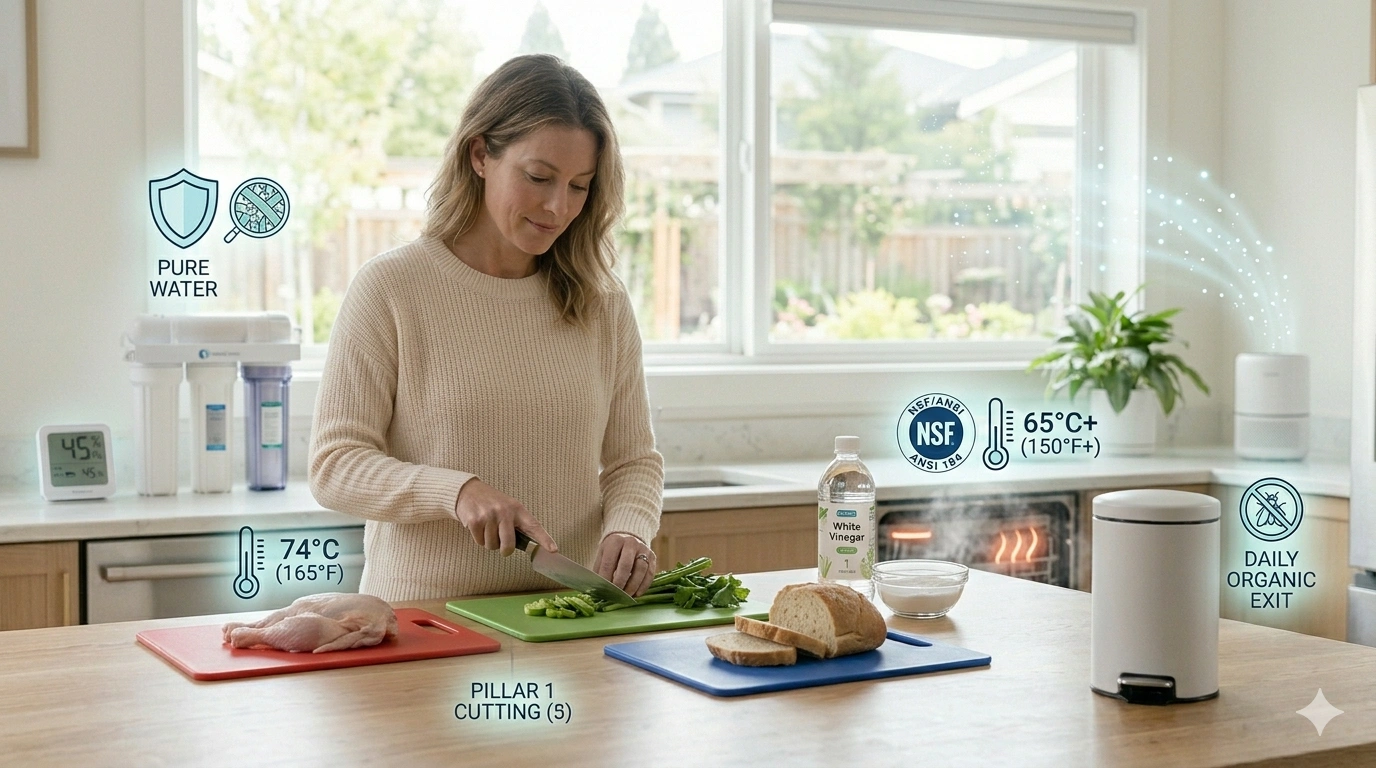
- The Color-Code: Implement a professional color-coded system for cutting boards. Use Red for raw meats, Green for vegetables, and Blue for cooked foods or bread.
- The Perimeter: Never place grocery bags or personal items (like phones or keys) on food-preparation surfaces. These items have touched public floors and transit seats, bringing environmental pathogens directly to your “clean” zone.
2. Thermal Integrity and the “Danger Zone”
Bacteria multiply most rapidly between 5°C (40°F) and 60°C (140°F)—the “Danger Zone.”
- The 2-Hour Rule: Never leave perishable food at room temperature for more than two hours. In temperatures above 30°C, this window shrinks to just one hour.
- Rapid Cooling: Do not put a large pot of hot food directly into the fridge; it can raise the internal temperature of the unit, putting other food at risk. Divide large portions into shallow containers to ensure they cool through the “Danger Zone” as quickly as possible.
3. The Refrigerator “Bio-Map”
How you organize your fridge is a matter of safety, not just neatness.
- The Hierarchy: Store raw meat and seafood on the bottom shelf in a secondary container. This prevents juices containing pathogens from dripping onto lower shelves and contaminating produce.
- The Temperature Audit: Keep a dedicated thermometer in your fridge. Ensure it remains at 4°C (39°F) or below to inhibit the growth of Listeria, which can thrive even in cold environments.
4. Advanced Dishcloth and Sponge Hygiene
The kitchen sponge is arguably the most contaminated object in the entire house, often harboring millions of bacteria per cubic inch.
- The Replacement Cycle: Switch to microfiber cloths that can be laundered daily at 60°C. If you must use a sponge, replace it weekly.
- The Sanitizer: Do not rely on “rinsing.” Soak sponges in a solution of 1 part bleach to 10 parts water, or run them through the dishwasher on a “Sanitize” cycle daily.
5. High-Heat Dishwashing: The Sterilization Cycle
Hand-washing dishes often fails to reach the temperatures required to kill resilient pathogens like Norovirus.
- The Tech: Use a dishwasher with an NSF/ANSI 184 certification. This ensures the final rinse reaches a temperature high enough to sanitize the load.
- Air-Dry vs. Towel: Whenever possible, let dishes air-dry inside the machine. Using a communal tea towel to dry dishes can re-introduce bacteria to a freshly cleaned surface.
6. The Produce “Detox” Protocol
Fresh produce is often treated with pesticides and handled by dozens of people before reaching your kitchen.
- The Wash: Rinse all fruits and vegetables under cold, running water. For firm produce (melons, potatoes), use a dedicated brush to scrub the surface.
- The Vinegar Soak: For leafy greens, a brief soak in a solution of 1 part vinegar to 3 parts water can help reduce surface bacteria and remove fine grit.
7. Hand Hygiene: The “Double-Wash” Method
In the kitchen, “touching” is constant. Standard hand-washing is often insufficient when dealing with sticky proteins or raw fats.
- The Trigger: Wash your hands before you start, every time you switch between different food types (meat to veg), and immediately after touching the trash can or your face.
- The Friction: Focus on the “surgical” scrub—20 seconds of vigorous friction, including the nails and the webbing between fingers.
8. Managing Kitchen “Touch Points”
We often forget the surfaces we touch while our hands are contaminated, such as the faucet handle, the fridge door, and the spice jars.
- The Wipe-Down: At the end of every cooking session, perform a “High-Touch Sweep” using a food-safe disinfectant on all handles, knobs, and spice containers used during the process.
9. Trash and Organic Waste Boundary
Decaying organic matter is a primary attractant for pests and a source of airborne fungal spores.
- The Lidded Bin: Always use a trash can with a tight-fitting, foot-operated lid.
- The Daily Exit: Empty kitchen trash daily, regardless of how full it is. This prevents the “fermentation” of food scraps that leads to odors and microbial blooms.
10. The Defrosting Safety Standard
The way you thaw food determines its safety.
- The Fridge Thaw: Thaw frozen meats in the refrigerator, not on the counter. Counter-thawing allows the outer layer of the meat to sit in the “Danger Zone” for hours while the center remains frozen.
- The Cold Water Method: If you are in a rush, use a leak-proof bag submerged in cold water, changing the water every 30 minutes.
Conclusion: Fueling Health, Not Illness
The kitchen should be a place of creation and nourishment. By adopting these ten pillars of culinary hygiene, you ensure that the food you prepare is a foundation for your health and vitality. Clinical discipline in the kitchen is the ultimate mark of a mastered home.