
We often view our kitchens as the heart of the home, but from a microbiological perspective, they are high-traffic laboratories where biological cross-contamination is a constant risk. According to the CDC, nearly 20% of foodborne illnesses are contracted within the home. While we often blame a “bad burger” from a restaurant, the reality is that poor kitchen hygiene at home is a frequent culprit.
To transform your kitchen into a culinary fortress, you must adopt the same rigorous standards used by professional chefs. Here are ten high-quality pillars of food safety and kitchen infection control to protect your household.
1. The “Active Wash” Hand Protocol
In a professional kitchen, handwashing isn’t a suggestion; it’s a timed protocol. At home, “rinse and go” is the most common mistake.
- The Soap Interaction: You must use warm water and soap for at least 20 seconds. The friction is what physically detaches the Salmonella or E. coli from the ridges of your skin.
- The Critical Moments: Wash before you touch food, but more importantly, wash every time you switch between tasks—such as moving from handling raw chicken to chopping garnishes.
2. Defeating the “Pathogen Highway”: Cross-Contamination
Cross-contamination occurs when bacteria are transferred from one substance or object to another, with harmful effects.
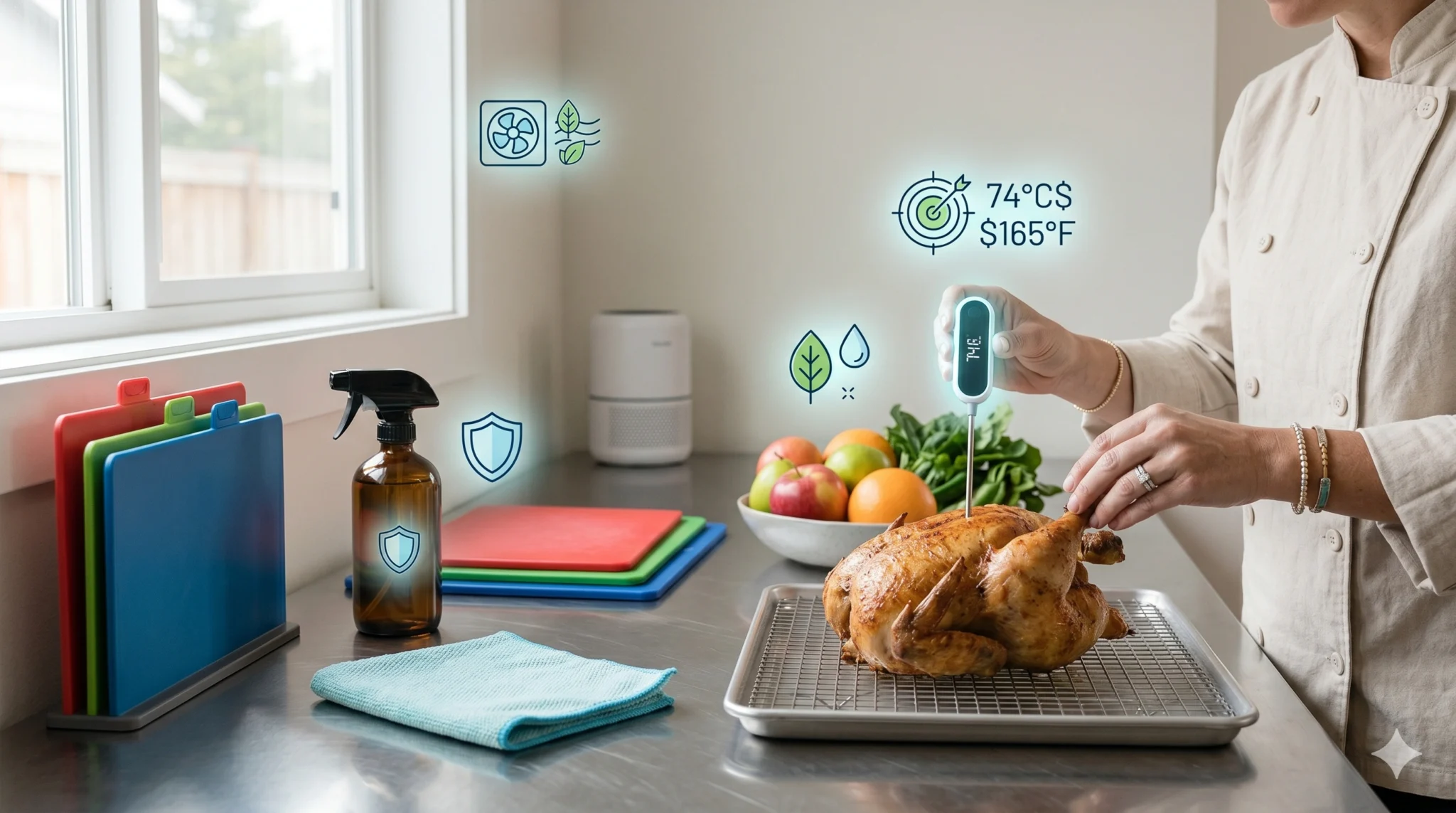
- The Color-Coding Strategy: Adopt the professional system. Use a red board for raw meats, a green board for produce, and a blue board for seafood. This visual cue prevents you from inadvertently placing a salad cucumber on a surface that just held raw poultry.
- Storage Hierarchy: In your refrigerator, always store raw meats on the bottom shelf. This ensures that if any juices leak, they won’t “rain” pathogens down onto your fruits, vegetables, or cooked leftovers.
3. The Science of the “Danger Zone”
Bacteria don’t just exist; they multiply—and they do so exponentially in a specific temperature range known as the Danger Zone.
- The Range: Between $5°C$ ($40°F$) and $60°C$ ($140°F$), bacteria can double in number every 20 minutes.
- The Two-Hour Rule: Never leave perishable food out for more than two hours. If the ambient temperature is above $32°C$ ($90°F$), that window shrinks to one hour.
- The Cooling Protocol: Don’t put a massive pot of hot chili directly into the fridge; it will raise the internal temperature of the refrigerator. Instead, portion it into smaller, shallow containers to allow for rapid cooling.
4. Thermal Lethality: Using a Meat Thermometer
Color is an unreliable indicator of safety. A “brown” burger can still harbor live bacteria, and a slightly pink chicken breast might be perfectly safe if it reached the correct internal temperature.
- The Standards: * Poultry: $74°C$ ($165°F$)
- Ground Meats: $71°C$ ($160°F$)
- Steaks/Chops: $63°C$ ($145°F$) with a 3-minute rest.
- Placement: Insert the probe into the thickest part of the meat, avoiding bone and fat, which conduct heat differently than muscle tissue.
5. Sanitizing vs. Cleaning: The Two-Step Method
“Cleaning” removes visible dirt and grease. “Sanitizing” reduces the number of microorganisms to a safe level. You cannot sanitize a surface that isn’t clean.
- The Method: First, wipe the counter with warm soapy water to remove organic debris. Second, apply a sanitizer (like a diluted bleach solution or a specialized kitchen spray).
- Contact Time: Most sanitizers require “dwell time.” If you spray and immediately wipe, you haven’t killed the bacteria. Read the label; most require 30 to 60 seconds of wet contact to be effective.
6. The Sponge Paradox
The kitchen sponge is often the dirtiest object in a home. By using a dirty sponge to “clean” a counter, you are effectively painting the surface with a bacterial film.
- The Alternatives: Switch to microfiber cloths or silicone scrubbers. Microfiber can be laundered at high temperatures ($60°C+$) to kill bacteria.
- Daily Sanitization: If you must use a sponge, run it through a full dishwasher cycle every night. Replace it the moment it develops an odor—that smell is the byproduct of bacterial metabolism.
7. Thawing Protocol: Forget the Counter
Thawing meat on the kitchen counter is a recipe for disaster. While the center of the meat remains frozen, the outer “skin” enters the Danger Zone for hours, allowing bacteria to bloom.
- The Professional Thaw:
- Refrigerator Thawing: The safest method. Plan 24 hours in advance.
- Cold Water Thawing: Submerge the meat in a leak-proof bag in cold tap water, changing the water every 30 minutes.
- Microwave Thawing: Only use this if you plan to cook the food immediately after, as some parts of the food may become warm and start to cook.
8. Produce Hygiene: More Than a Rinse
Fruits and vegetables often travel thousands of miles and are handled by dozens of people before reaching your kitchen.
- The Friction Method: For firm produce like melons or potatoes, use a clean vegetable brush.
- The Leafy Green Protocol: Submerge greens in a bowl of cold water, swish them around to let sediment sink, and then dry them in a salad spinner. Removing excess moisture prevents the rapid growth of spoilage bacteria in the fridge.
9. High-Touch Hardware Disinfection
While we focus on the food, we often forget the “intermediaries”—the objects we touch while our hands are contaminated.
- The Hit List: Refrigerator handles, oven knobs, spice jars, and the faucet lever.
- The Routine: Wipe these down with a disinfectant wipe at the end of every meal prep session. This prevents “bio-transfer” from a raw chicken hand to the handle of the fridge.
10. Waste Management and Pest Prevention
Pests like flies and cockroaches are biological vectors for disease. They are attracted to food waste and standing water.
- The Sealed Bin: Use a trash can with a tight-fitting, hands-free lid.
- The Drain Clean: Food particles trapped in the sink drain can rot and attract “drain flies.” Periodically pour a mixture of baking soda and vinegar followed by boiling water down the drain to clear organic buildup.
Conclusion: Vigilance as an Ingredient
Food safety isn’t a chore; it’s a fundamental part of the cooking process, as essential as salt or heat. By adopting these professional standards, you move from “hoping” your food is safe to “knowing” it is. A clean kitchen is the foundation of a healthy life.