
While previous articles established clinical and architectural standards for the home, implementing these protocols in a house with children introduces a unique set of challenges. Children are biological explorers; their developmental milestones—crawling, teething, and social play—are inherently high-contact and microbially intensive.
For parents and caregivers, the goal of high-quality infection control is not to create a sterile “bubble” that hinders development, but to implement a strategic defense that mitigates high-risk pathogens while allowing for healthy immune system “priming.” This article outlines 10 specialized pillars for pediatric hygiene and domestic safety.
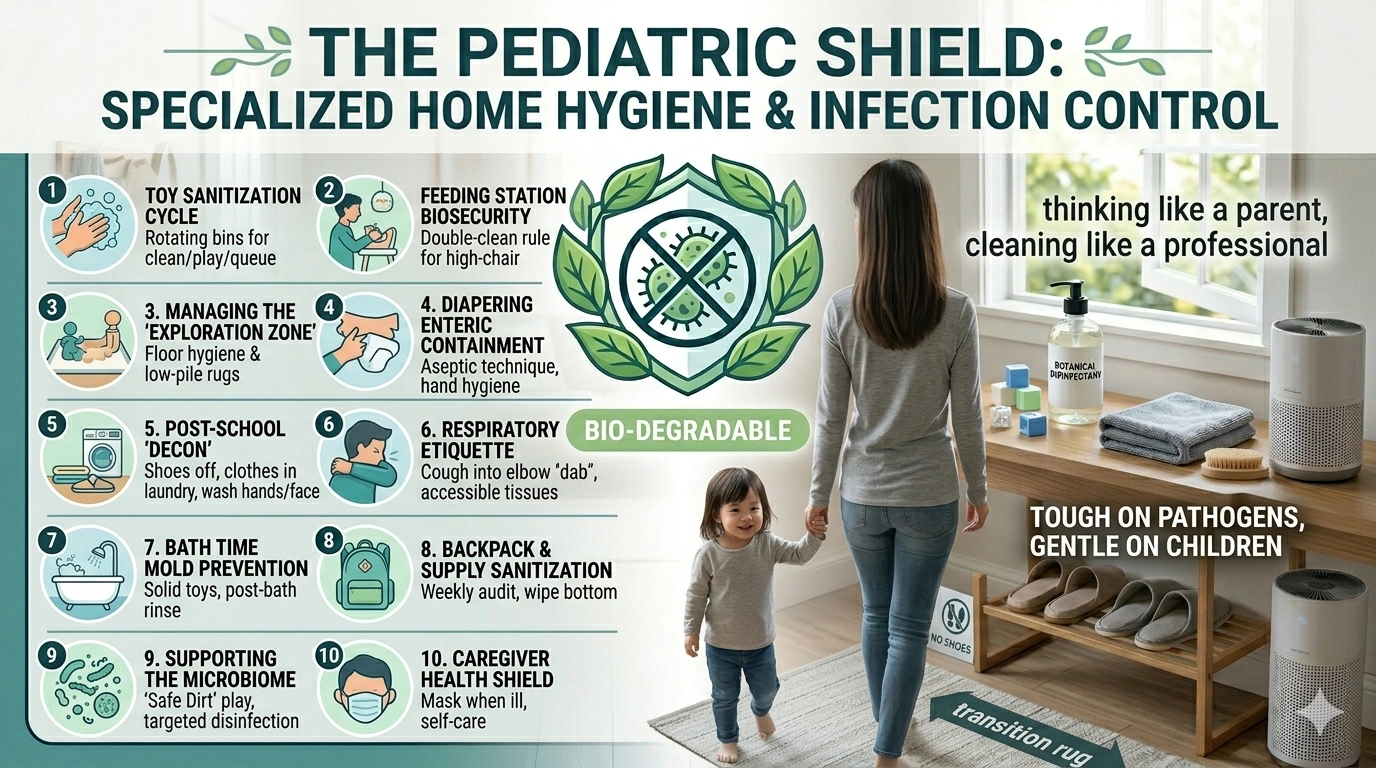
1. The “Toy Rotation” and Sanitization Cycle
Toys are the primary fomites in a child’s environment. They are chewed, dragged across floors, and shared during playdates, creating a high-frequency transmission route for respiratory and enteric viruses.
- The Protocol: Divide toys into three bins. Keep one out for play, one in “quarantine” (storage), and one in the “sanitization queue.”
- The Method: Hard plastic toys should be washed in a dishwasher or a basin of warm soapy water weekly. For plush toys, a high-heat dryer cycle for 20 minutes can neutralize dust mites and many surface bacteria without a full wash.
2. High-Chair and Feeding Station Biosecurity
The high-chair tray is often where a child’s food makes direct contact with a surface. Standard wiping often leaves behind organic residues that foster bacterial colonies like Staphylococcus aureus.
- The Double-Clean Rule: First, use a surfactant (soap) to remove visible food particles and “biofilm.” Second, apply a food-safe disinfectant (like a diluted hydrogen peroxide solution).
- Underside Awareness: Pathogens and mold often grow on the underside of the tray or in the crevices of the safety straps. Perform a “flip-clean” once a week to ensure these hidden areas are addressed.
3. Managing the “Exploration Zone” (Floor Hygiene)
For infants and toddlers, the floor is their primary interface with the world. Standard floor cleaning is insufficient when a child is constantly placing their hands (and objects from the floor) into their mouths.
- The “Zone” Strategy: Designate specific areas as “High-Crawl Zones” where a strict no-shoe policy is enforced and floors are disinfected daily using non-toxic, botanical agents.
- Rug Maintenance: Carpets trap allergens and pathogens that vacuuming alone cannot remove. In homes with crawlers, low-pile, machine-washable rugs are the professional choice for infection control.
4. Diapering and “Enteric” Containment
Diaper changing areas are the most significant source of fecal-oral transmission in the home, posing risks for Norovirus and Rotavirus.
- The Aseptic Change: Use a non-porous changing mat that can be wiped with a disinfectant after every single use.
- Hand Hygiene Sequence: Caregivers must wash their hands before the change (to protect the infant) and after the change (to protect the household). Hand sanitizer is a secondary backup but cannot replace the mechanical removal of pathogens via soap and water in this context.
5. Social Distancing for Schools and Playdates
Infection control doesn’t mean isolation, but it does mean situational awareness.
- The “Wellness Check”: Before a playdate, a polite “wellness check” text to the other parent (“Everyone healthy on your end?”) is a standard protocol for high-quality domestic safety.
- Post-School “Decon”: When children return from school or daycare, implement an immediate “Transition Routine”: shoes off, school clothes into the laundry or a dedicated bin, and a full hand-and-face wash.
6. Pediatric Respiratory Etiquette
Teaching a child to “catch their cough” is a foundational step in domestic infection control that pays dividends for the entire household’s health.
- The “Dab” Technique: Teach children to cough into their elbow by calling it the “vampire sneeze” or the “dab.”
- Accessible Tissues: Place tissue boxes at child-height in every room, accompanied by a small lidded trash bin, so the child can take agency over their own respiratory hygiene.
7. Bath Time: More Than Just Scrubbing
The bathtub can ironically be a site of cross-contamination, especially if bath toys are not properly maintained.
- Internal Mold Prevention: Squeeze-toys that hold water inside are notorious for growing black mold (Aspergillus). Discard these in favor of solid toys or “open-drain” toys that can dry completely.
- The Rinse Protocol: After a bath, rinse the tub and the child with fresh water to remove any residual bacteria lifted during the soak.
8. Backpack and School Supply Sanitization
School backpacks are rarely cleaned and often sit on classroom floors or bus aisles before being placed on the kitchen table at home.
- The “Table-Top” Ban: Never allow school bags on food-prep surfaces.
- Weekly Audit: Empty backpacks weekly and wipe the interior and exterior with a botanical disinfectant. Pay special attention to the bottom of the bag, which is the primary contact point for outdoor contaminants.
9. Supporting the Developing Microbiome
As discussed in previous articles, over-sterilization can be detrimental. In a pediatric context, “clean” must be balanced with “natural.”
- The “Safe Dirt” Concept: Allow children to play outside in non-polluted soil. This exposure to environmental microbes is essential for the maturation of their immune system.
- Targeted vs. Global: Focus your disinfection on the “Bio-Zones” (bathroom, kitchen, changing table) while allowing “Play Zones” to remain microbially diverse.
10. The Caregiver’s Health: The Final Link
A child’s health is inextricably linked to the health of their caregivers.
- The “Shield” Protocol: If a parent feels the onset of a cold, they should wear a mask during close-contact activities like feeding or rocking to sleep.
Self-Care as Hygiene: Ensuring caregivers get adequate sleep and nutrition keeps their immune systems strong, preventing the “household cycle” where an illness