
The bedroom is the most intimate space in the home biome. It is where we spend a third of our lives in a state of vulnerability, performing the essential biological work of cellular repair and cognitive consolidation. However, from a hygiene perspective, the bed is a “bio-accumulator”—a warm, moist environment that collects liters of sweat, millions of skin cells, and microscopic dust mites every year.
A “Sleep Sanctuary” requires more than just high-thread-count sheets; it demands a clinical strategy to manage the microbial load of your bedding and the air quality of your recovery zone. Here are the ten pillars of sleep hygiene and infection control.
1. The Bedding Rotation: The $60^{\circ}\text{C}$ Standard
Sheets and pillowcases are in direct, prolonged contact with your skin and respiratory system. They act as a filter for body oils and shed skin.
- The Cycle: Launder all sheets and pillowcases at least once a week.
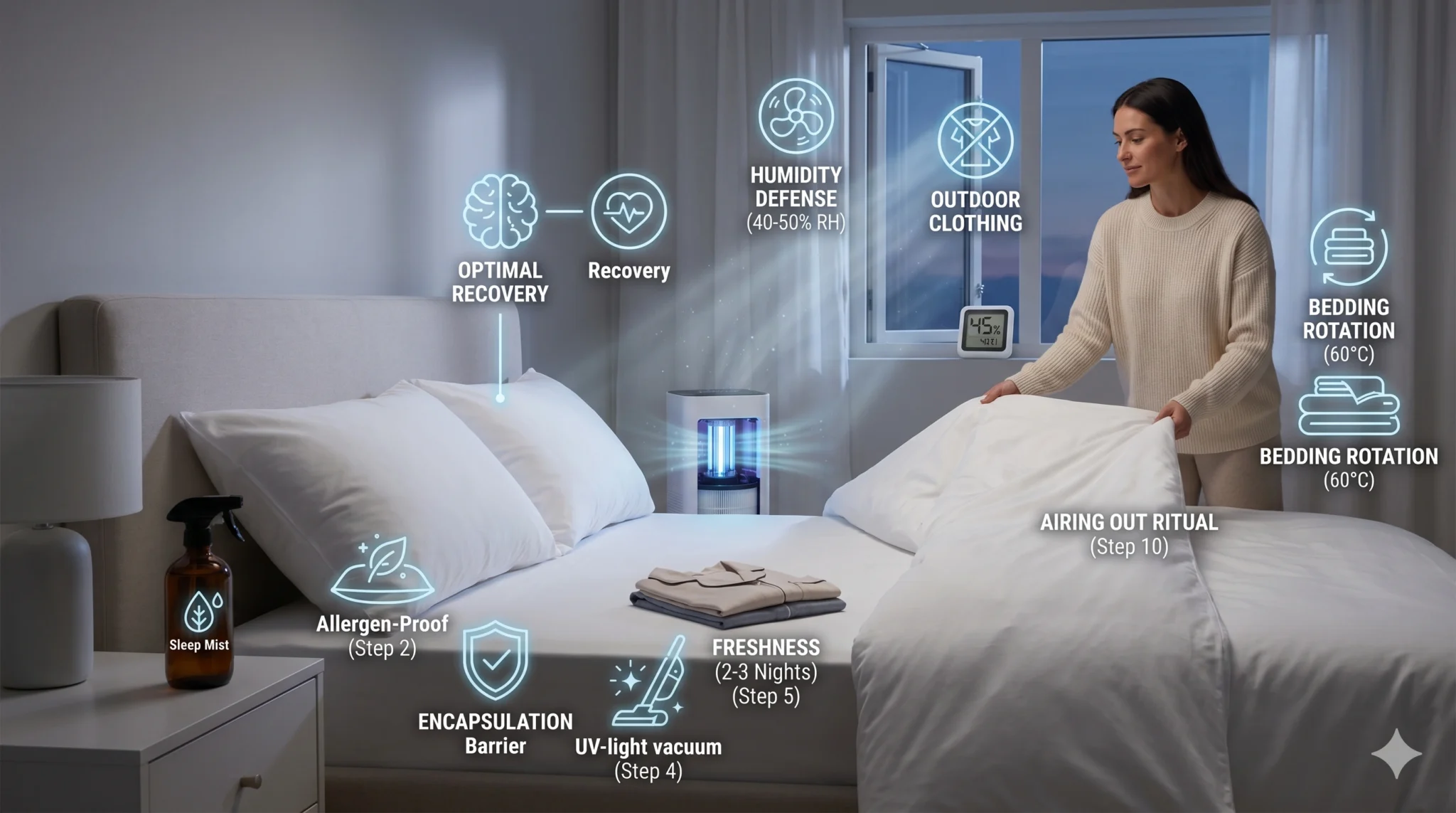
- The Temperature: Use a $60^{\circ}\text{C}$ ($140^{\circ}\text{F}$) wash cycle. This is the thermal threshold required to denature the proteins in dust mite allergens and kill resilient skin bacteria like Staphylococcus aureus.
Pillows are often the most overlooked item in a hygiene routine. Over two years, up to $30\%$ of a pillow’s weight can consist of dead skin, dust mites, and their waste.
- The Barrier: Use a high-quality, zippered “allergen-proof” pillow protector under your pillowcase. This creates a physical barrier that prevents skin cells from entering the pillow core.
- The Wash: Wash the pillows themselves every 3–6 months. If they are not washable, replace them every two years to maintain a clean breathing zone.
3. Managing the “Breathing Zone” Air Qualit
While we sleep, our respiration rate slows, but our exposure to indoor pollutants remains constant.
- HEPA Placement: Position an air purifier within 3 feet of the head of the bed. This ensures the air you inhale for 8 hours is stripped of $99.97\%$ of mold spores, pet dander, and fine particulate matter ($PM_{2.5}$).
- Dust Mite Sequestration: If you have carpets, vacuum them with a HEPA-rated machine twice a week to prevent the “kicking up” of allergens into your breathing space.
4. Mattress Hygiene: The Vacuum and Shield
The mattress is the largest filter in your home. It cannot be laundered, so it must be shielded.
- The Encapsulation: Use a waterproof, breathable mattress protector. This prevents sweat and oils from reaching the foam or springs, where they can encourage the growth of deep-seated mold.
- The Vacuum: Every time you change your sheets, use a handheld vacuum with a UV-light attachment on the bare mattress surface to reduce surface-level microbial populations.
5. Nightwear Sequestration
Your pajamas act as the “first line of defense” for your bedding.
- The Freshness Rule: Change your nightwear every 2–3 nights. If you shower before bed, you can extend this slightly, but nightwear should never be worn for a full week, as it traps the very oils you are trying to keep out of your linens.
6. The “Outdoor Clothing” Boundary
The bedroom should be a “clean-room” environment.
- The Rule: Never sit on the bed in “street clothes.” Clothing worn in public spaces (offices, gyms, transit) carries a significant environmental load. By maintaining a strict “sleep-wear only” rule for the bed, you preserve the biological integrity of your recovery surface.
7. Humidity Control for Respiratory Health
As discussed in our seasonal hygiene articles, humidity is the “governor” of your respiratory defenses.
- The Target: Maintain bedroom humidity between $40\%$ and $50\%$.
- The Risk: RH above $60\%$ triggers dust mite explosions and mold growth; RH below $30\%$ dries out your nasal passages, making you more susceptible to nighttime viral infections.
8. Managing “Tech Hygiene” in the Sanctuary
Many professionals bring phones or tablets into the bedroom.
- The Contamination Vector: Your phone is a “third hand” that has touched everything you encountered during the day. If you must use it in bed, it must be wiped with a $70\%$ alcohol solution first. Ideally, keep all devices on a charging station away from the bed to prevent the transfer of “office microbes” to your linens.
9. The Pet Boundary in the Bedroom
If pets sleep on the bed, the hygiene requirements escalate.
- The Top-Layer Defense: Use a dedicated “pet throw” on top of your duvet. This is easily removable and can be washed more frequently than the heavy duvet itself.
- The Dander Factor: Increase air purifier speeds to “Medium” or “High” overnight to compensate for the additional biological load introduced by your pet.
10. The Morning “Airing Out” Ritual
Counter-intuitively, making your bed immediately after waking can be a hygiene mistake.
- The Science: A made bed traps the heat and moisture generated by your body overnight, providing the perfect environment for dust mites to rehydrate.
- The Protocol: Pull back the covers and leave the bed “unmade” for 30 minutes with a window cracked or the fan on. This allows the mattress and linens to dry out before you seal them back up for the day.
Conclusion: Recovery as a Standard
The quality of your sleep is the foundation of your professional and creative performance. By implementing these ten pillars of sleep hygiene, you ensure that your recovery isn’t just restorative for your mind, but healthy for your body. A Sleep Sanctuary is the ultimate investment in your long-term vitality.