
We spend approximately $90\%$ of our lives indoors, inhaling over 10,000 liters of air every day. Yet, indoor air is often two to five times more polluted than outdoor air. For the modern professional, air is the most overlooked “surface” in the home. From volatile organic compounds (VOCs) off-gassing from furniture to microscopic mold spores and viral aerosols, the air you breathe is the primary gateway for environmental pathogens.
Creating an “Air Sanctuary” is about moving beyond pleasant scents and focusing on clinical particulate management and molecular filtration. Here are the ten pillars of advanced indoor air quality and respiratory hygiene.
1. The HEPA Standard: Particulate Defense
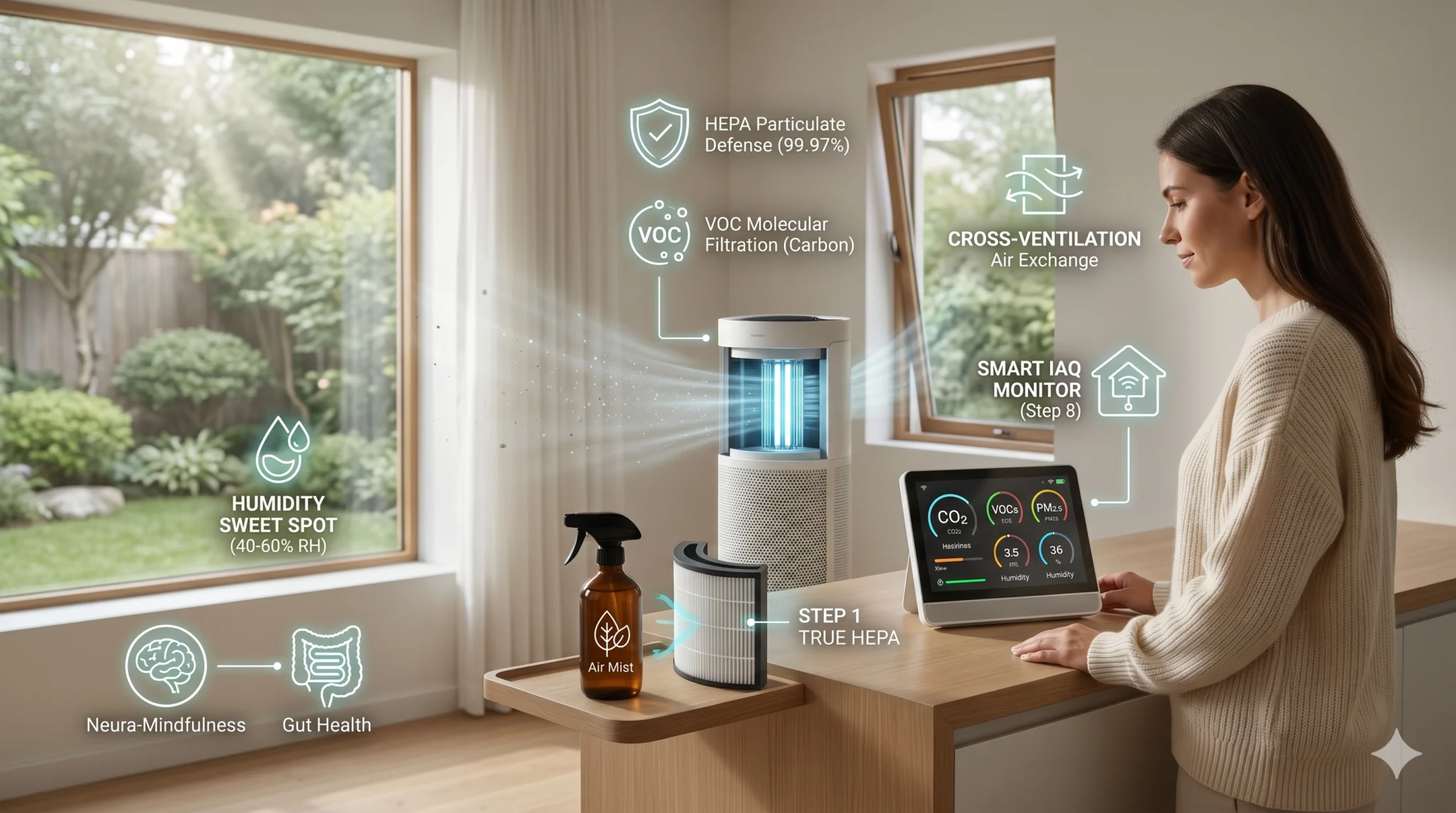
High-Efficiency Particulate Air (HEPA) filters are the gold standard for respiratory hygiene. A true HEPA filter must capture $99.97\%$ of particles as small as $0.3$ microns.
- The Application: Use standalone HEPA purifiers in “high-occupancy” zones (the bedroom and the office).
- The Logic: This size threshold includes most bacteria, fungal spores, and the droplet nuclei that carry viruses. By “scrubbing” these from the air, you drastically reduce the bio-burden your immune system must process.
2. Molecular Filtration: Managing VOCs
Particulate filters cannot stop gases. Volatile Organic Compounds (VOCs)—chemicals emitted by paints, adhesives, and electronics—require molecular filtration.
- The Solution: Ensure your air purifier has a substantial Activated Carbon stage. Carbon has a massive surface area that “adsorbs” chemicals and odors, preventing them from irritating your lungs and causing systemic inflammation.
3. The Humidity “Sweet Spot” ($40-60\%$)
Relative Humidity (RH) is the master controller of your respiratory health.
- The Biology: When RH drops below $40\%$, your nasal “cilia” (tiny hairs that move mucus) become paralyzed, and your mucus thins, leaving your “respiratory gate” open to viruses.
- The Physics: In dry air, viral droplets stay airborne longer. At $50\%$ RH, these droplets absorb moisture, become heavy, and fall out of the breathing zone onto surfaces where they can be cleaned.
4. Cross-Ventilation: The “Air Exchange” Protocol
Filtered air is good, but “fresh” air is vital for managing $CO_2$ levels, which can impair cognitive function and focus during long work sessions.
- The Routine: Perform a “Full Exchange” twice daily. Open windows on opposite sides of the home for 15 minutes. This uses the pressure differential to flush out stagnant air that purifiers might miss in corners.
5. Managing the “Source” (VOC Reduction)
The most efficient way to clean air is to never pollute it.
- The Inventory: Audit your cleaning supplies and furniture. Move away from aerosol sprays and synthetic fragrances, which are primary sources of indoor $PM_{2.5}$ (fine particulate matter).
- The “Off-Gassing” Rule: When buying new tech or furniture, unbox it in a well-ventilated garage or spare room for 48 hours before bringing it into your primary sleep or work sanctuary.
6. The Kitchen Exhaust Imperative
Cooking is the #1 source of indoor particulate pollution. Frying or gas cooking can spike $PM_{2.5}$ levels to several times the “unhealthy” outdoor limit.
- The Protocol: Always run your kitchen exhaust fan on its highest setting while cooking and for 10 minutes after. If your fan only recirculates air (rather than venting outside), place a HEPA purifier nearby to catch the cooking aerosols.
7. Dust Mite and Spore Sequestration
Dust is not just dirt; it is a complex bio-mixture of skin cells, insect waste, and mold spores.
- The Tech: Use a vacuum with a Sealed HEPA System. Standard vacuums often leak the smallest, most irritating particles back into the air through the exhaust. A sealed system ensures that once dust enters the machine, it never returns to your breathing zone.
8. The “Bio-Indicator” Strategy
You cannot manage what you do not measure.
- The Monitor: Invest in a high-quality Indoor Air Quality (IAQ) monitor that tracks $CO_2$, VOCs, $PM_{2.5}$, and Humidity.
- The Trigger: Use these readings as “triggers.” If $CO_2$ crosses 800 ppm, open a window. If $PM_{2.5}$ rises during cooking, increase the air purifier speed.
9. Managing the “Entryway Plume”
Every time you open your front door, a “plume” of outdoor pollutants, pollen, and dust enters the home.
- The Barrier: Place an air purifier near the main entrance. This acts as a “biological air curtain,” capturing outdoor particles before they can drift deeper into your living spaces.
10. Upper-Room UVGI (For High-Risk Zones)
In shared spaces like a computer coaching center, consider Ultraviolet Germicidal Irradiation (UVGI).
- The Science: UV-C light at $254$ nm deactivates the DNA/RNA of airborne pathogens. Professional “upper-room” units sanitize the air as it naturally circulates toward the ceiling, providing a continuous “kill zone” for viruses without exposing people to the light.
Conclusion: Breath as a Wellness Foundation
Respiratory hygiene is the “invisible” layer of your home sanctuary. By mastering the air you breathe, you reduce the background stress on your immune system, improve your sleep quality, and sharpen your cognitive performance. Air is not empty space; it is a resource to be managed.