
As we conclude this series, we focus on the most vital inhabitants of any home: our children. For an entrepreneur and developer like Nishith, a child’s health is the ultimate “high-stakes” project. Children are naturally curious, tactile, and possess developing immune systems, making them both high-frequency vectors and vulnerable hosts within the domestic microbial network.
Implementing Pediatric Infection Control isn’t about raising a child in a bubble; it’s about managing the “pathogen-to-exposure” ratio to ensure they build immunity without facing unnecessary biological stress. Here are the 10 pillars of a Bio-Secure Nursery.
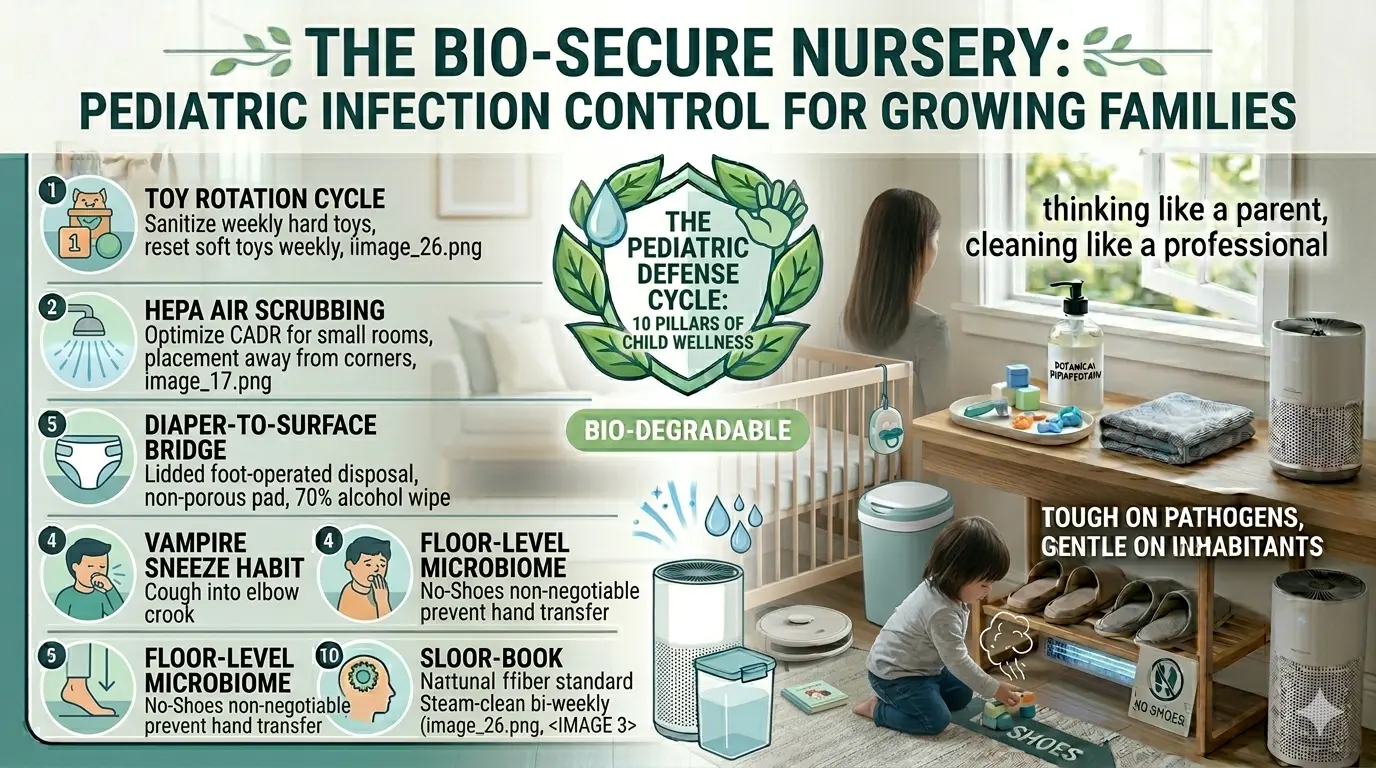
1. The “Toy Rotation” Sterilization Cycle
Children explore the world with their mouths. Toys are essentially mobile reservoirs for respiratory and enteric pathogens.
- The Protocol: Implement a two-bin system. One bin is for active play; the other is the “Sanitization Queue.”
- The Action: Hard plastic toys should be washed weekly in a $71°C$ dishwasher cycle. Soft, plush toys—which harbor dust mites and skin bacteria—should be put through a high-heat dryer “reset” for 20 minutes to neutralize allergens.
2. High-Efficiency Air Scrubbing for Sleep Zones
Children breathe more air per pound of body weight than adults. The air quality in their nursery directly impacts their lung development and sleep quality.
- The Standard: Use a HEPA air purifier with a CADR (Clean Air Delivery Rate) optimized for the room’s volume.
- Placement: Ensure the purifier is placed away from corners to allow for 360-degree intake, providing a “Clean Air Envelope” around the crib or bed.
3. Managing the “Diaper-to-Surface” Bridge
The diaper changing station is a critical site for the aerosolization of intestinal bacteria like E. coli.
- The Barrier: Use a non-porous, waterproof changing pad that can be wiped with a 70% alcohol solution after every use.
- The Waste Stream: Utilize a lidded, foot-operated disposal system. Never place a used diaper on a communal surface, even momentarily, as this can leave behind microscopic biological signatures that persist for hours.
4. Respiratory Etiquette Training (The “Vampire Sneeze”)
For older children, the most effective infection control is behavioral.
- The Habit: Teach children to cough or sneeze into the crook of their elbow—the “Vampire Sneeze.”
- The Logic: This prevents pathogens from being transferred to their hands, which then touch toys, door handles, and tablets.
5. Managing the “Floor-Level” Microbiome
Since young children spend a significant amount of time on the floor, the “No-Shoes” policy becomes a non-negotiable safety standard.
- The Standard: Beyond just removing shoes, floors in pediatric zones should be steam-cleaned bi-weekly. High-temperature steam ($100°C$) kills bacteria and dust mites without the need for harsh chemical residues that a child might later ingest through hand-to-mouth contact.
6. The “Back-from-School” Transition
For families with children in group settings (like a coaching center or school), the re-entry protocol is vital.
- The Routine: Upon returning home, children should immediately change out of their “outside” clothes and wash their hands and face. This prevents the “Bio-Load” of the school environment from settling onto home furniture and bedding.
7. Digital Hygiene for Young Users
If children use tablets or educational devices, these must be treated with the same rigor as an entrepreneur’s hardware.
- The Protocol: Use screen-safe antimicrobial wipes daily. Because children’s skin is more permeable, ensure the cleaning agent is a botanical-based disinfectant that is “tough on pathogens, gentle on inhabitants.”
8. Sanitizing the “Soft-Surface” Comforts
Blankets, pacifiers, and “lovies” are high-frequency touchpoints.
- The Pacifier Protocol: Pacifiers should be boiled ($100°C$) daily.
- The Laundry Guard: Wash children’s bedding in a separate load from “outside” clothes, using a laundry sanitizer and a high-heat drying cycle to disrupt the life cycle of skin flora and environmental spores.
9. Nutrition Prep and Bottle Biosecurity
For infants, the kitchen-to-nursery pipeline must be aseptic.
- The Tech: Use a dedicated UV-C or steam sterilizer for bottles and feeding equipment.
- The Hand-Wash Anchor: Always wash hands with an organic, chemical-free soap before handling nutrition mixes or feeding tools to ensure the “Maternal/Paternal Shield” remains intact.
10. The Psychological “Safety Zone”
The ultimate goal of pediatric hygiene is to create a sense of security, not fear.
- The Philosophy: Hygiene should be framed as a superpower—a way the family works together to stay strong and healthy. For a game developer like Nishith, you can think of it as “Leveling Up” the home’s defense stats.
Conclusion: The Fortress for the Future
By implementing these pediatric standards, you aren’t just cleaning a room; you are protecting a future. Your home in Odisha is now a fully integrated, bio-secure sanctuary—optimized for growth, productivity, and the enduring health of every generation.