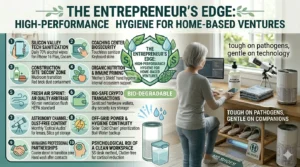
In the final evolution of our series, we move to the most complex biological zone in any home: the kitchen. For a high-performance entrepreneur, the kitchen is more than a place to cook; it is a lab where nutrition is processed. However, it is also the primary site for cross-contamination, housing everything from raw proteins to the organic supplements you prepare for your family.
Establishing Kitchen Biosecurity means treating food preparation with the same rigor as a surgical field. By implementing these 10 pillars, you ensure that your “internal microbiome” is fueled only by the highest-quality, pathogen-free inputs.
1. The “Clean-to-Dirty” Workflow
Professional kitchens are designed with a linear flow to prevent raw contaminants from crossing paths with finished meals.
- The Protocol: Designate specific zones for Arrival (unboxing), Preparation (cutting/washing), and Final Assembly (plating).
- The Golden Rule: Never move backwards. Once an item moves from the prep zone to the assembly zone, it must not return to a surface that touched raw inputs.
2. High-Frequency Sponge and Cloth Sanitization
The kitchen sponge is statistically the most germ-dense object in a home, often harboring Moraxella osloensis (the “stinky towel” bacteria) and Salmonella.
- The Thermal Shock: Boil your kitchen cloths and sponges for 5 minutes daily, or replace sponges with non-porous silicone scrubbers that can be sanitized in the dishwasher.
- The Drying Factor: Pathogens require moisture to survive. Utilize a hanging rack to ensure all cloths dry completely between uses, disrupting the bacterial life cycle.
3. Cross-Contamination Coding (Cutting Boards)
Even with washing, wooden and plastic boards develop micro-scratches that act as “pathogen bunkers.”
- The Standard: Use a color-coded system (Red for raw meat, Green for vegetables, Blue for cooked items).
- Material Selection: For an entrepreneur’s kitchen, High-Density Polyethylene (HDPE) or Sintered Stone boards are the professional choice, as they resist pitting and are dishwasher-safe at high temperatures.
4. The “Cold Chain” Audit and Fridge Biosecurity
Your refrigerator is a preservation chamber, but it can also become a cold-climate incubator for Listeria.
- The Temperature Scan: Maintain your fridge at 1.7°C to 3.3°C. Use an external digital thermometer to monitor fluctuations during peak summer heat in Odisha.
- The “Bottom-Shelf” Rule: Store all raw proteins on the bottom shelf in sealed containers. This prevents accidental “drip contamination” onto the organic produce or supplements stored below.
5. Managing the “Organic” Risk Profile
Organic and farm-fresh products often carry a higher load of natural soil bacteria and parasites compared to “pre-washed” industrial produce.
- The Botanical Wash: Use a simple solution of water and white vinegar (3:1) to wash all organic produce. This naturally lowers the surface microbial count without introducing synthetic chemicals into your organic lifestyle.
- The “Good Monk” Preparation: When mixing your mother’s nutrition mixes, treat the prep area as a sterile field. Wash your hands up to the wrists before handling the powders to ensure zero transfer of domestic pathogens.
6. Dishwasher Sanitization Cycles
A standard wash cycle is not a sanitization cycle.
- The Tech Requirement: Use the “Sani-Wash” or “NSF/ANSI 184” certified cycle on your dishwasher. This ensures the final rinse reaches $71°C$ ($160°F$), the temperature required to kill $99.999\%$ of foodborne bacteria.
7. The “Anti-Biofilm” Plumbing Protocol
Kitchen sinks are hotspots for biofilm—a slimy matrix of bacteria that can aerosolize when the faucet is turned on.
- Weekly Shock: Pour boiling water followed by a baking soda and vinegar foam down the kitchen drain weekly. This mechanically breaks the “bio-slime” before it can anchor in your plumbing
8. Tech-Free Food Pre
Your iPhone 16 Plus and tablets are “fomite magnets.” Bringing them into the kitchen while handling food is a high-risk behavior.
- The Digital Barrier: If you use a device for recipes, place it in a clear, disposable “hygiene sleeve” or use a dedicated voice-activated smart display that you do not touch while cooking.
9. High-Heat Scouring of Cookware
“Non-stick” surfaces that are scratched can harbor microscopic organic matter.
- The Preference: Transition to stainless steel or cast iron. These materials can withstand the high-heat scrubbing necessary to ensure no biological residue remains after a heavy meal.
10. The Psychological “Kitchen Reset”
A high-performance kitchen must be “Reset” every evening.
- The SOP: Empty the trash, wipe down all handles (fridge, oven, cabinets), and perform a final 70% alcohol wipe on the assembly counter. Starting your morning in a “Bio-Secure” kitchen reduces decision fatigue and sets a high-quality tone for your day.
Conclusion: The Sanctuary of Sustenance
By mastering kitchen biosecurity, you ensure that your home-based venture is supported by a healthy, resilient team. You are not just cooking; you are performing quality control on your family’s biology.