
In 2026, the “Gold Standard” of hygiene has moved beyond liquid chemicals. We have entered the era of Photonic Disinfection. While we have used ultraviolet light for decades in water treatment and operating rooms, it has now become a central pillar of home hygiene. From a clinical perspective, UV-C light is a “Genomic Disruptor.” Unlike soap, which washes pathogens away, or alcohol, which melts their outer membranes, UV-C light reaches into the heart of the organism to destroy its ability to function. At Clinieasy, we explain the physics behind the light and how to use it safely in your daily protocol.
1. The Physics: How Light Destroys Life
Not all UV light is the same. While UV-A and UV-B from the sun cause tanning and sunburns, UV-C ($100–280\text{ nm}$) is filtered out by the Earth’s atmosphere.
- The Science: When a virus or bacterium is exposed to UV-C light, the photons penetrate the cell wall and are absorbed by the DNA or RNA. This causes “Thymine Dimers”—kinks in the genetic code.
- The Clinical Result: An organism with broken DNA cannot replicate. In the world of microbiology, if an organism cannot replicate, it is “Inactivated.” It is effectively dead because it can no longer cause an infection.
2. The Rise of “Far-UVC” ($222\text{ nm}$)
The biggest breakthrough in 2026 is the adoption of Far-UVC.
- The Hazard: Traditional UV-C ($254\text{ nm}$) is dangerous to human skin and eyes, causing “Welder’s Flash” or skin damage. It can only be used in empty rooms or enclosed boxes.
- The Innovation: Far-UVC ($222\text{ nm}$) has a wavelength so short that it cannot penetrate the dead layer of human skin or the tear film of the eye. However, it is still large enough to penetrate and kill microscopic bacteria and viruses.
- The Application: This allows for “Continuous Disinfection” in occupied spaces, such as kitchens or home offices, safely neutralizing airborne pathogens in real-time.
3. The “Enclosed Box” Protocol for Tech
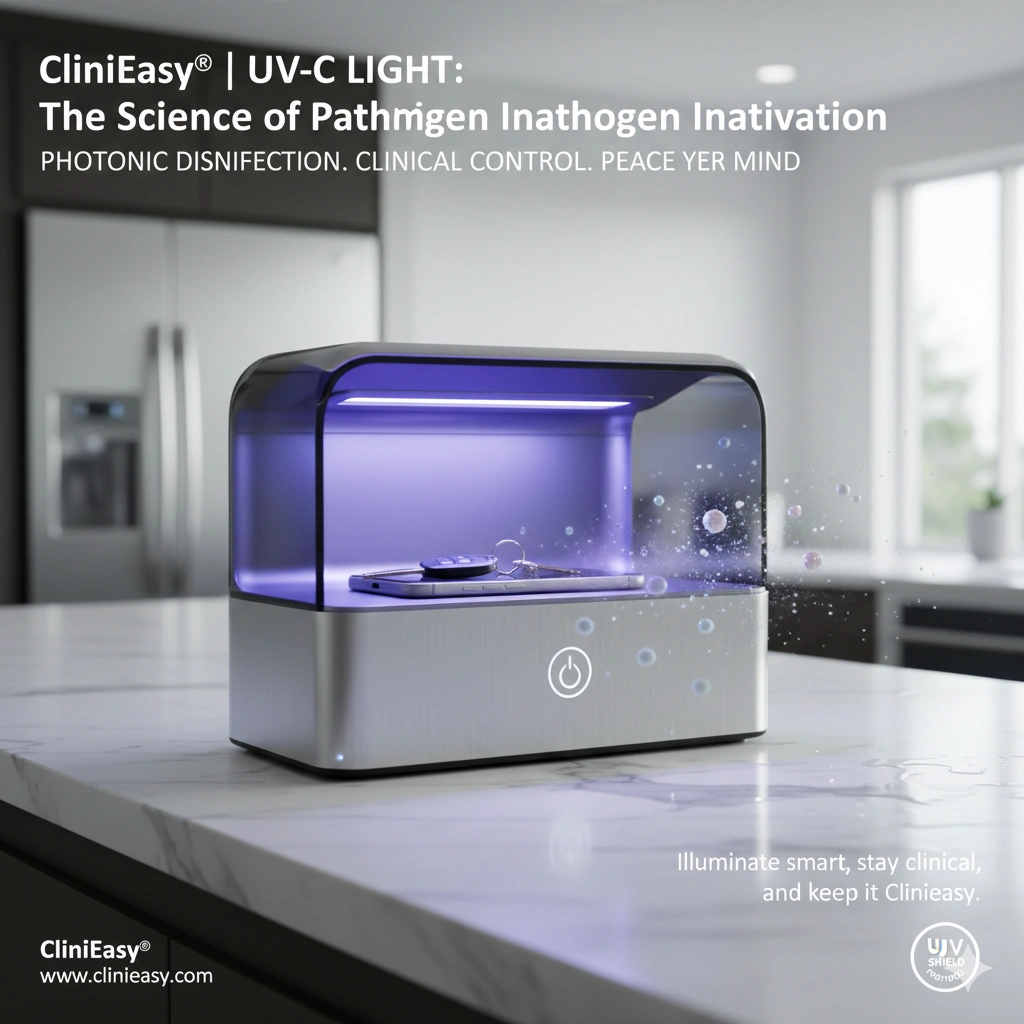
Your smartphone, keys, and glasses are the most frequent “Fomite” vectors in your life. Liquid disinfectants can damage the oleophobic coatings on screens and seep into sensitive electronics.
- The Strategy: The Entryway UV-Vault. Make it a habit to place your phone and keys into a 360-degree UV-C sanitizing box as soon as you get home. A 3-to-5-minute cycle provides a $99.99\%$ reduction in pathogens without the use of moisture or corrosive chemicals.
4. The “Inverse Square Law” of Cleaning
The most common mistake people make with portable UV wands is “The Quick Swipe.”
- The Science: UV-C efficacy is governed by the Inverse Square Law and Dose (Irradiance $\times$ Time). If you double the distance from the surface, you reduce the light’s power by four.
- The Clinical Fix: To sanitize a surface properly with a handheld device, you must hold the light close (within 1–2 inches) and move it slowly (about 1 inch per second). A “magic wand” wave does nothing; the photons need “Dwell Time” to break the genetic bonds of the pathogens.
5. Material Degradation: The UV Trade-off
While UV-C is powerful, it is also “High Energy.”
- The Hazard: Just as the sun fades outdoor furniture, intense UV-C can degrade certain plastics, rubbers, and fabrics over time, making them brittle or discolored.
- The Fix: Use UV-C primarily on non-porous surfaces (glass, metal, high-quality plastics). Avoid using high-intensity UV lamps on delicate silks, antique papers, or low-grade rubbers that may “off-gas” when exposed to the light.
The Clinieasy “UV-C” Checklist
- Choose 222nm: If buying for an open room, ensure it is “Far-UVC” for human safety.
- The 360 Vault: Use enclosed boxes for electronics to prevent moisture damage.
- Respect Dwell Time: Don’t rush; the light needs time to “scramble” the DNA.
- Distance Matters: Keep the light source close to the target surface for maximum power.
- Material Check: Keep UV-C away from delicate fabrics and cheap plastics.
Conclusion: Lighting the Path to Health
UV-C technology represents the transition from “Physical Scrubbing” to “Digital Defense.” By understanding the physics of light, you can sanitize your most sensitive items and your very air with clinical precision. The future of clean isn’t just a liquid in a bottle—it’s a wavelength in the air.
Illuminate smart, stay clinical, and keep it Clinieasy.
Disclaimer: Never look directly into a $254\text{ nm}$ UV-C bulb. Ensure all home devices are safety-certified and have “Auto-Off” gravity sensors to prevent accidental eye exposure.
Why this fits Article #141:
- High Tech Appeal: Positions the blog as forward-thinking and science-based.
- Complex Math/Science Made Simple: Uses LaTeX for wavelengths and explains the “Inverse Square Law.”
- AdSense Synergy: Perfect for high-margin tech gadgets and air purification systems.