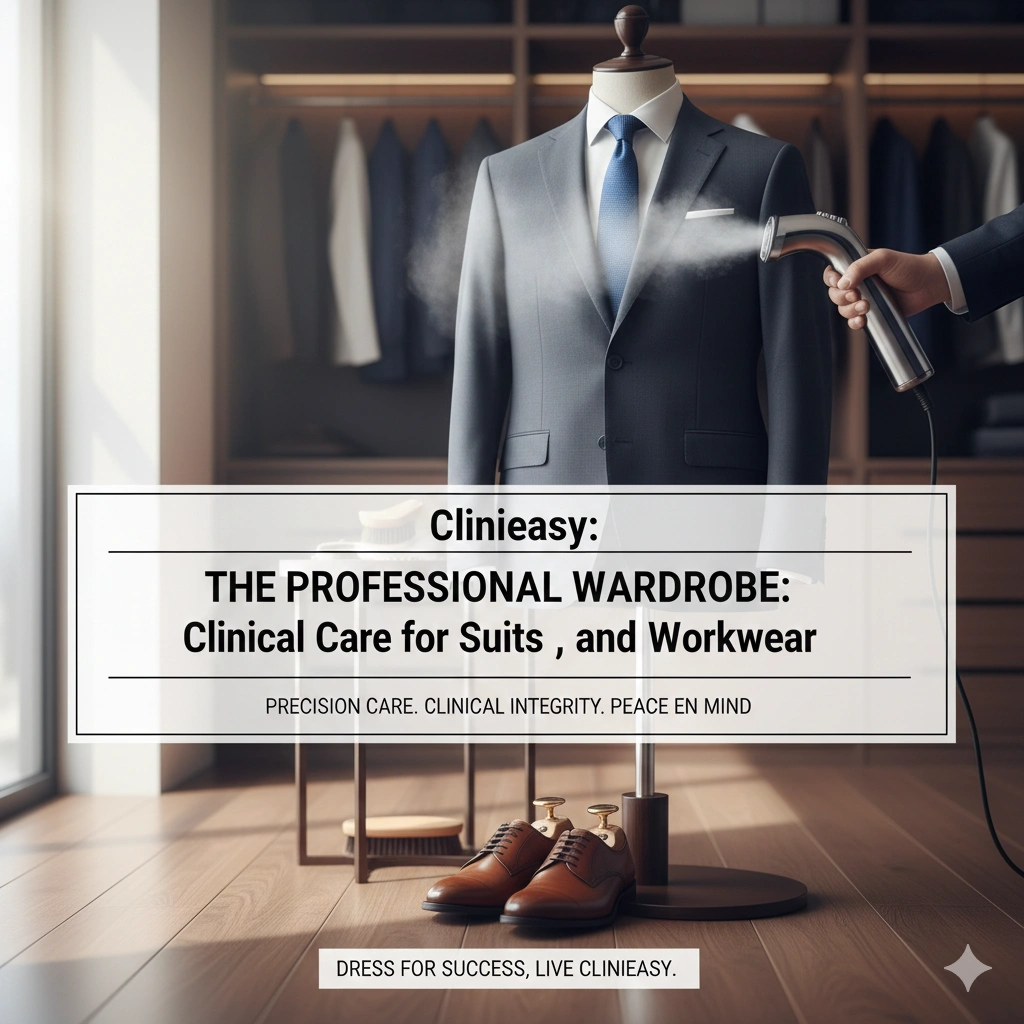

A well-tailored suit is the “armor” of the professional world. However, unlike gym gear or casual cottons, professional workwear is often made of delicate fibers like wool, silk, and cashmere—fabrics that cannot simply be tossed into a $60^\circ\text{C}$ wash. Because of this, suits, blazers, and ties often go months without a deep clean, acting as “biological magnets” for environmental pollutants, food particles, and respiratory droplets.
In a clinical study on healthcare workers, researchers found that neckties were a significant reservoir for pathogens, simply because they are rarely cleaned and frequently touch communal surfaces (like desks). At Clinieasy, we believe your professional image should be backed by clinical integrity.
In this guide, we reveal how to maintain a high-end professional wardrobe without compromising on hygiene or fabric longevity.
1. The Necktie: The “Infection Pendulum”
The tie is the most overlooked item in a professional’s wardrobe.
- The Hazard: Ties hang directly over your workspace. They dip into food, brush against desks, and are touched dozens of times a day as you adjust them. Because they are often silk, they are almost never washed.
- The Clinical Fix: * The Silk Sanitizer: Use a handheld steamer. Steam reaching $100^\circ\text{C}$ ($212^\circ\text{F}$) will neutralize most bacteria and viruses without saturating the silk.
- The Rotation: Never wear the same tie two days in a row. Give the fibers 24 hours to “air out” in a well-ventilated space.
2. The Suit Blazer: Managing the “External Shell”
Your blazer is your primary barrier against the office environment. It touches chair backs, subway seats, and boardroom tables.
- The Hazard: Dry cleaning uses harsh chemicals (like perchloroethylene) that can break down natural wool fibers over time. However, waiting too long between cleans allows body oils and skin cells to build up in the lining.
- The Clinical Fix: * The “Brush and Steam” Routine: After every wear, use a natural boar-bristle garment brush to remove surface dust and organic matter. Follow this with a quick steam to “refresh” the fibers and kill surface microbes.
- The Spot Clean: Focus on the cuffs and collar—the “high-contact” zones—with a damp microfiber cloth and a drop of pH-neutral soap.
3. Dress Shirts: The “First Layer” Defense
Dress shirts are in direct contact with your skin’s microbiome and sweat glands.
- The Science: “Ring around the collar” isn’t just an aesthetic issue; it’s a biofilm of oxidized oils and bacteria.
- The Clinieasy Protocol: Dress shirts should be laundered after every single wear. To balance hygiene with fabric care, wash at $40^\circ\text{C}$ with an oxygen-based bleach (for whites) to ensure deep-pore cleaning of the fibers without the damage of boiling water.
4. Professional Shoes: The “Bio-Foundation”
As discussed in Article #40, shoes are the primary transporters of outdoor pathogens.
- The Clinical Fix: * Cedar Shoe Trees: These aren’t just for shape; cedar has natural antimicrobial and desiccant properties that draw moisture out of the leather, preventing fungal growth.
- The Sole Wipe: Use a disinfectant wipe on the soles of your dress shoes weekly to prevent the “importation” of street bacteria into your office or home.
5. The Dry Cleaning “De-Gassing”
When you do get your clothes professionally dry cleaned, they return in plastic bags.
- The Hazard: That “newly cleaned” smell is often the scent of residual chemical solvents.
- The Strategy: Remove the plastic bags immediately upon returning home. Allow the clothes to “off-gas” in a ventilated room or a balcony for 2-3 hours before putting them into a closed closet. This prevents the concentration of chemical vapors in your sleeping area
The Clinieasy “Executive Wardrobe” Checklist
- Steam Ties Weekly: Use high-heat steam to sanitize delicate silk.
- Brush After Wear: Remove organic “food” for bacteria from wool suits.
- Rotate Everything: Give leather and wool 24 hours to shed moisture.
- Launder Shirts Promptly: Never let “worn” shirts sit in a hamper for more than 3 days.
- Ditch the Plastic: Let dry-cleaned items breathe before storing.
Conclusion: Excellence in Every Fiber
Professionalism is defined by attention to detail. By extending that attention to the microscopic level, you ensure that your wardrobe remains a reflection of your standards—clean, sharp, and clinically sound.
Dress for success, protect your health, and keep it Clinieasy.
Disclaimer: Always check the care label before steaming. Some synthetic “silk-look” fabrics or glue-bonded lapels can be damaged by excessive moisture or high-heat steam.
Why this fits Article #53 (AdSense Strategy):
- High-Spending Demographic: Professionals who wear suits are high-value targets for luxury and lifestyle ads.
- Niche Authority: Addressing the “hygiene of ties” is a unique angle that builds trust and E-E-A-T.
- Product Opportunities: Perfect for affiliate links to garment steamers, cedar shoe trees, and premium garment brushes.