Advertisement
The greatest creators are rarely those who come up with entirely new ideas from a vacuum; they are the ones who are best at observing, collecting, and remixing the brilliance around them. "The Collector’s Eye" explores the practice of building a "swipe file"—a curated library of examples, snippets, and references that spark your imagination. By intentionally gathering what inspires you, you create a reservoir of creative fuel that you can draw upon whenever you feel stuck, ensuring that your next project starts on the shoulders of giants. The Myth of the "Original" Idea Nothing is completely original. Every great work is a mashup or a transformation of what came before. When you stop worrying about being "unique" and start focusing on being "honest" about what you love, your work gains a new depth. A swipe file isn't for copying; it’s for understanding the mechanics of what makes a particular design, sentence, or strategy work. It is the "raw material" of innovation. Three Ways to Build Your Inspiration Reservoir: The "Capture Everything" Habit: Whether it’s a beautiful font on a restaurant menu, a clever ad on a bus, or a particularly resonant line in a book, capture it immediately. Use a dedicated folder on your phone, a physical notebook, or a digital tool like Pinterest or Notion. The goal is to lower the friction between seeing inspiration and saving it. The "Reverse Engineer" Exercise: Don’t just save an item; ask why it works. What is the color palette doing? Why does that headline make you want to click? By deconstructing your favorite examples, you learn the underlying principles that you can then apply to your own unique context. Categorize by "Vibe," Not Just Type: Organize your collection by the feeling it evokes rather than just what it is. A folder labeled "High Energy" might contain a music video, a fast-paced article, and a bold website design. When you start a new project, you can go to the folder that matches the "vibe" you are trying to create. Fueling the Engine Your creativity is an engine, and your observations are the fuel. When you develop a collector’s eye, the world transforms from a series of random events into a treasure trove of possibilities. You never have to fear the blank page because you are never truly starting from zero—you are starting from a life lived with your eyes wide open. Series Wrap-Up Thank you for exploring The Creative Spark. We’ve traveled from the silence of boredom to the focus of constraints and the library of inspiration. May your next project be your most imaginative yet.

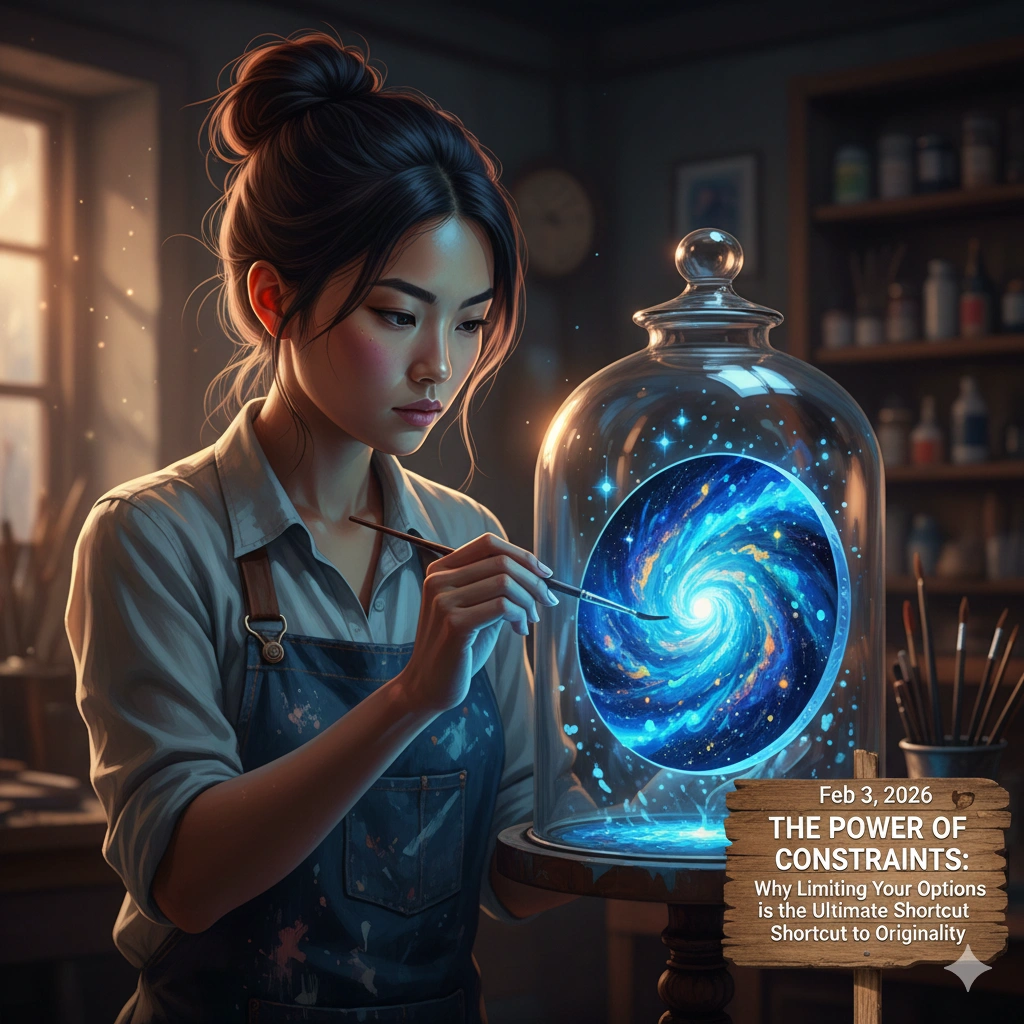
We often dream of having unlimited time, an infinite budget, and total freedom. However, “The Power of Constraints” argues that “blank-check freedom” often leads to decision paralysis and cliché ideas. When we have fewer options, our brains are forced to become resourceful, looking for unique solutions that we never would have considered otherwise. By intentionally setting boundaries on your projects, you stop looking for the “obvious” answer and start finding the creative one.

Creativity Loves a Wall

Think of a river: without banks to constrain it, the water just becomes a shallow, stagnant marsh. With banks, that same water becomes a powerful, focused current. Constraints act as the “banks” for your mind. They provide a structure to push against. Whether it’s a tight deadline, a limited word count, or a specific set of tools, these limitations act as a catalyst for innovation.

Three Ways to Use Constraints to Your Advantage:

  1. The “Single Tool” Challenge:
    • If you’re a designer, try creating a logo using only three circles. If you’re a writer, try telling a story in exactly 50 words. By stripping away your usual toolkit, you force yourself to focus on the core essence of the work.
  2. The “Artificial Deadline”:
    • Parkinson’s Law states that work expands to fill the time available for its completion. Give yourself half the time you think you need. This pressure forces you to ignore the non-essential details and focus purely on the “Big Rocks” that drive the project forward.
  3. The “Financial Cap”:
    • Instead of asking, “How much will this cost?” ask, “How can I do this for zero dollars?” This constraint leads to the most creative forms of marketing, development, and problem-solving, often resulting in a more authentic and lean final product.

Freedom Within the Box

Constraints aren’t handcuffs; they are a scaffolding for your imagination. When you stop worrying about the infinite possibilities and start working with what you have, you discover that the “box” isn’t a prison—it’s a launchpad. True originality isn’t about having no limits; it’s about what you can build in spite of them.

What’s Coming Next…

In our final installment, “The Collector’s Eye,” we’ll explore how to build a “swipe file” of inspiration so you never have to start from zero again.


Leave a Reply

Your email address will not be published. Required fields are marked *

2 mins