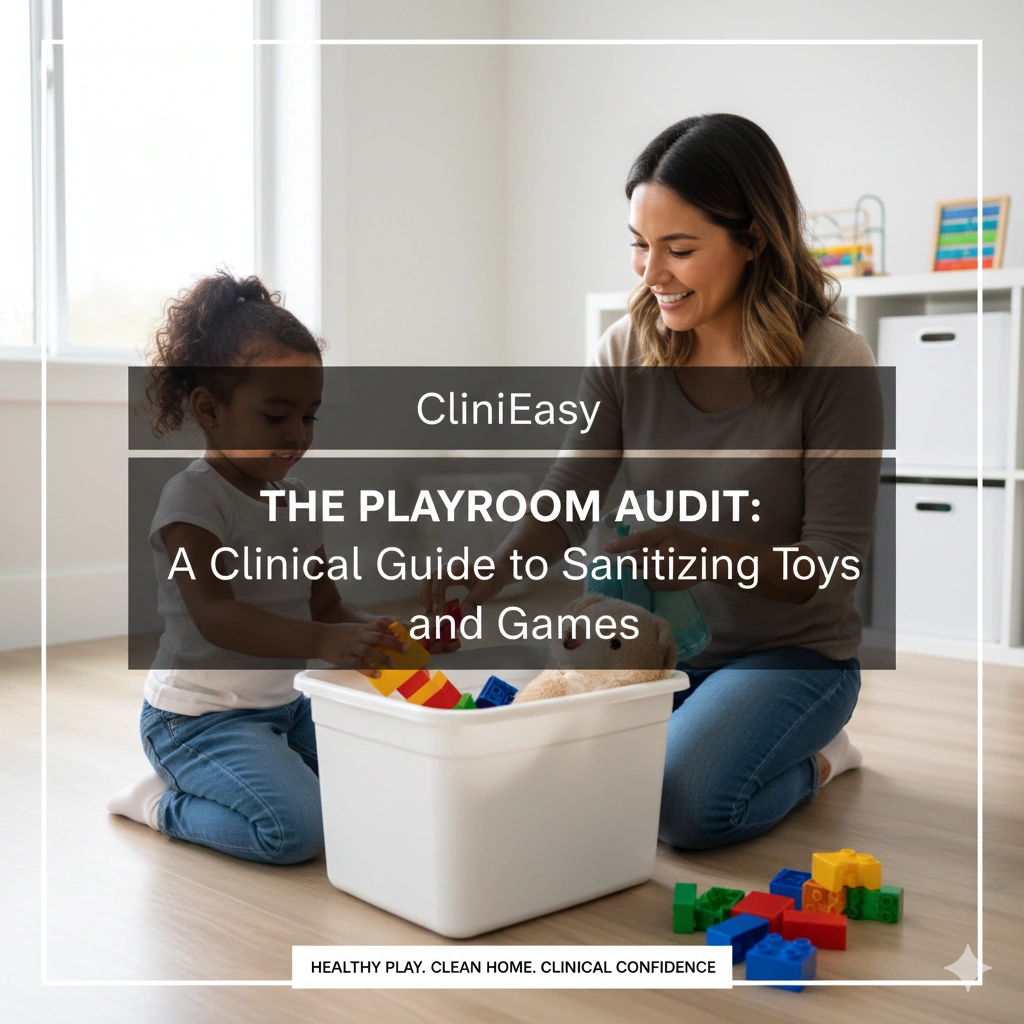

A child’s playroom is a land of imagination, but from a microbiological perspective, it is a high-traffic zone of cross-contamination. Children explore their world through touch—and often through taste. Toys are dropped on the floor, shared during playdates, and frequently “mouth-tested.”
Because toys are made from a vast array of materials—from porous plush to hard plastics and natural woods—a “one-size-fits-all” cleaning approach doesn’t work. To maintain a truly hygienic home, you must treat your child’s toy collection with clinical rigor, ensuring that their play environment supports their developing immune system rather than taxing it.
At Clinieasy, we believe safety starts with the things they hold closest. In this guide, we break down the clinical standards for sanitizing every type of toy in your home.
1. Plastic and Hard Toys: The Non-Porous Protocol
Plastic blocks, action figures, and rattles are the easiest to clean but also the most likely to be shared.
- The Hazard: These surfaces can harbor viruses like RSV and the flu for hours.
- The Clinical Fix: * Dishwasher Method: If the toy is labeled “top-rack safe,” run it through a cycle. The high heat ($60^\circ\text{C}$ / $140^\circ\text{F}$) is a highly effective sanitizer.
- Hand Soak: For delicate plastics, soak for 5 minutes in a solution of 1 gallon of water and 1 tablespoon of bleach (or a 50/50 vinegar-water mix for a natural alternative). Rinse thoroughly with fresh water and air dry.
2. Plush and Soft Toys: The “Dust Mite” Challenge
Teddy bears and blankets are more than toys; they are reservoirs for dust mites, saliva, and skin cells.
- The Hazard: Soft fibers trap allergens and can harbor bacteria deep within the stuffing.
- The Clinical Fix:
- The Hot Wash: Most plush toys can go in the washing machine inside a pillowcase. Use the warmest setting allowed by the tag.
- The “Freezer Trick”: If a toy is too delicate to wash, place it in a sealed bag in the freezer for 24 hours. This kills dust mites. Follow up with a vacuuming using a HEPA attachment to remove the debris.
3. Electronic Toys: Delicate Decontamination
Handheld consoles, musical toys, and tablets cannot be submerged.
- The Hazard: These are some of the germiest items in the house because they are handled constantly but rarely cleaned.
- The Clinical Fix: Use a 70% isopropyl alcohol wipe. Focus on the buttons and edges where grime accumulates. Ensure the wipe is damp, not dripping, to avoid moisture entering the internal circuits.
4. Wooden Toys: Nature’s Antimicrobial Surface
Wood has natural antibacterial properties, but it can crack if it stays wet.
- The Hazard: Bacteria can hide in cracks in the wood or the paint finish.
- The Clinical Fix: Never soak wooden toys. Instead, wipe them with a cloth dampened with white vinegar. Vinegar’s acidity is effective against many household germs without warping the wood.
5. Bath Toys: The Mold “Squirter” Danger
If you use hollow plastic toys that squirt water, you likely have a mold problem.
- The Science: The dark, damp interior of a bath toy is a perfect “petri dish” for black mold.
- The Clinical Fix: If you see black flecks coming out of a bath toy, discard it immediately. To prevent this, seal the holes of new bath toys with a dab of waterproof hot glue before the first use, or switch to solid, “hole-free” silicone bath toys.
The Clinieasy “Toy Rotation” Hygiene Habit
To prevent cleaning from becoming overwhelming, use the Rotation System:
- Divide toys into three bins.
- Keep only one bin out for play.
- At the end of the week, sanitize the “active” bin and swap it for a clean one from storage. This ensures every toy is clinically cleaned at least once a month.
Conclusion: Healthy Play, Healthy Kids
Sanitizing toys isn’t about creating a sterile “bubble” for your children; it’s about breaking the cycle of reinfection that often plagues families. When you apply clinical standards to the playroom, you create a space where your children can explore, imagine, and grow without the unnecessary burden of lingering pathogens.
Keep the fun, kill the germs, and keep it Clinieasy.
Disclaimer: Always check for small parts or loose batteries before and after cleaning to prevent choking hazards.
Why this fits Article #39 (AdSense Strategy):
- High Trust (E-E-A-T): Parents look for authoritative “Safety” advice.
- Ad Relevance: Triggers ads for brands like Seventh Generation, Babyganics, LEGO, and Fisher-Price.
- Evergreen Traffic: Cleaning toys is a constant concern for new parents, ensuring steady traffic year-round.