
Introduction It starts with a harmless “treat jar” at the reception desk or a bowl of pretzels in the breakroom during a long meeting. We see them as perks—small boosts of glucose to get us through the afternoon slump. However, from a clinical perspective, the communal snack bowl is one of the most efficient “pathogen exchange programs” in the modern office.
Think of it as a “Shared Touch Reservoir.” If ten people reach into a bowl of unwraped nuts or candies, they are effectively shaking hands with everyone who came before them. In a 2025 workplace where we are hyper-aware of surface-to-hand transmission, the “open-air” snack is a relic that needs a clinical upgrade.
At Clinieasy, we don’t want to kill the office culture; we want to sanitize it. In this guide, we break down the “Double-Dip” science and how to snack with clinical integrity.
1. The “Open Bowl” Problem: The Microbiology of Reach-In
When someone reaches into a bowl of loose snacks (chips, nuts, candies), their fingers inevitably brush against other pieces of food.
- The Hazard: Hand-to-food-to-hand transmission. If a colleague has a sub-clinical viral load on their fingertips, it is transferred to the surface of the snacks. Because these foods are eaten raw and dry, there is no “kill step” (like heat) to neutralize the pathogens.
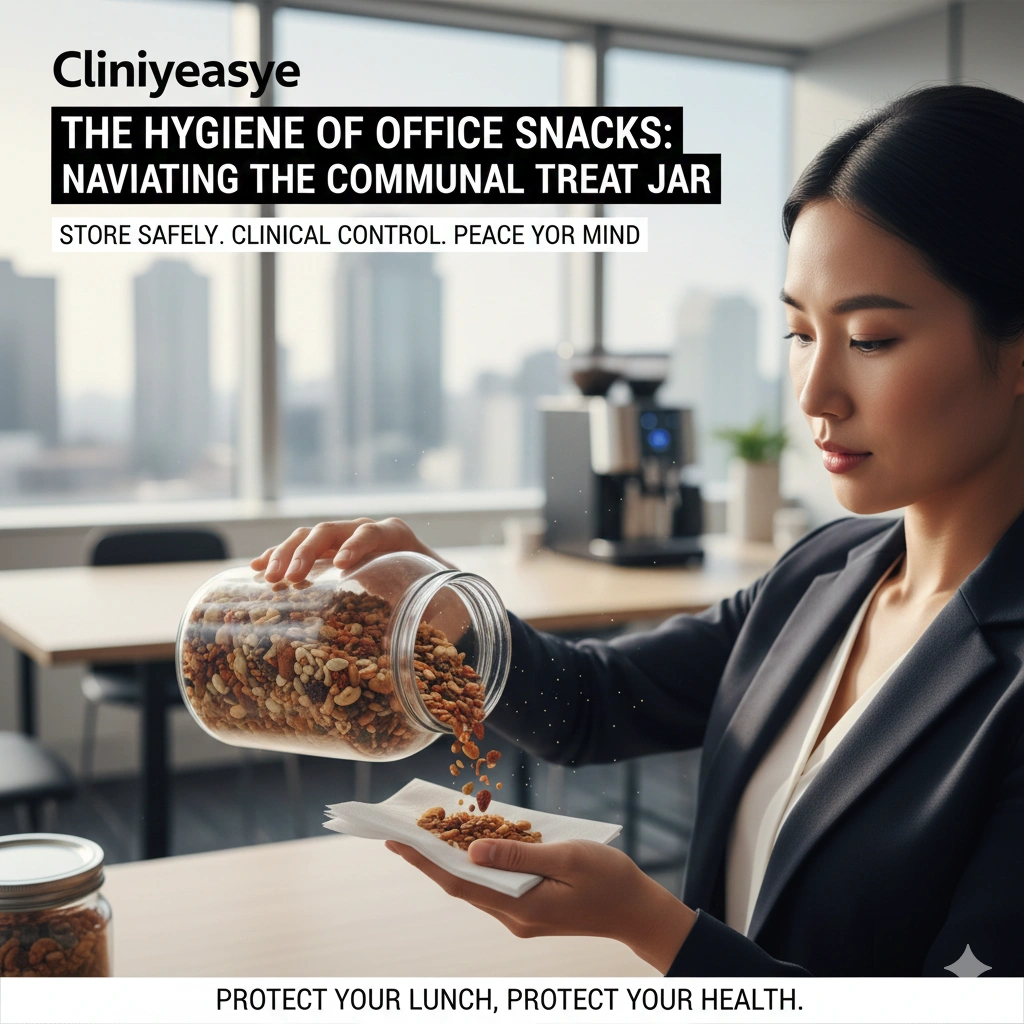
- The Clinical Fix: The “Individual Pour” method. Never reach your hand into a communal bag or bowl. Pour the snacks into your hand or a napkin without making contact with the container or the remaining food.
2. The “Shared Utensil” Myth
Many offices provide a “communal spoon” or tongs for the snack bowl, thinking this solves the hygiene issue.
- The Hazard: The handle of that spoon is now the “Hotspot.” If everyone touches the same handle and then uses their hands to eat the snacks they just scooped, the chain of transmission remains unbroken.
- The Strategy: Treat shared utensils as contaminated. If you use the office tongs, sanitize your hands after scooping and before eating.
3. Wrapped vs. Unwrapped: The “Barrier” Rule
In 2025, the clinical gold standard for office treats is individual packaging.
- The Science: A wrapper acts as a non-porous physical barrier. It protects the food from “aerosol plumes” (coughs and sneezes) and direct finger contact.
- The Clinieasy Recommendation: If you are the person providing snacks for the team, choose individually wrapped items (granola bars, small bags of nuts, wrapped chocolates). It signals that you value your colleagues’ health as much as their morale.
4. The “Double-Dip” Reality
We’ve all seen it: the colleague who dips a chip, takes a bite, and dips again into the communal salsa or hummus.
- The Science: A study published in the Journal of Food Safety confirmed that double-dipping transfers thousands of bacteria from the mouth to the dip. While the acidity in some dips (like salsa) can kill some bacteria, many viruses can survive in that medium for hours.
- The Rule: If you are at an office party, move a portion of the dip to your own plate. “Plate, then Partake.”
5. The Desk-Snacking Bio-Accumulation
Eating at your desk introduces food particles into your keyboard and mouse (see Article #51).
- The Hazard: Crumbs act as “nutrient islands” for bacteria on your desk.
- The Fix: If you must snack at your desk, use the “Chopstick Technique” for messy snacks (like popcorn or chips). This keeps your fingers clean of oils and seasonings, preventing the transfer of “food-gunk” to your electronics, which would otherwise encourage bacterial growth.
The Clinieasy “Office Snacker’s” Checklist
- Pour, Don’t Reach: Transfer snacks to a napkin or your own hand.
- Choose Wrappers: Prioritize individually sealed treats.
- The Plate Rule: Never dip directly into a communal container.
- Hand-Wash Bridge: Wash hands immediately after visiting the breakroom.
- Chopstick Hack: Use utensils for “finger foods” at your desk to keep your tech clean.
Conclusion: Fueling Without Fault
Office snacks should be a moment of joy, not a gamble with your immune system. By moving away from “communal reaching” and embracing “individual portions,” you maintain the social benefits of office culture while upholding a clinical standard of hygiene.
Eat smart, stay healthy, and keep it Clinieasy.
Disclaimer: If you are allergic to nuts or other common allergens, be aware that communal snack zones are high-risk areas for cross-contamination, regardless of the hygiene level. Always carry your own “safe” snacks.
Why this fits Article #58 (AdSense Strategy):
- Relatability: Everyone has an “office snack” story, making this highly clickable on LinkedIn and Facebook.
- B2B Opportunity: Attracts ads from office pantry services and healthy snack delivery companies (NatureBox, SnackCrate).
- Educational Angle: Teaching the “Pour” method establishes the site as a practical, high-utility resource.