
In the modern open-plan office, we share more than just ideas; we share every breath. From the perfume of a colleague three desks away to the aerosolized respiratory droplets of a team member with a “summer cold,” the air in a workplace is a complex soup of particulates.
As we move through 2025, “Personal Air Space Management” has become a top priority for health-conscious professionals. Many have turned to desktop air purifiers—compact, sleek devices promising a “bubble” of clean air. But from a clinical perspective, can a device the size of a toaster really protect you in a room of 5,000 square feet?
At Clinieasy, we look at the fluid dynamics of hygiene. In this guide, we investigate the science of desktop filtration and how to actually secure your “breathing zone.”
1. The Physics of the “Breathing Zone”
To understand if a desktop purifier works, you must understand the “Breathing Zone”—the 12-inch radius around your nose and mouth.
- The Science: Large office HVAC systems are designed for general dilution, not localized extraction. This means air moves slowly, often allowing “pockets” of stagnant air to form around desks.
- The Clinical Verdict: A desktop purifier cannot clean the air of the entire office. However, it can create a Laminar Flow of filtered air directly into your breathing zone. If placed correctly, it acts as a “wash” that displaces unfiltered air before you inhale it.
2. HEPA vs. Ionizers: Choosing the Right Filter
Not all “mini” purifiers are created equal. In a clinical setting, the technology inside is what determines the hygiene outcome.
- True HEPA (H13): This is the gold standard. It captures 99.97% of particles down to 0.3 microns, including mold spores, pollen, and viral carriers.
- The “Ionizer” Trap: Many cheap desktop units use “negative ions.” From a hygiene standpoint, these can be problematic. They don’t remove particles; they just make them “heavy” so they stick to your desk, keyboard, and clothes. Furthermore, some produce trace amounts of ozone, a respiratory irritant.
- The Clinieasy Recommendation: Only use devices labeled “True HEPA” with no ozone-producing ionizers.
3. The CADR Metric: Why Size Matters
CADR stands for Clean Air Delivery Rate. It measures how much filtered air a device produces per minute.
- The Hazard: If a desktop purifier has a low CADR, the ambient air of the office will overwhelm it faster than it can clean.
- The Fix: For a desktop unit to be clinically effective, it should have a CADR high enough to “turn over” the air in your immediate 3×3 foot workspace at least 5 times per hour.
4. Managing the “Invisible” Threat: CO2
While purifiers handle particles (dust/viruses), they do not remove Carbon Dioxide ($CO_2$).
- The Science: High $CO_2$ levels in offices (above 1,000 ppm) lead to “Brain Fog,” headaches, and decreased cognitive function.
- The Strategy: A desktop purifier should be one part of a two-pronged approach. Use a portable $CO_2$ monitor. If the levels spike, a purifier won’t help your focus—you need to advocate for increased “Fresh Air Intake” from the building’s main HVAC system.
5. Positioning for Maximum Hygiene
Where you put the device determines its efficacy.
- The Wrong Way: Putting the purifier on the floor under your desk. This just kicks up floor dust and provides no benefit to your breathing zone.
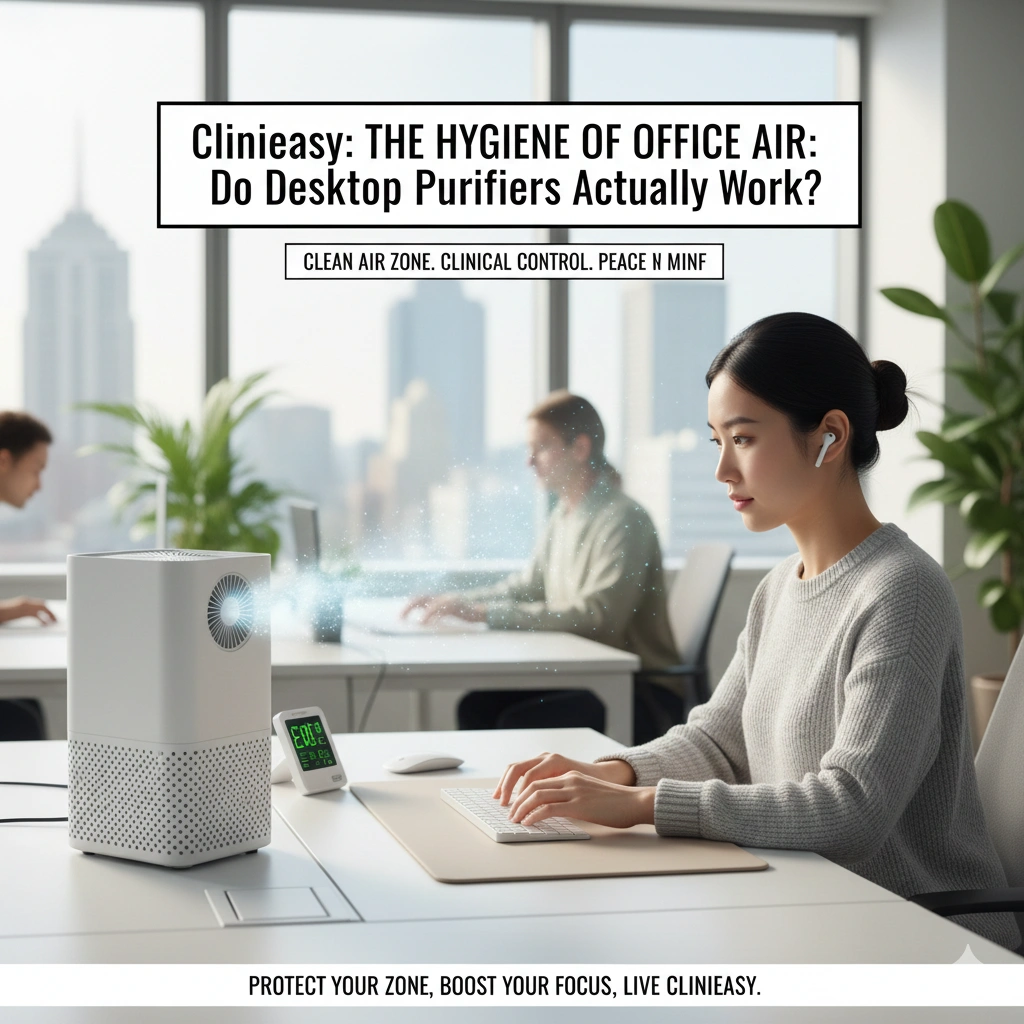
- The Clinieasy Way: Place the unit on your desk, roughly 18 to 24 inches from your face, with the output vent directed toward your chest or chin. This ensures you are the primary recipient of the “clean air plume” before it mixes with the rest of the room.
True HEPA Only: Avoid “HEPA-like” or ionic-only units.
- Strategic Aim: Point the clean air flow toward your breathing zone.
- Filter Discipline: Replace the small filters every 3 months; they clog faster in high-traffic offices.
- Monitor $CO_2$: Pair your purifier with a $CO_2$ sensor to track ventilation.
- Quiet Mode: Ensure the unit is below 50dB so it doesn’t cause noise-pollution for colleagues.
Conclusion: Investing in Your Atmosphere
A desktop air purifier isn’t a “magic shield,” but it is a powerful tool for localized risk reduction. In a world of shared air, taking control of your immediate cubic meter is a profound act of self-care and clinical foresight.
Breathe with intention, protect your zone, and keep it Clinieasy.
Disclaimer: A personal air purifier is a supplement to, not a replacement for, high-quality building ventilation and personal hand hygiene. If you work in a high-risk environment (like a medical clinic), professional-grade room-sized HEPA units are required.
Why this fits Article #57:
- Affiliate Magnet: Directly promotes high-end tech items that readers are likely to buy for their “New Year” office setup.
- Scientific Authority: Uses terms like “Laminar Flow” and “CADR” to distinguish Clinieasy from generic “lifestyle” blogs.
- High Trend: Personal air quality is a top-3 wellness trend for the 2025 workplace.