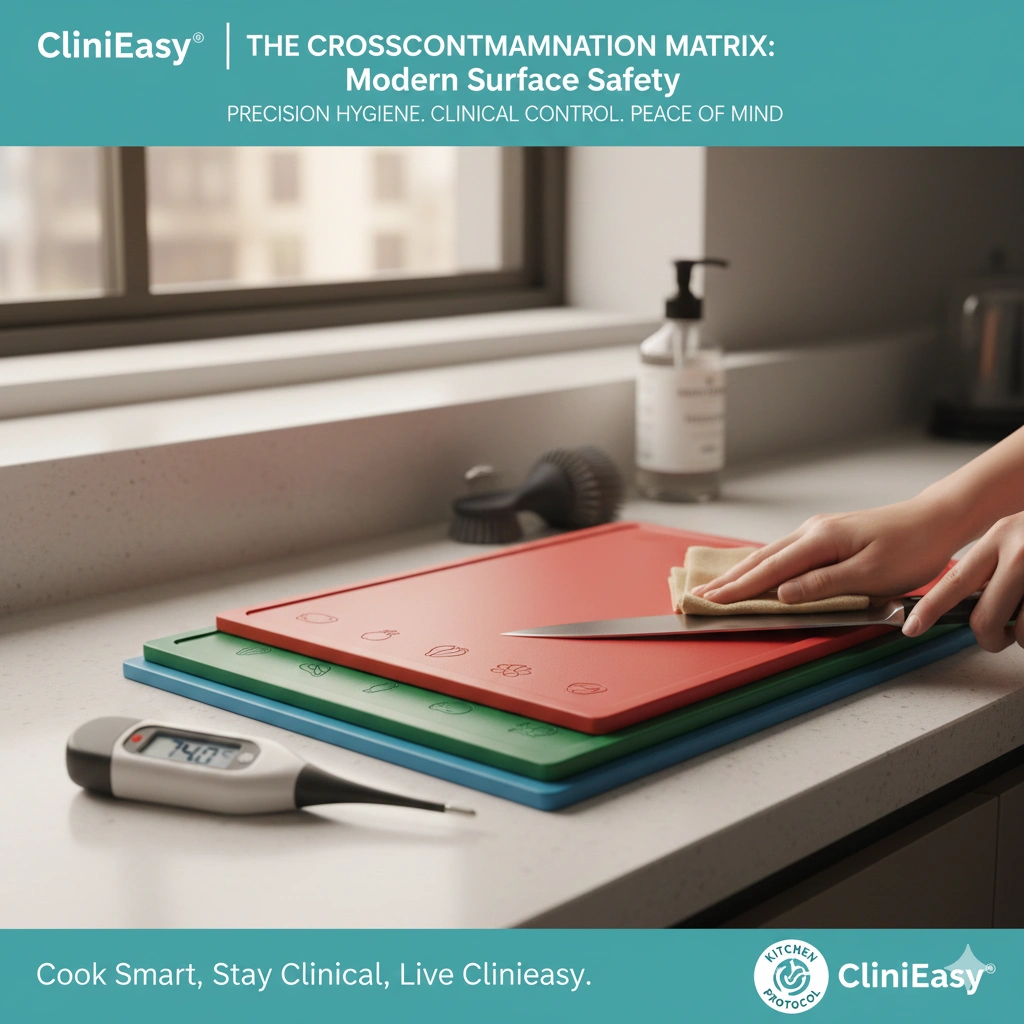

In the professional culinary world, hygiene is treated as a “Critical Control Point” (CCP). In the home kitchen, however, it is often treated as an afterthought. From a clinical perspective, your kitchen is a “Bio-Transfer Hub.” Pathogens like Salmonella, Campylobacter, and E. coli don’t just stay on the chicken breast; they move via your hands, your knives, and your sponges to your “Ready-to-Eat” foods.
In 2026, we have moved beyond simple “wiping.” We now use a Matrix Approach to ensure that raw proteins and fresh produce never meet. At Clinieasy, we provide the clinical blueprint for a pathogen-free kitchen.
1. The “Zoning” Strategy
The most effective way to prevent cross-contamination is physical separation.
- The Science: Bacteria cannot “walk,” but they can be “shuttled.” If you chop onions on a board that previously held raw beef—even if you rinsed it—you are performing a “Microbial Inoculation.”
- The Clinical Fix: Implement the Color-Code Standard.
- Red: Raw Meats only.
- Green: Fruits and Vegetables.
- Blue: Cooked Foods.
- Yellow: Raw Poultry.
- The Protocol: Use non-porous materials like high-density polyethylene (HDPE) or glass. Avoid wood for raw meats, as the grain can trap bacteria deep within the fibers where sanitizers cannot reach.
2. The “Sponge” Fallacy
The humble kitchen sponge is, clinically speaking, the filthiest object in the modern home.
- The Hazard: A sponge’s porous, damp structure is a five-star hotel for bacteria. Wiping a counter with a “dirty” sponge simply spreads a thin film of pathogens across a larger surface area.
- The 2026 Standard: Replace sponges with Silicone Scrubbers or Disposable Bamboo Cloths. Silicone is non-porous and dries almost instantly, preventing bacterial colonization. If you must use a cloth, it should be laundered at 90°C after every single day of use.
3. The “Sink Splash” Radius
We often wash poultry in the sink thinking it’s cleaner. Science tells us the opposite.
- The Science: Washing raw chicken creates a “Pathogen Aerosol.” Water droplets hit the meat and bounce off, carrying Campylobacter up to 3 feet in every direction—landing on your clean dishes, your dish soap bottle, and your face.
- The Protocol: Never wash raw meat. Pat it dry with a paper towel if necessary and dispose of the towel immediately. The heat of the cooking process (reaching an internal temperature of $74°C$ or $165°F$) is the only “wash” that matters.
4. Knife Hygiene and “The Tang”
Most people wash the blade of a knife but forget the Tang (where the blade meets the handle).
- The Hazard: Meat juices can seep into the seam where the handle is riveted. This creates a hidden reservoir of rotting organic matter.
- The Fix: When working with raw proteins, use “Full-Tang” knives with seamless handles. Sanitize the handle just as thoroughly as the blade. Between tasks, do not just “wipe” the knife; it must be washed with hot, soapy water ($45°C+$) to break down lipids.
5. The “Three-Stage” Counter Decon
A “clean-looking” counter is not necessarily a “sanitized” counter.
- The Protocol: 1. Clear: Remove all physical debris and crumbs.
2. Clean: Use a surfactant (dish soap) to break down oils and proteins.
3. Sanitize: Apply an EPA-approved disinfectant (or HOCl) and let it dwell for 60 seconds before wiping. Without “dwell time,” the sanitizer doesn’t have the contact time required to penetrate the bacterial cell wall.
The Clinieasy “Kitchen Matrix” Checklist
- Color-Code Boards: Strictly separate meat, poultry, and produce.
- No-Wash Meat: Stop rinsing poultry to prevent aerosolized bacteria.
- Ditch the Sponge: Switch to non-porous silicone scrubbers.
- Dwell Time: Let sanitizers sit on the counter for 60 seconds before wiping.
- High-Heat Cloths: Launder kitchen linens at 90°C daily.
Conclusion: Cooking with Clinical Precision
Kitchen hygiene isn’t about being a “clean freak”; it’s about being a “safety expert.” By managing the Cross-Contamination Matrix, you ensure that the meals you prepare for your family are as safe as they are delicious.
Cook smart, stay clinical, and keep it Clinieasy.
Disclaimer: Always use a digital meat thermometer to ensure food has reached a safe internal temperature. Hygiene prevents contamination, but proper cooking is what ultimately kills pathogens.
Why this fits Article #111:
- High Educational Value: Corrects the common mistake of “washing chicken.”
- Authority Building: Explains “Dwell Time” and “Pathogen Aerosols.”
- AdSense Synergy: Perfect for cutting boards, thermometers, and smart kitchen gear.