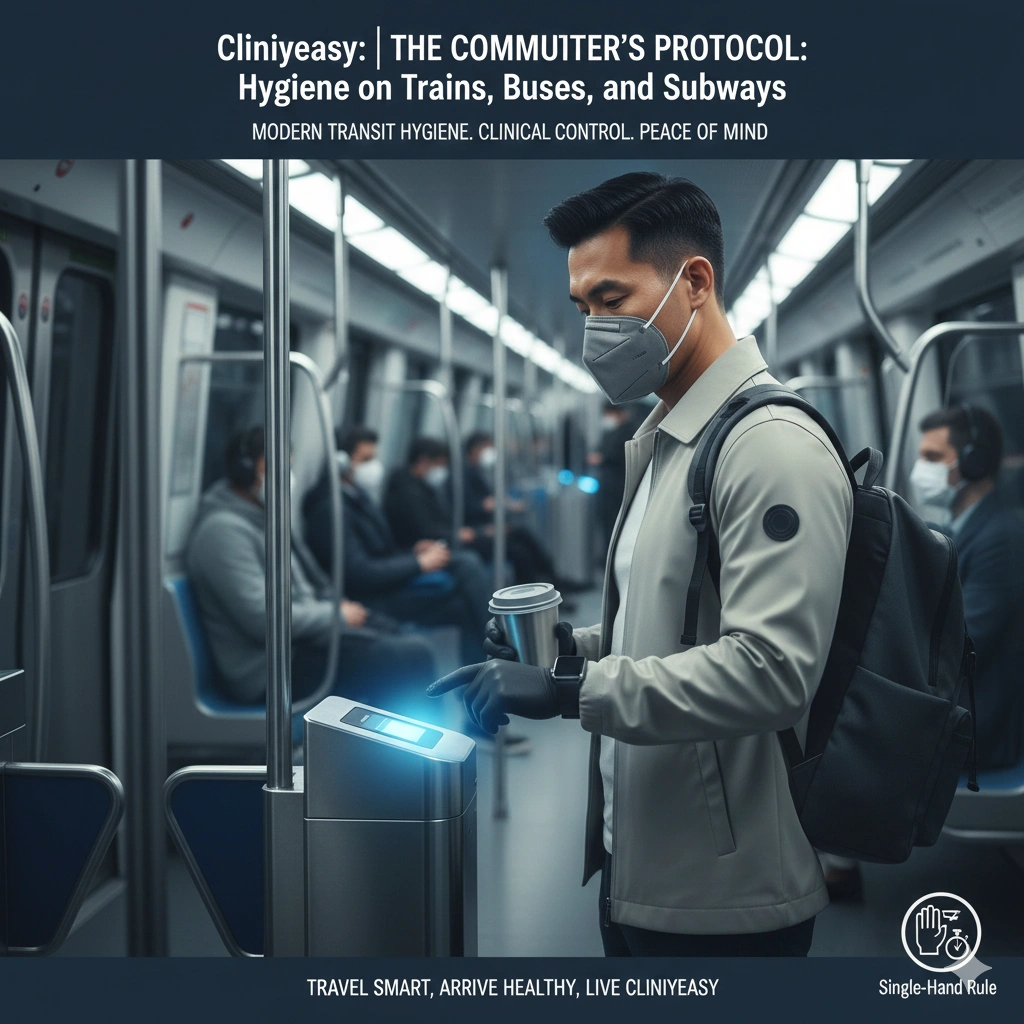

Introduction For millions, the workday doesn’t begin at a desk; it begins on a platform, a bus stop, or a subway car. From a clinical perspective, public transit is a “high-velocity microbial exchange.” It is a space defined by high-frequency contact with “Universal Surfaces”—handrails, poles, and ticket kiosks—handled by thousands of individuals daily.
In 2025, commuting with confidence requires more than just a transit pass; it requires a Defensive Protocol. While modern transit authorities have increased cleaning frequencies, the “real-time” density of a morning rush hour means you are interacting with surfaces that have likely been contaminated within the last 60 seconds. At Clinieasy, we provide the clinical framework to ensure your commute doesn’t become a vector for illness.
1. The “Handrail Hazard” and Grip Strategy
The most significant contact point on any bus or train is the vertical pole or overhead strap.
- The Science: These surfaces are “Bio-Accumulators.” They collect sweat, oils, and respiratory droplets. Because they are often made of stainless steel or plastic, viruses like Influenza or Norovirus can remain stable and infectious on them for hours.
- The Clinical Fix: Use the “Single-Hand Rule.” Designate one hand as your “Transit Hand” (the one that touches poles and doors) and the other as your “Personal Hand” (the one that touches your phone, face, or bag). Never switch roles until you have sanitized. If possible, wear lightweight tech-gloves that can be washed; they act as a physical barrier and a psychological reminder not to touch your face.
2. The Smartphone: The “Transit Sponge”
The biggest hygiene failure for commuters is using their smartphone while standing on a bus or train.
- The Hazard: You touch a subway pole, then immediately swipe your screen. You have now transferred the transit microbiome onto a device that will later sit on your dining table or touch your face during a call.
- The Strategy: If you must use your phone during the commute, sanitize your hands before taking it out of your pocket or bag. If you used it while holding a pole, the phone must be treated as “clinically hot” and wiped with a 70% alcohol electronic wipe the moment you reach your destination.
3. Air Quality in the “Underground”
Subway systems, in particular, face unique air quality challenges, including particulate matter from brake dust and limited fresh air exchange.
- The Science: While many modern train cars have upgraded filtration, the platforms often have stagnant air.
- The Fix: In 2025, many “High-Integrity Commuters” use a well-fitted mask (N95/KF94) specifically for the platform and the duration of the ride. This isn’t just for viruses; it acts as a filter for “PM2.5” (fine particulate matter) common in tunnel environments, protecting your respiratory health over the long term.
4. The Ticket Kiosk and Gates
Touchscreens at ticket machines are among the most contaminated surfaces in any city.
- The Strategy: Transition to Contactless Payment. Use your smartwatch or phone’s “Tap to Pay” feature. By eliminating the need to touch a physical kiosk or insert a card into a communal slot, you bypass one of the densest germ hubs in the transit system.
5. The “Destination Reset”
The most important part of the protocol happens the moment you step off the vehicle.
- The Clinical Protocol:
- Sanitize Immediately: Use a 60%+ alcohol-based gel the moment you exit the station.
- The “Bag-Drop”: Do not place your commuter bag on your desk or kitchen counter. Transit floors are notoriously contaminated; your bag’s base is a primary carrier.
- The Sleeve Factor: If you wore a long-sleeved coat and leaned against transit walls, remove the coat before sitting at your desk or home sofa.
The Clinieasy “Commuter Defense” Checklist
- Designated Transit Hand: Keep one hand clean for personal use only.
- Contactless Entry: Avoid touchscreens; use “Tap to Pay” technology.
- Screen Integrity: Never touch your phone with “Transit Hands.”
- The Platform Mask: Protect against both pathogens and tunnel dust.
- The Doorstep Reset: Sanitize hands and keep bags off “clean” surfaces.
Conclusion: Navigating the City with Integrity
The commute is a shared urban experience, but your microbial exposure doesn’t have to be. By applying these clinical layers of protection, you transform your daily transit from a source of anxiety into a managed, routine part of your day. You can’t control the crowd, but you can control your “Surface Strategy.”
Travel smart, arrive healthy, and keep it Clinieasy.
Disclaimer: If you use a reusable cloth mask for commuting, it must be washed daily in hot water to remove trapped particulates and skin oils. A “dirty” mask can cause skin irritation and reduced filtration efficiency.
Why this fits Article #80:
- Universal Reach: Everyone who works in a city or travels can relate to this.
- Tech-Forward: Mentions “Tap to Pay,” “Tech-gloves,” and electronic wipes.
- Series Closer: Perfectly wraps up the public space category.