
2026, we recognize that the “Open Office” was a biological disaster. The constant auditory interruptions and poor air circulation of the previous decade have been replaced by Neurological Ergonomics. We now understand that productivity is not a result of “grinding,” but a result of Atmospheric Integrity. If your office air is high in $CO_{2}$ or your desk setup is static, you are operating with a self-imposed cognitive ceiling.
At Clinieasy, we treat the workspace as a Cognitive Clean Room. By optimizing your physical and atmospheric environment, you don’t just work faster—you work with higher “Neural Clarity.”
1. The $CO_{2}$ Ceiling: Monitoring Cognitive Load
One of the most overlooked “Hygiene Gaps” in 2026 is indoor air stagnation.
- The Science: When $CO_{2}$ levels exceed $1000\text{ ppm}$, cognitive function—specifically strategic thinking and crisis response—can drop by up to $15\%$. In a crowded meeting room, levels often hit $2000\text{ ppm}$, effectively “drugging” the participants into a state of drowsiness.
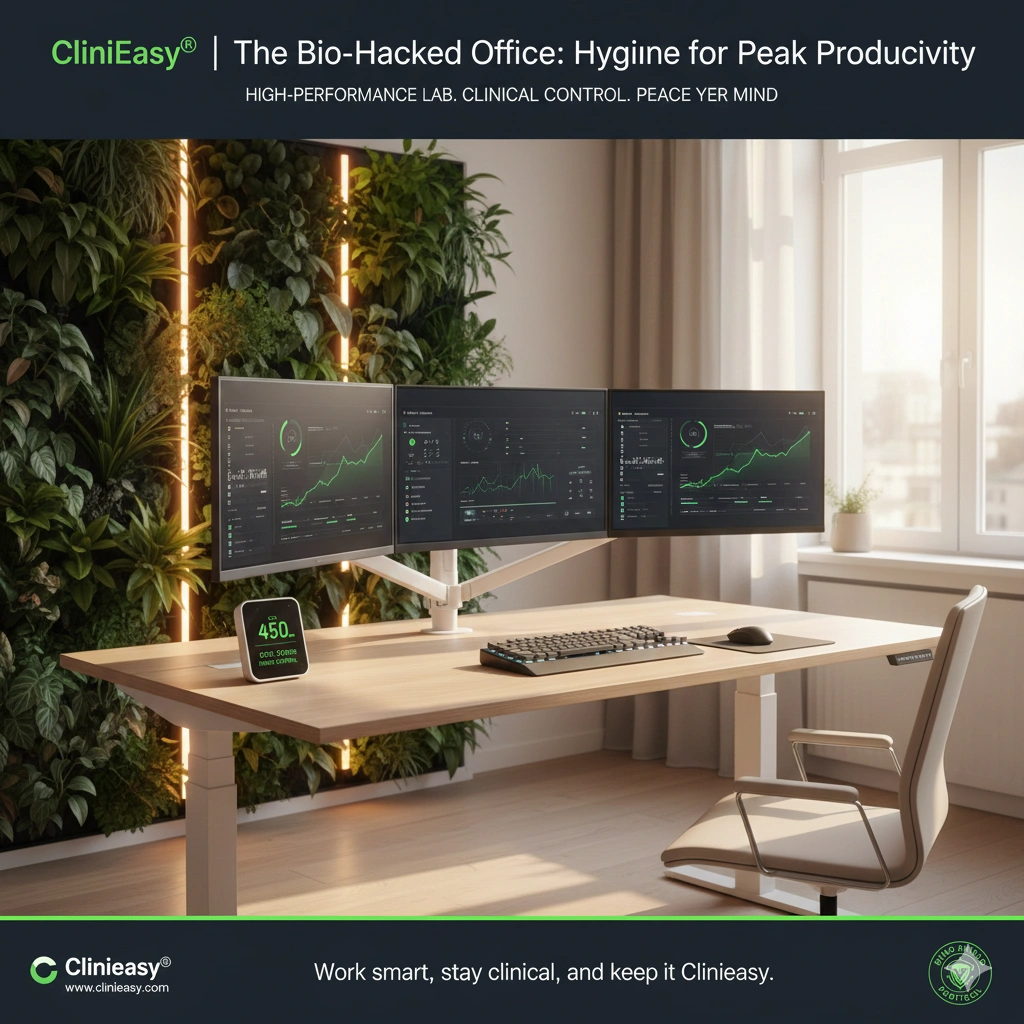
- The Clinical Fix: Real-Time NDIR Sensors. In 2026, every “Clinieasy” desk is equipped with a non-dispersive infrared ($CO_{2}$) monitor. If the levels cross $800\text{ ppm}$, it’s a clinical mandate to open a window or activate a mechanical “Purge Ventilation” cycle. You cannot think clearly in “Exhaled Air.”
2. Active Workstations: “Movement Hygiene”
The “Standing Desk” was just the beginning. In 2026, we focus on Postural Rotation.
- The Hazard: Standing still for 8 hours is just as biologically taxing as sitting. It leads to “Venous Pooling” and lower-back strain.
- The Strategy: The 20-8-2 Rule. For every 30 minutes of work, you should sit for 20, stand for 8, and move/stretch for 2.
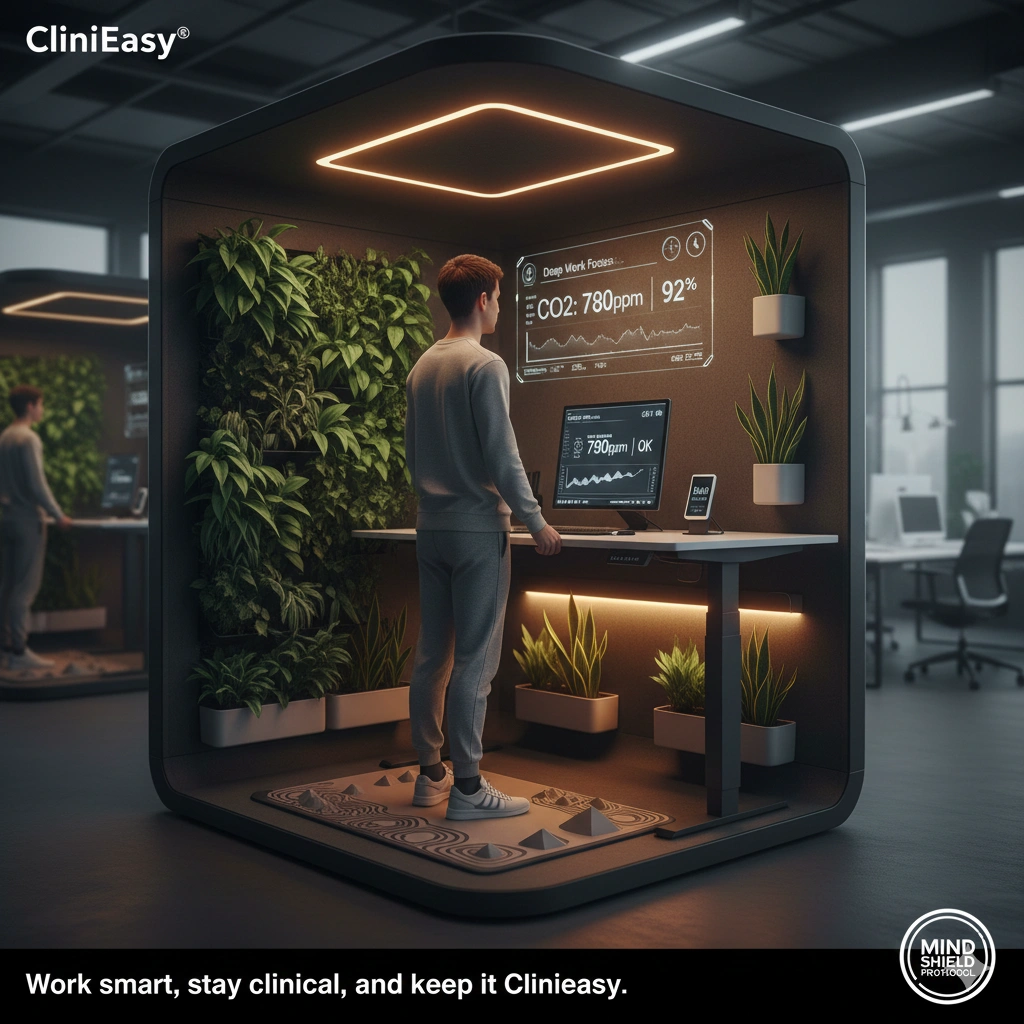
- The Gear: Use an Anti-Fatigue Topography Mat. These mats aren’t flat; they have “terrain” that forces your feet to make micro-adjustments, keeping your calves engaged and your blood moving back toward your brain.
3. Acoustic Hygiene: The “Sound Bubble”
In 2026, we treat “Noise Pollution” as a physiological stressor that spikes cortisol and breaks “Deep Work” cycles.
- The Tech: Active Acoustic Pods. For tasks requiring high focus, we move from the open floor to “Sound-Insulated Pods.” These pods use integrated acoustic felt and white-noise masking to create a “Personal Sound Bubble.”
- The Benefit: Research shows that it can take up to 23 minutes to return to a deep state of focus after a single interruption. Acoustic hygiene is the practice of protecting that “Flow State” with physical and digital barriers.
4. Circadian-Responsive Lighting: The 2026 Standard
Office lighting should follow the sun, not a fixed switch.
- The Innovation: Human-Centric Lighting (HCL). Modern offices use LED arrays that transition from high-energy blue-white light ($6500\text{K}$) in the morning to a soft, amber hue ($2700\text{K}$) in the late afternoon.
- The Result: This maintains your “Alertness Window” during the day without suppressing the melatonin you’ll need tonight. It is “Neurological Priming” through the eyes.
5. Biophilic Integration: The “Restorative View”
Looking at a screen for hours causes “Attention Fatigue.”
- The Fix: The 20-20-20 Rule with a Biophilic Twist. Every 20 minutes, look at something 20 feet away for 20 seconds.
- The Bio-Hack: That “something” should be a living plant. In 2026, we use Living Walls or “Desktop Jungles.” The fractal patterns in plants have been shown to trigger an alpha-wave response in the brain, instantly lowering stress levels and resetting your “Cognitive Endurance.”
The Clinieasy “Bio-Hacked Office” Checklist
- $CO_{2}$ Vigilance: Keep a monitor on your desk and ventilate whenever levels cross $800\text{ ppm}$.
- Terrain Mats: Use a non-flat anti-fatigue mat to encourage micro-movement while standing.
- The 20-8-2 Cycle: Set a timer to rotate between sitting, standing, and moving every half hour.
- HCL Lighting: Use smart bulbs that shift from blue to amber as the workday progresses.
- Acoustic Sanctuary: Use noise-canceling headphones or a focus pod for “Deep Work” sessions.
Conclusion: Your Workspace is a Tool
In 2026, your office is not just where you are; it is What You Use to perform. By applying the principles of atmospheric and neurological hygiene, you transform your work from a drain on your biology into an expression of your peak potential.
Work smart, stay clinical, and keep it Clinieasy.
Disclaimer: While standing desks are beneficial, they are not a replacement for regular cardiovascular exercise. Ensure your monitor is at eye level to prevent “Tech Neck,” regardless of whether you are sitting or standing.
Why this fits Article #165:
- Evidence-Based: Cites specific $CO_{2}$ thresholds and the “20-8-2” rule.
- Modern Context: Addresses the failure of the “Open Office” and the rise of “Deep Work.”
- AdSense Synergy: Perfect for ergonomic furniture, high-end tech, and air quality sensors.