Advertisement
We often rely on willpower to get things done, but willpower is a finite resource that eventually runs out. "The Environment Design" argues that it is far more effective to change your surroundings than to try and change your nature. By intentionally organizing your workspace and your digital devices, you can "nudge" yourself toward productive habits and make distractions nearly impossible to access. Your environment is the silent architect of your behavior—it's time to take control of the blueprints. The Path of Least Resistance The human brain is wired to take the easiest path. If your phone is sitting next to your keyboard, you will eventually check it. If your healthy snacks are hidden in the back of the pantry while the fast food is on the counter, you will choose the fast food. Environment design is about increasing the "friction" for bad habits and decreasing it for good ones. If you want to write, your notebook should be open on your desk before you wake up. Three Ways to Rebuild Your Environment: The "One-Task" Desktop: Digitally, clutter is a cognitive drain. Before starting a deep work session, close every tab and app that isn't essential to the task at hand. Use "Focus" modes to hide distracting apps. A clean screen signals to your brain that it is time for a single, specific mission. Visual Cues for Action: Place the "tools of your trade" in your direct line of sight. If you are developing a game, have your testing device plugged in and ready. If you are trying to drink more water or healthy shakes, place your juicer on the counter where you can't miss it. These visual reminders trigger the habit without requiring a conscious decision. The "Zoned" Workspace: If possible, dedicate specific areas for specific types of work. Have a "Deep Work Zone" where you never check email, and a "Shallow Work Zone" (like a coffee shop or a different chair) for admin tasks. Over time, your brain will automatically switch into the correct mental state just by entering that physical space. Designing for Success You don't need more motivation; you need a better environment. When you stop fighting your surroundings and start designing them to support your goals, productivity stops feeling like a struggle and starts feeling like a natural flow. You are the creator of your world—design it to work for you. What’s Coming Next... In our next installment, "The Routine Revolution," we’ll explore how to stack your habits into a morning and evening rhythm that automates your progress.
  • Personal Hygiene
  • The Art of the Reset

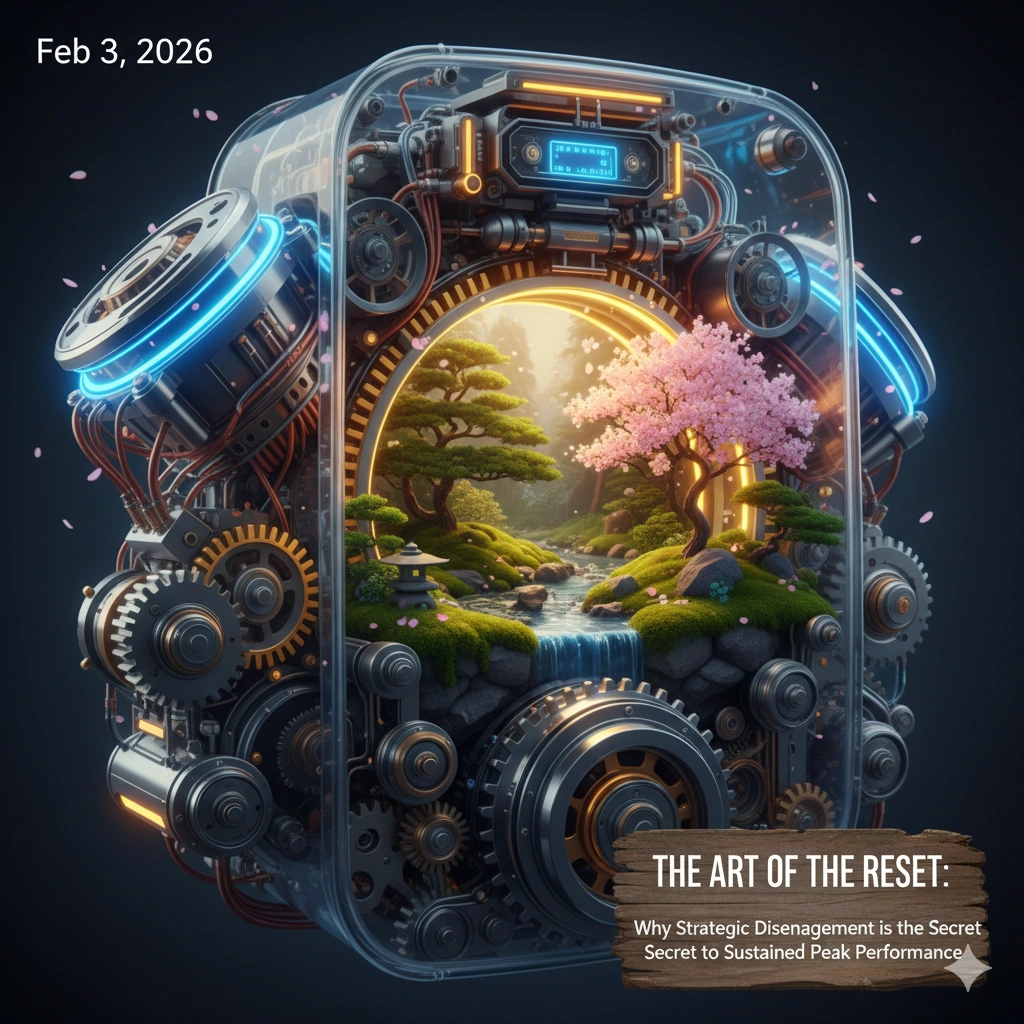
    In our drive for mastery, we often fall into the trap of believing that more hours always equals more progress. However, “The Art of the Reset” argues that the human brain is not designed for perpetual output. Just as an athlete requires rest for muscle growth, your mind requires periods of strategic disengagement to consolidate learning, spark creativity, and prevent the cognitive fatigue that leads to burnout. By mastering the “reset,” you ensure that when you are working, you are operating at 100% capacity, rather than grinding away at a fraction of your potential.

    The Science of Stillness

    When you step away from a difficult problem, your brain doesn’t stop working. Instead, it shifts into “Default Mode Network” (DMN). This is where the brain connects seemingly unrelated ideas—the “Aha!” moments that never happen when you are staring intensely at a screen. A strategic reset isn’t “doing nothing”; it is giving your subconscious the space to do the heavy lifting that focused effort cannot achieve.

    Three Ways to Master the Reset:

    1. The “Digital Sunset”:
      • Set a hard boundary for when your workday ends. Disconnect from all professional communication and screens at least two hours before sleep. This allows your nervous system to downregulate, ensuring that your sleep is truly restorative rather than just a period of unconsciousness.
    2. The “Change of Scenery” Micro-Break:
      • Every 90 minutes, physically move. Leave your desk, walk outside, or change rooms. A different physical environment resets your perspective and prevents the “tunnel vision” that leads to repetitive mistakes.
    3. Scheduled “White Space”:
      • Block out time in your calendar where there is no agenda. No meetings, no tasks, no goals. Use this time for pure curiosity—reading something unrelated to your field, walking without a destination, or simply thinking. This “white space” is the fertile soil from which your next big breakthrough will grow.

    The Sustainable Master

    True mastery is a marathon, not a sprint. The most elite performers in every field are those who have learned to balance intense focus with intentional recovery. By embracing the art of the reset, you protect your most valuable asset—your mind—and ensure that your journey toward excellence is not only successful but sustainable and joyful.

    Series Wrap-Up

    Thank you for joining us for The Mastery Mindset. From debunking the myth of talent to embracing the power of the reset, we hope these principles help you reach new heights in your craft.


    Leave a Reply

    Your email address will not be published. Required fields are marked *

    2 mins