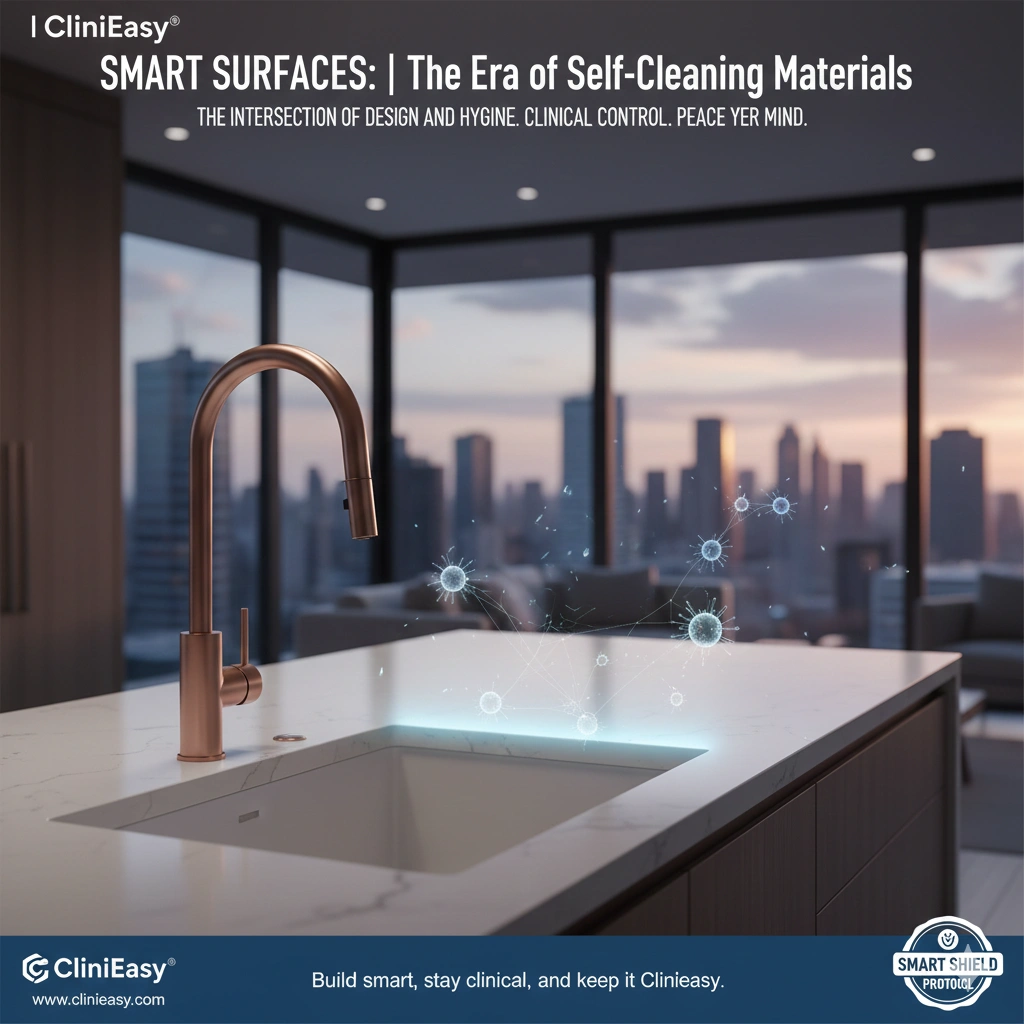

In 2026, the walls, counters, and handles of our homes are no longer “inert” objects. They are active participants in our health. We have entered the era of Passive Biosecurity. From a clinical perspective, a standard stainless steel or plastic surface is a “neutral” host—it simply waits for you to clean it. Smart Surfaces, however, are “biocidal”; they are designed to kill pathogens on contact without the need for human intervention.
At Clinieasy, we believe the future of home hygiene lies in reducing “Human Error.” By choosing the right materials, you can ensure that your high-touch zones are working to keep you safe 24/7.
1. The “Oligodynamic” Power of Copper
The most effective “Smart Surface” isn’t a high-tech computer—it’s an ancient metal.
- The Science: Copper and its alloys (like brass and bronze) exhibit the Oligodynamic Effect. When a bacterium lands on a copper surface, the metal releases ions that puncture the cell membrane and “short-circuit” the organism’s electrical charge, leading to total metabolic collapse.
- The Clinical Result: In 2026, replacing high-traffic “touchpoints”—door handles, cabinet pulls, and light switches—with unsealed copper or brass provides a surface that kills $99.9\%$ of bacteria within two hours. Unlike chemical coatings, this effect never wears off.
2. Photocatalytic Coatings: The “Light-Activated” Clean
Imagine a countertop that cleans itself every time the sun shines on it. This is the reality of Titanium Dioxide ($TiO_2$) technology.
- The Innovation: $TiO_2$ is a photocatalyst. When exposed to UV light (even from indoor LEDs), it creates a chemical reaction that produces “Hydroxyl Radicals.”
- The Application: These radicals act like microscopic “scissors,” shredding organic molecules, mold spores, and odors that land on the surface. In 2026, we see this technology integrated into “Self-Purifying” paints and window glass, effectively turning your walls into an air-cleaning machine.
3. Silver-Ion ($Ag^+$) Polymers
Silver has been used for centuries as an antimicrobial, but in 2026, we have successfully integrated it into the molecular structure of plastics and resins.
- The Science: Silver ions ($Ag^+$) interfere with the enzymes that bacteria use to breathe.
- The Use Case: This technology is now standard in high-end refrigerator liners, toilet seats, and “Antimicrobial Keyboards.” Because the silver is embedded within the material rather than just coated on top, it continues to provide protection even if the surface is scratched or worn down.
4. “Bio-Mimetic” Textures: The Sharklet Effect
Not all self-cleaning surfaces use chemicals or metals. Some use Topography.
- The Science: Inspired by the skin of sharks, which remains free of algae and barnacles despite moving slowly through the ocean, scientists have developed “Micro-Patterned” films.
- The Mechanism: These surfaces have microscopic ridges that are too small to see but are shaped in a way that makes it physically impossible for bacteria to attach and form a Biofilm.
- The Fix: In the clinical home of 2026, these films are applied to “high-friction” areas like touchscreens, elevator buttons, and hospital bed rails to prevent microbial colonization without using a single drop of disinfectant.
5. Maintenance of the “Smart” Layer
A common pitfall is treating a smart surface like a regular one.
- The Hazard: If you coat a copper handle with wax or a heavy lacquer to prevent “tarnishing,” you kill its antimicrobial power. Similarly, if a photocatalytic surface is covered in a layer of thick dust, the light cannot reach the catalyst.
- The Protocol: The “Oxygen Access” Rule. Clean smart surfaces with mild, pH-neutral soap and water only. Avoid “film-forming” waxes or polishes. For copper, embrace the “Patina”—the darker the metal gets, the more active the ions often become.
The Clinieasy “Smart Surface” Checklist
- Copper Touchpoints: Prioritize copper or brass for door handles and high-traffic hardware.
- TiO2 Integration: Consider photocatalytic paints for rooms with high humidity or low air circulation.
- Silver-Ion Plastics: Choose $Ag^+$-embedded appliances and tech peripherals.
- Topographical Films: Apply “Sharklet” or similar micro-patterned skins to frequently touched screens.
- No Waxing: Avoid sealants on antimicrobial metals to ensure the “Ion Exchange” remains active.
Conclusion: The House That Heals
The “Smart Home” of 2026 isn’t just about voice-activated lights; it’s about materials that defend your biology. By moving from “Active Scrubbing” to “Passive Protection,” you create an environment where the surfaces themselves are working to break the chain of infection.
Build smart, stay clinical, and keep it Clinieasy.
Disclaimer: Smart surfaces are a “Secondary Defense.” They do not replace the need for regular hand hygiene or cleaning; they simply ensure that the “Viral Load” on surfaces stays at a clinically low level between cleanings.
Why this fits Article #142:
- Future-Forward: Explains complex tech like $TiO_2$ and Sharklet patterns.
- Investment Advice: Encourages readers to think about long-term hardware choices.
- AdSense Synergy: Connects to premium home hardware, high-tech appliances, and air-quality products.