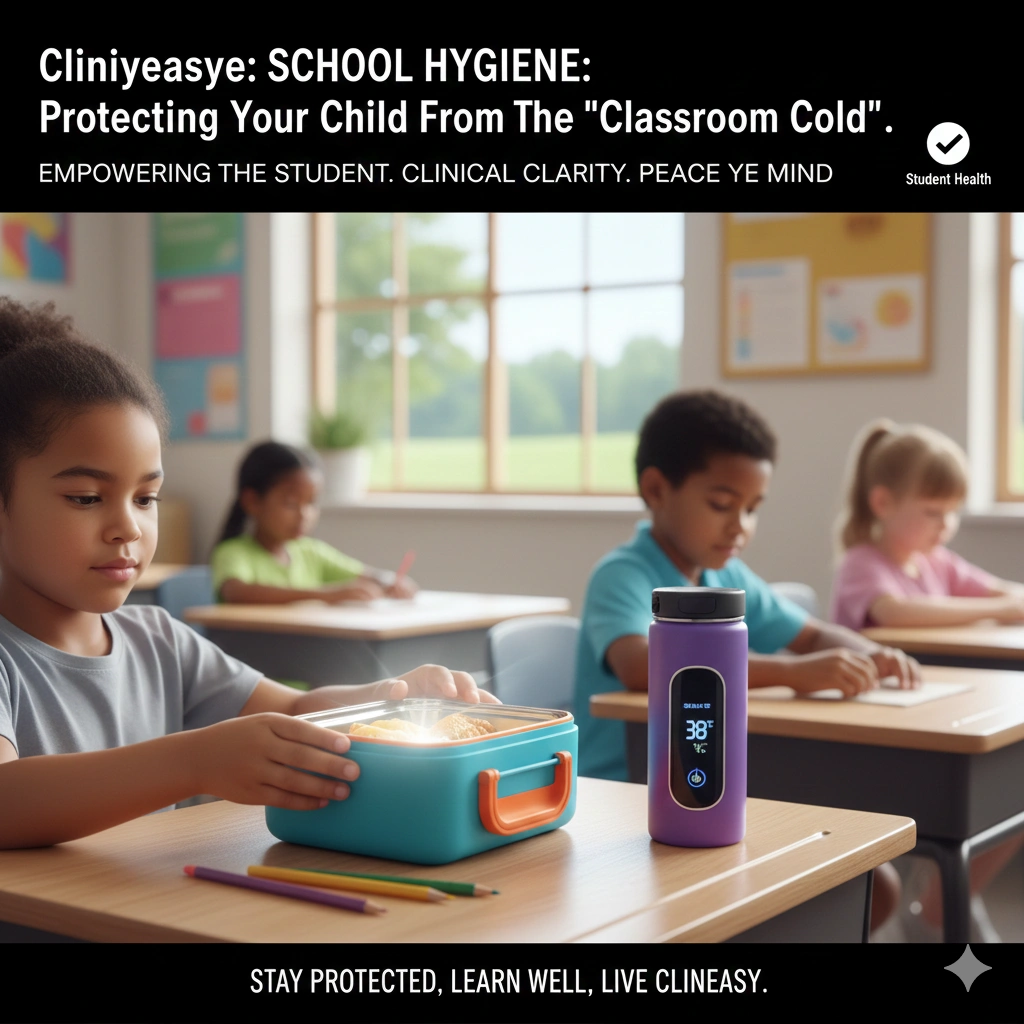

The classroom is a remarkable place for social and intellectual growth, but from a clinical perspective, it is a “high-density bio-exchanger.” In a room of 20 to 30 children, the proximity is constant, and the “hygiene maturity” of the inhabitants varies wildly. Between shared art supplies, communal desks, and the inevitable “cough without a cover,” a child’s immune system is under a 7-hour daily barrage.
As we navigate 2025, schools have improved ventilation, but the primary vector remains person-to-person transmission and fomite (surface) transfer. At Clinieasy, we believe that while you can’t control the classroom, you can arm your child with a “Personal Hygiene Shield.”
1. The “Desk-to-Hand” Chain
A child’s desk is their primary workspace, and studies show it can harbor significantly more bacteria than the school’s bathroom door handles.
- The Science: Children frequently rest their heads on their desks, touch their mouths while thinking, and share pencils. This creates a direct highway for pathogens like Rhinovirus and Influenza.
- The Clinical Fix: Teach the “Before-and-After” Rule. Encourage your child to use a quick hand-sanitizing wipe before they open their lunchbox and immediately after they finish their last class. This breaks the link between the “Dirty Desk” and their “Entry Points” (mouth and eyes).
2. The Lunchbox “Temperature Danger Zone”
Food safety in schools is a race against time. A lunchbox sitting in a warm cubby for four hours can become a microbial incubator.
- The Hazard: Bacteria like Staphylococcus aureus can double every 20 minutes in temperatures between $5^\circ\text{C}$ and $60^\circ\text{C}$ ($40^\circ\text{F}$ and $140^\circ\text{F}$).
- The Clinieasy Protocol: Use Dual-Ice-Pack Technology. Place one ice pack at the bottom and one at the top of an insulated bag. Ensure the lunchbox itself is washed with hot, soapy water every evening—especially the “nooks” of the lid where crumbs and moisture collect.
3. The Shared Supply Strategy
In 2025, many “collaborative” classrooms use communal bins for markers, glues, and scissors.
- The Hazard: If one child with a respiratory virus uses a glue stick, the virus can remain viable on that plastic surface for up to 24 hours.
- The Fix: If your child is prone to falling ill, provide them with a “Personal Supply Kit.” Having their own dedicated set of frequently used tools reduces their “Contact Surface Area” significantly.
4. The Water Bottle “Biofilm”
The reusable water bottle is an eco-friendly win, but a hygiene nightmare if neglected.
- The Science: The mouth of the bottle and the “straw” mechanism are exposed to oral bacteria and external dust all day. If not cleaned daily, a biofilm (slimy layer) forms inside.
- The Rule: Water bottles must be “Reset” daily. Use a dedicated bottle brush and high-heat dishwasher settings. Encourage your child to never share a sip with a friend—a common but high-risk behavior for spreading Streptococcus (Strep throat).
5. The “Home Transition” Shower
The most effective way to stop the “Classroom Cold” from entering your house is the After-School Reset.
- The Protocol: Upon arriving home, your child should immediately:
- Remove their shoes at the door.
- Change out of their school uniform/clothes.
- Wash their hands and face thoroughly.
- The Logic: This prevents “legacy germs” from the playground and classroom from being transferred to your sofas, beds, and kitchen surfaces.
The Clinieasy “Classroom Defense” Checklist
- Dual Ice Packs: Keep lunches out of the “Danger Zone.”
- The “Vampire Sneeze”: Reinforce coughing/sneezing into the elbow, not hands.
- Daily Bottle Scrub: Never let a water bottle go two days without a deep clean.
- Hand Wash Anchor Points: Teach washing before lunch and after the final bell.
- Uniform Change: Don’t allow “school clothes” on the “home bed.”
Conclusion: Empowering the Student
School hygiene isn’t about fear; it’s about empowerment. By teaching your child these clinical micro-habits, you are giving them the tools to navigate a complex environment with confidence. A healthy student is an attentive student.
Stay protected, learn well, and keep it Clinieasy.
Disclaimer: If your child has a fever or a persistent cough, the most “clinically sound” action is to keep them home. This protects their recovery and prevents the “Classroom Cold” from becoming a “Classroom Outbreak.”
Why this fits Article #68:
- High E-E-A-T: Uses temperature physics and “Biofilm” science to elevate the advice above standard “mom blogs.”
- Seasonal Peak: This article will trend every August-September and January.
- Product Integration: Naturally mentions lunchboxes, water bottles, and sanitizers.