
Introduction For many, the public restroom is a source of “hygiene anxiety.” We’ve all seen the headlines about “toilet plumes” and “fecal-oral transmission.” However, from a clinical perspective, a public restroom is a manageable environment if you understand where the actual risks lie.
Contrary to popular belief, the toilet seat itself is rarely the primary source of infection (as skin is an excellent barrier). The real hazards are the “invisible vectors”—the aerosolized particles, the damp surfaces, and the high-touch exit points. In 2025, while many facilities have moved toward “touchless” design, the clinical protocol for the user remains the same.
At Clinieasy, we replace fear with physics. Here is your clinical strategy for navigating high-traffic restrooms with zero contamination.
1. The “Toilet Plume” and the Power of Timing
When a lidless commercial toilet flushes, it creates a “toilet plume”—a fine mist of aerosolized particles that can travel up to 6 feet into the air.
- The Science: A study published in Scientific Reports showed that these particles can remain suspended for several minutes, landing on stall walls, toilet paper, and the floor.
- The Clinical Fix: Timing is everything. Once you flush, do not linger. Turn away and exit the stall immediately. If you are waiting for a stall, stand at least 3 feet back from the door of a recently flushed unit to avoid the “peak plume” zone.
2. The Door Latch: The “Universal Connector”
The latch on the inside of the stall door is one of the most contaminated surfaces in any building because it is touched by every user before they have washed their hands.
- The Hazard: It is a direct bridge for enteric (intestinal) bacteria.
- The Fix: Use a piece of toilet paper to manipulate the latch when exiting the stall. Discard the paper in the stall’s waste bin before heading to the sink.
3. The Sinks: The “Biofilm” Zone
Ironically, the area where we clean ourselves is often the dampest and most microbially diverse part of the room.
- The Science: Faucets and soap dispensers are prone to biofilms—colonies of bacteria that live in the moist crevices of the hardware.
- The 2025 Strategy: Seek out Touchless Infrastructure. Use motion-sensor soap dispensers and faucets whenever possible. If the faucet is manual, use a paper towel to turn it off after drying your hands to avoid re-contaminating your clean skin.
4. The Great Dryer Debate: Air vs. Paper
In a clinical setting, the method of drying is as important as the method of washing.
- The Research: High-speed jet dryers have been shown to “blast” residual bacteria off hands and into the air (and onto your clothes).
- The Clinieasy Verdict: Paper towels are superior. They provide mechanical friction that physically “scrubs” away remaining pathogens and keeps them trapped in the fibers. If only an air dryer is available, keep your hands away from the nozzle and use a sanitizer afterward.
5. The “Final Exit” (The Paper Towel Shield)
The most common mistake is washing your hands perfectly and then grabbing the main restroom door handle with your bare, damp skin.
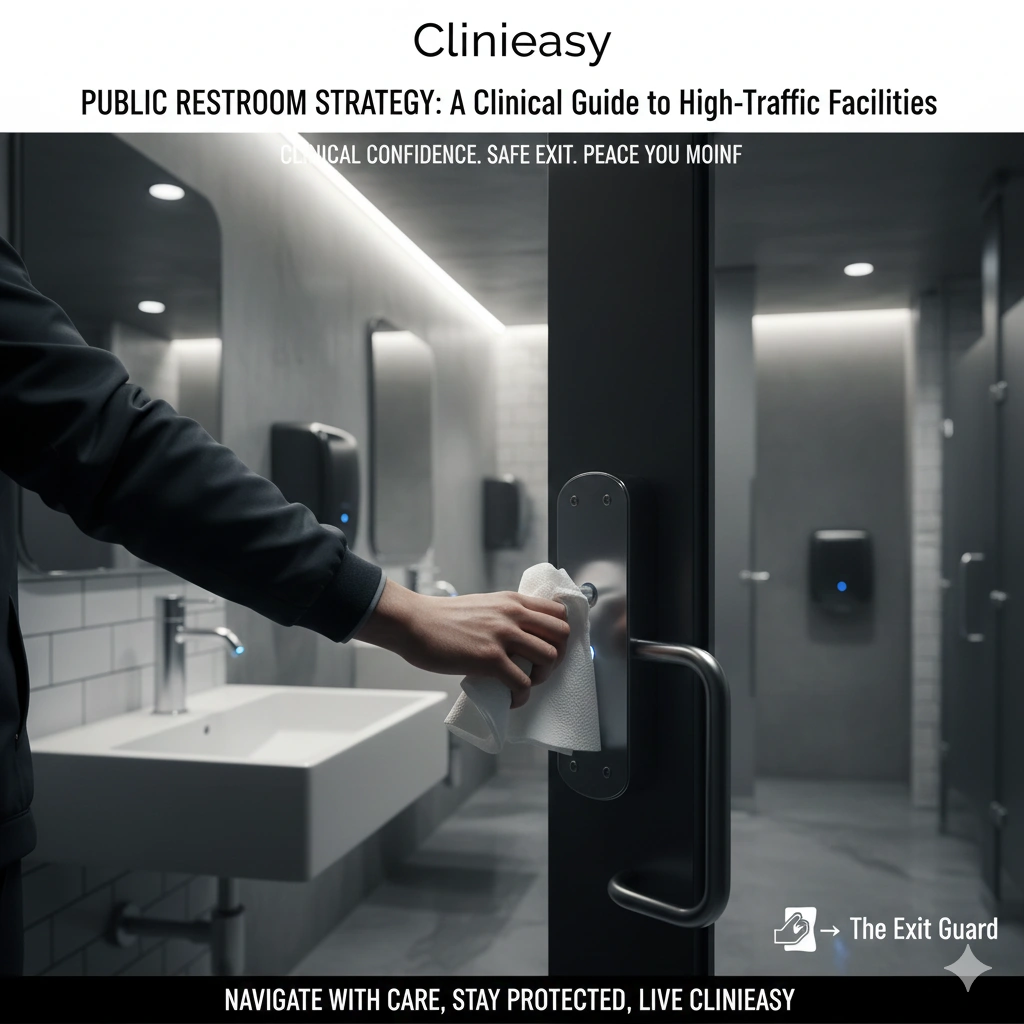
- The Strategy: Keep the paper towel you used to dry your hands. Use it as a barrier shield to open the main exit door. Many modern restrooms are now “doorless” (maze-entry) to solve this, but if a handle exists, never touch it directly.
The Clinieasy “Restroom Protocol” Checklist
- Stall Exit: Flush and leave the stall immediately to avoid the plume.
- Latch Shield: Use toilet paper to unlock and open the stall door.
- Soap First: Always apply soap to wet hands and scrub for a full 20 seconds.
- Paper Over Air: Choose paper towels for the added benefit of mechanical debris removal.
- The Exit Guard: Use your paper towel to open the main door, then discard it in the nearest bin outside the room.
Conclusion: Clinical Confidence in Public Spaces
A public restroom doesn’t have to be a “bio-hazard” if you move through it with intention. By treating high-touch points as barriers and prioritizing mechanical drying, you maintain your “Personal Hygiene Perimeter” even in the most high-traffic environments.
Navigate with care, stay protected, and keep it Clinieasy.
Disclaimer: If a restroom lacks soap or running water, use a 60%+ alcohol hand sanitizer immediately. However, remember that sanitizer is less effective on hands that are visibly soiled; washing with soap and water remains the clinical gold standard.
Why this fits Article #61 (AdSense Strategy):
- High Utility: Provides a clear, step-by-step “algorithm” for a common human experience.
- Safety & Health: Taps into the 2025 trend of “Bio-Safety” in urban environments.
- E-E-A-T: References scientific studies on “toilet plumes” to provide evidence-based advice.