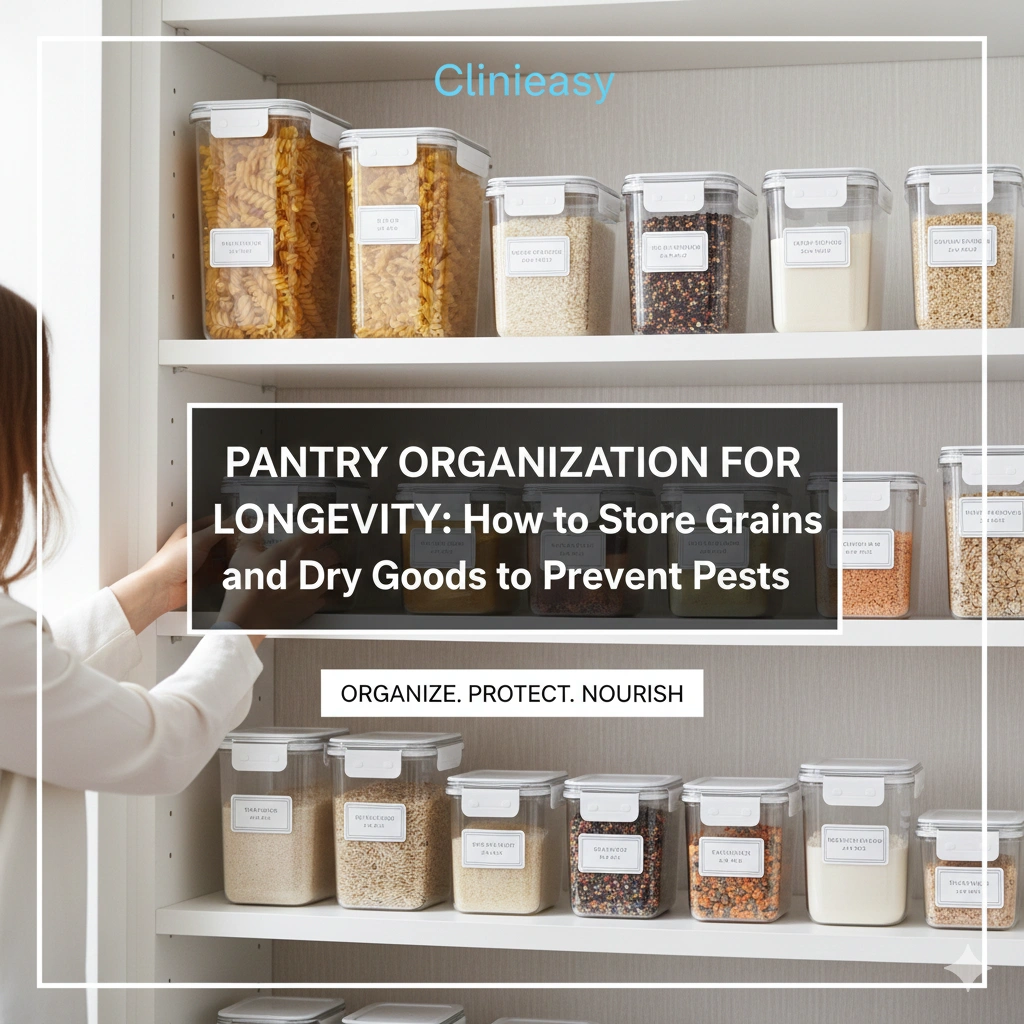

We often focus our clinical hygiene efforts on the “wet” areas of the kitchen—the sink, the fridge, and the cutting boards. However, the pantry is a silent frontier for biological contamination. While dry goods like flour, rice, and pasta have a long shelf life, they are susceptible to a specific set of hygiene risks: oxidation, moisture-driven mold, and invasive pests.
An infestation of pantry moths or weevils isn’t just a nuisance; it represents a failure in food security. These pests can bore through plastic bags and cardboard, spreading bacteria and ruining hundreds of dollars’ worth of groceries.
At Clinieasy, we believe a healthy kitchen starts with a secure pantry. In this guide, we provide a clinical protocol for storing dry goods to ensure they remain fresh, nutritious, and pest-free.
1. The “Decanting” Rule: Breaking the Cardboard Cycle
Most dry goods are sold in porous packaging: thin plastic bags or cardboard boxes.
- The Hazard: Cardboard is a magnet for moisture and provides no barrier against pests like weevils, which can actually arrive from the grocery store inside the packaging.
- The Clinical Fix: Immediately “decant” your dry goods into airtight glass or BPA-free plastic containers. This creates an impenetrable barrier against pests and prevents the “cross-contamination” of an infestation from one bag to the next.
- Pro Tip: Square or rectangular containers are more space-efficient and allow for better air circulation in the pantry than round jars.
2. The “Freezer Quarantine” Protocol
Did you know that many grain-based products already contain microscopic insect eggs from the milling process?
- The Science: Weevil eggs are often present in flour and rice. In a warm pantry, these eggs hatch, leading to a sudden, “unexplained” infestation.
- The Clinical Fix: When you bring home a new bag of flour, rice, or oats, place it in the freezer for 48 to 72 hours. This kills any potential eggs or larvae, ensuring that when you decant the product into your containers, it is biologically “sterile.”
3. Managing Humidity: The Silica Solution
Grains and spices are hygroscopic, meaning they absorb moisture from the air.
- The Hazard: High humidity leads to clumping, loss of flavor, and eventually, the growth of mycotoxins (toxic compounds produced by fungi).
- The Clinical Fix: Store your pantry goods in a cool, dark, and dry place (ideally below $21^\circ\text{C}$ / $70^\circ\text{F}$). For high-moisture climates, consider adding a food-grade silica gel packet to containers of sugar or salt to keep them free-flowing and dry.
4. The “FIFO” System (First In, First Out)
Even dry goods have an expiration date for peak nutrition.
- The Method: Always place newer items at the back of the shelf and move older items to the front.
- The Labeling Habit: When you decant food into containers, use a label maker or a chalk marker to note the product name and the original expiration date. Don’t rely on memory; a clinical pantry is an organized one.
5. Detecting the “Invisible” Infestation
Sometimes the signs of spoilage aren’t obvious bugs, but subtle changes in the food.
- The Red Flags:
- Webbing: If you see fine, silk-like webbing in the corners of your flour or cornmeal, you have pantry moth larvae.
- Pungent Odors: Oils in nuts and whole-grain flours (like brown rice flour) can turn rancid. If it smells “soapy” or “metallic,” it is chemically compromised.
- Clumping: This indicates moisture ingress and potential mold risk.
The Clinieasy “Pantry Defense” Checklis
- Freeze new grains for 3 days before storing.
- Decant all items into airtight containers.
- Wipe pantry shelves with a 50/50 vinegar-water solution every 3 months.
- Label every container with its “Best By” date.
- Check for webbing or “pinholes” in original packaging before buying.
Conclusion: Secure Your Food Chain
A clinical pantry is your home’s internal warehouse. By treating it with the same level of organizational rigor as a medical supply room, you eliminate waste and protect your family from the hidden pathogens that thrive in dark, forgotten corners.
Organize with intention, store with seals, and eat with confidence.
Disclaimer: If you discover a significant infestation of pantry moths, you must remove all unsealed food items, vacuum all cracks/crevices, and wash shelves thoroughly. Pheromone traps can help monitor for remaining adults.
Why this fits Article #37 (AdSense Strategy):
- High Problem/Solution Value: People actively search for “how to stop pantry moths,” making this a high-click-through article.
- Product Integration: Perfect for showcasing airtight container sets, label makers, and vacuum sealers.
- Evergreen Utility: Food storage and organization are popular topics year-round, especially during “Spring Cleaning” or “Back to School” seasons.