
As we age, our skin—our primary biological shield—undergoes significant physiological changes. It becomes thinner, loses elasticity, and produces fewer natural oils (sebum). From a clinical perspective, the “Acid Mantle” that protects younger skin becomes more alkaline and fragile in seniors. This makes traditional hygiene routines, which might have worked for decades, potentially hazardous, leading to “Skin Tears,” chronic dryness, and increased infection risk.
In 2025, geriatric hygiene has moved away from “scrubbing clean” toward Barrier Preservation. The goal is to remove pathogens while reinforcing the skin’s structural integrity. At Clinieasy, we provide a clinical roadmap for maintaining hygiene in the aging population with dignity and dermatological precision.
1. The “Less is More” Bathing Frequency
One of the most common clinical errors in senior care is daily full-body bathing with harsh soaps.
- The Science: Frequent hot water exposure strips away the already-depleted lipid layer of aging skin, leading to “Asteatotic Eczema”—painful, cracked skin that serves as an entry point for bacteria.
- The Clinical Fix: Limit full baths or showers to 2–3 times per week, focusing on daily “Spot Cleaning” for high-hygiene areas (face, underarms, and the perineal area). Keep water temperature lukewarm ($37^\circ\text{C}$ or $98^\circ\text{F}$), as hot water causes rapid moisture loss.
2. The pH-Balanced Cleanser Shift
The “bar soap” found in many households is often highly alkaline, which can disrupt the skin’s natural pH for hours.
- The Hazard: Alkaline skin is more susceptible to Staphylococcus colonization and fungal infections.
- The Strategy: Switch to Syndets (Synthetic Detergents) or soap-free cleansers that are strictly pH-balanced (around 5.5). These formulas clean effectively without stripping the proteins that keep skin cells bonded together.
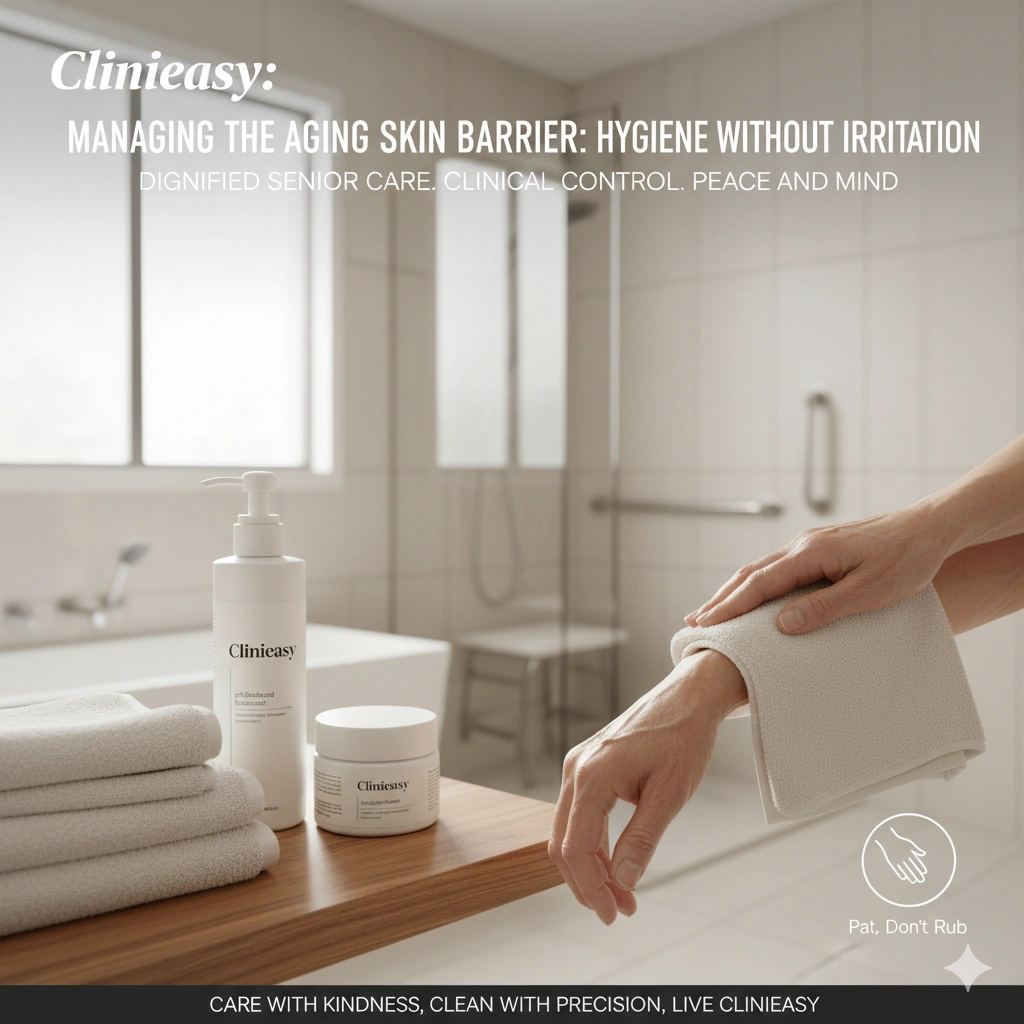
3. The “Pat, Don’t Rub” Drying Technique
The mechanical friction of a standard towel can be enough to cause a “Skin Tear” on fragile, paper-thin skin.
- The Science: Shear force—the sliding of one layer of tissue over another—is the primary cause of injury in senior hygiene.
- The Protocol: Use ultra-soft microfiber or high-GSM cotton towels. Use a patting motion to remove moisture. Never “buff” the skin dry. Pay close attention to skin folds (under the breasts or abdominal folds), where trapped moisture can lead to Intertrigo (candidiasis).
4. The 3-Minute Moisture Window
In clinical dermatology, timing is everything.
- The Science: Once the skin is patted dry, there is a narrow window before the remaining moisture evaporates, further drying the skin.
- The Clinieasy Rule: Apply a ceramide-rich emollient within 3 minutes of bathing. Look for “Occlusives” like petrolatum or “Humectants” like glycerin. This “locks in” the hydration and creates a secondary barrier that the skin can no longer produce on its own.
5. Foot Hygiene: The Diabetic and Vascular Factor
For seniors, foot hygiene is not just about cleanliness; it’s about limb preservation.
- The Hazard: Reduced circulation and peripheral neuropathy mean a senior may not feel a small cut or a fungal infection developing between the toes.
- The Fix: Perform a Daily Visual Inspection. Wash feet with lukewarm water and dry thoroughly between every toe. Moisture trapped between toes is the #1 cause of fungal “Maceration,” which can lead to serious cellulitis.
The Clinieasy “Fragile Skin” Checklist
- Lukewarm Only: Ensure water never exceeds body temperature.
- pH-Balanced Cleansers: Eliminate traditional alkaline bar soaps.
- The Pat-Dry Rule: Use zero friction when drying the body.
- 3-Minute Lotioning: Apply moisturizer immediately after patting dry.
- Toe-Gap Drying: Ensure the spaces between toes are bone-dry to prevent fungal growth.
Conclusion: Hygiene as Healthcare
For the aging population, hygiene is a delicate balance between cleanliness and structural preservation. By adopting these clinical protocols, caregivers and seniors can prevent the painful complications of skin breakdown and maintain the comfort and health of the body’s largest organ.
Care with kindness, clean with precision, and keep it Clinieasy.
Disclaimer: If you notice “non-blanching” redness (redness that doesn’t turn white when pressed) on bony areas like heels or the tailbone, this is a sign of a burgeoning pressure injury. Consult a wound care specialist immediately.
Why this fits Article #81:
- High E-E-A-T: Focuses on the “Acid Mantle,” “Shear Force,” and “Syndets.”
- High Social Value: Highly shareable for family caregivers.
- AdSense Potential: High-value keywords like “Geriatric hygiene” and “Ceramide-rich emollient.”