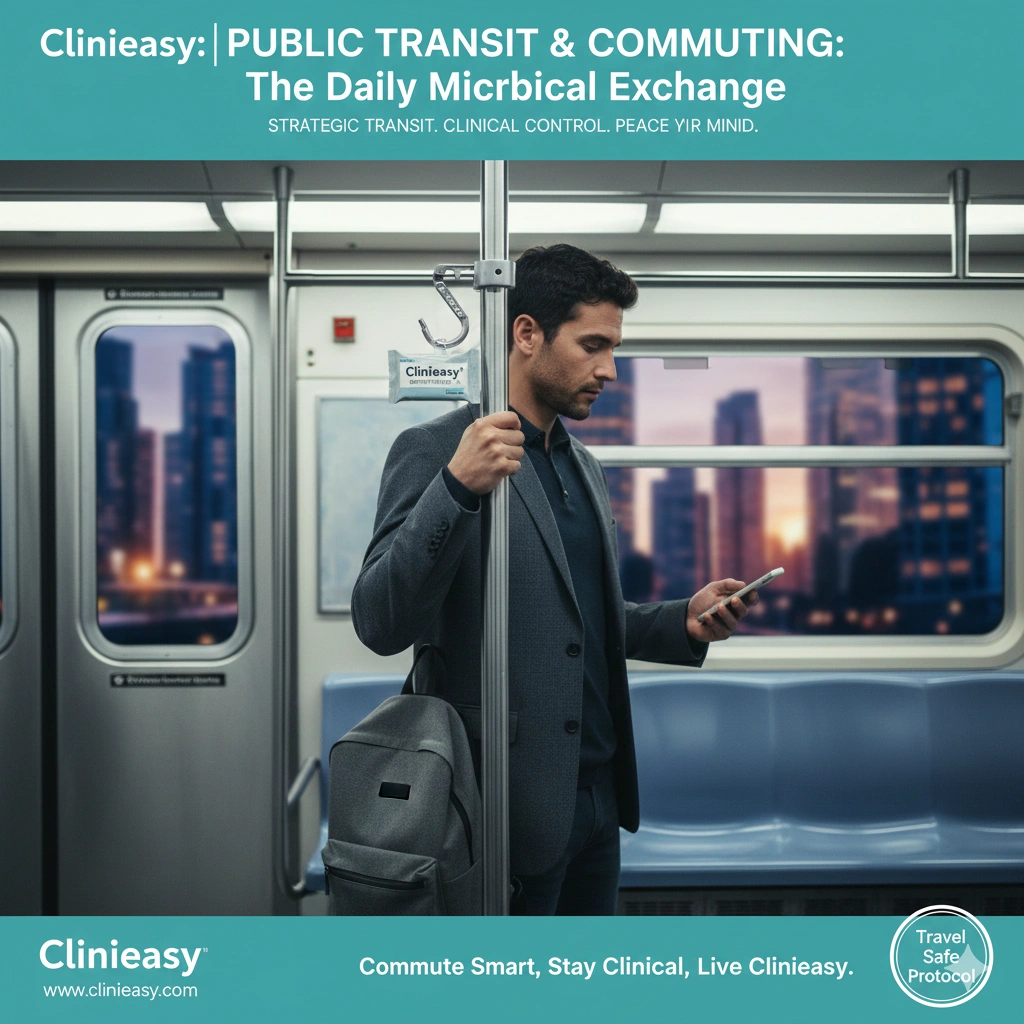

Introduction In 2026, the global commute has returned to full capacity. Whether you are navigating the London Underground, the New York Subway, or a Tokyo commuter train, you are participating in a massive, invisible “Microbial Exchange.” Public transit vehicles are “High-Velocity Vectors”—they move pathogens across geographic zones faster than a biological system can naturally adapt.
From a clinical perspective, your commute is the period of your day with the highest “Pathogen Encounter Rate.” At Clinieasy, we provide the strategy for navigating the urban transit network without bringing the city’s microbes back to your home or office.
1. The “Surface-to-Face” Pipeline
The primary risk on transit isn’t necessarily breathing the same air; it is the mechanical transfer of bacteria from a handrail to your mucous membranes.
- The Science: A single transit pole can be touched by over 50 different people in a single 15-minute window. Viruses like Influenza or Norovirus can remain viable on these non-porous stainless steel surfaces for hours.
- The Clinical Fix: Adopt the “One-Hand Rule.” Designate one hand as your “Transit Hand” (for holding poles and pushing buttons) and the other as your “Clean Hand” (for checking your phone or adjusting your glasses). Never switch them until you have sanitized.
2. Rideshare Hygiene: The “Backseat” Audit
Rideshares (Uber/Lyft) present a different challenge: a confined, low-volume space with high-frequency passenger turnover.
- The Hazard: “Aerosolized Residue.” If the previous passenger was sneezing, the micro-droplets remain suspended in the cabin air for several minutes.
- The Protocol: Upon entering, crack the window at least two inches. This creates Cross-Ventilation that dramatically increases the Air Exchange Rate (ACH), flushing out potential airborne pathogens. Avoid touching the interior door handles directly; use a knuckle or a tissue if possible.
3. The Backpack “Bottom” Contamination
We often worry about our hands, but we ignore our gear.
- The Science: Transit floors are reservoirs for everything from street grime to fecal matter (tracked in by shoes). When you place your backpack or purse on the floor of a bus or train, the fabric absorbs these contaminants.
- The Fix: Never place your bag on the floor. If you must set it down, place it on your lap or use a “Heroclip” to hang it from a rail. When you get home, do not place that bag on your kitchen counter or bed; it is a “Bio-Hazard” that requires its own storage hook near the door.
4. Commuter Tech: The Earbud Loop
In 2026, noise-canceling earbuds are the “Urban Armor.” However, they create a hygiene loop.
- The Hazard: You touch a subway pole, then you adjust your earbud, transferring transit microbes directly to your ear canal.
- The Strategy: Set your playlist and volume before you board. If you must adjust your tech, use your “Clean Hand.” Once you arrive at your destination, sanitize both your hands and the exterior of your earbuds (as discussed in Article #98).
5. The “Home-Entry” Decontamination
Your front door is the “Air-Lock” of your clinical environment.
- The Protocol: 1. Hand Hygiene: The very first thing you do upon entering is wash your hands for 20 seconds. 2. The “Phone Wipe”: Your phone likely touched your “Transit Hand.” Wipe it down immediately. 3. Outerwear Management: Designate a specific closet or hook for “Commuter Coats.” These should not mix with your “Home Clothes” or be tossed onto furniture.
The Clinieasy “Commuter Shield” Checklist
- The One-Hand Rule: Designate one hand for surfaces, one for personal use.
- Rideshare Venting: Always crack a window in a shared vehicle for air exchange.
- No-Floor Policy: Keep bags and personal items off transit floors.
- The “Heroclip” Hack: Use a hook to keep your bag elevated and clean.
- Entryway Reset: Wash hands and wipe your phone the moment you get home.
Conclusion: Navigating the Urban Jungle
The city is a vibrant, shared space, and public transit is its circulatory system. You don’t have to fear the commute; you simply have to manage it. By treating the transit network as a high-contact zone and maintaining your “Clean Hand” discipline, you can navigate the urban landscape with clinical confidence.
Commute smart, stay clean, and keep it Clinieasy.
Disclaimer: During peak respiratory seasons, a high-quality (KF94 or N95) mask remains the most effective defense against airborne transmission in crowded transit environments.
Why this fits Article #107:
- High Relevance: Millions of people commute daily and worry about “subway germs.”
- Psychological Ease: The “One-Hand Rule” is a simple, memorable habit.
- AdSense Synergy: Perfect for backpacks, sanitizers, and commuter-centric tech.