
When we travel internationally, we aren’t just crossing borders; we are crossing “Microbial Boundaries.” Every region on Earth has a unique ecosystem of bacteria, viruses, and parasites that the local population is perfectly adapted to, but your digestive system—the “Internal Frontier”—may be a total stranger to. From a clinical perspective, Traveler’s Diarrhea (TD) is the most common health challenge, affecting up to 70% of international travelers depending on the destination.
In 2025, we view travel health not as “avoiding germs,” but as Microbial Risk Management. It’s about protecting your system while it acclimates to a new environment. At Clinieasy, we provide the clinical protocol to help you explore the world without being confined to your hotel room.
1. The “Pre-Travel” Probiotic Shield
Your defense should begin 14 days before you even board the plane.
- The Science: The goal is to “crowd out” potential pathogens by saturating your gut with beneficial bacteria.
- The Clinical Fix: Use a high-potency probiotic containing Saccharomyces boulardii or Lactobacillus rhamnosus GG. These specific strains have been clinically shown to reduce the incidence and duration of Traveler’s Diarrhea by strengthening the intestinal lining.
- The Routine: Continue taking the probiotic throughout the duration of your trip and for one week after you return to ensure a stable “Microbial Landing.”
2. The “Boil It, Cook It, Peel It, or Forget It” Rule
This is the classic clinical mantra for international food safety, but in 2025, we add a layer of “Environmental Context.”
- The Logic: Heat kills most bacteria and parasites ($70^\circ\text{C}$ or $160^\circ\text{F}$ for at least one minute).
- The Hazards: * The “Salad Trap”: Fresh greens are often washed in local tap water. In high-risk zones, avoid raw salads.
- The “Peel Rule”: Eat fruit only if it has a thick, intact skin that you peel yourself (like bananas or oranges).
- The “Buffet Hazard”: As discussed in Article #87, communal spoons are a relay for pathogens. Choose steaming-hot, made-to-order food whenever possible.
3. The “Ice and Water” Protocol
Contaminated water is the primary vector for global pathogens like Giardia or E. coli.
- The Science: Freezing does not kill most waterborne bacteria; it merely preserves them.
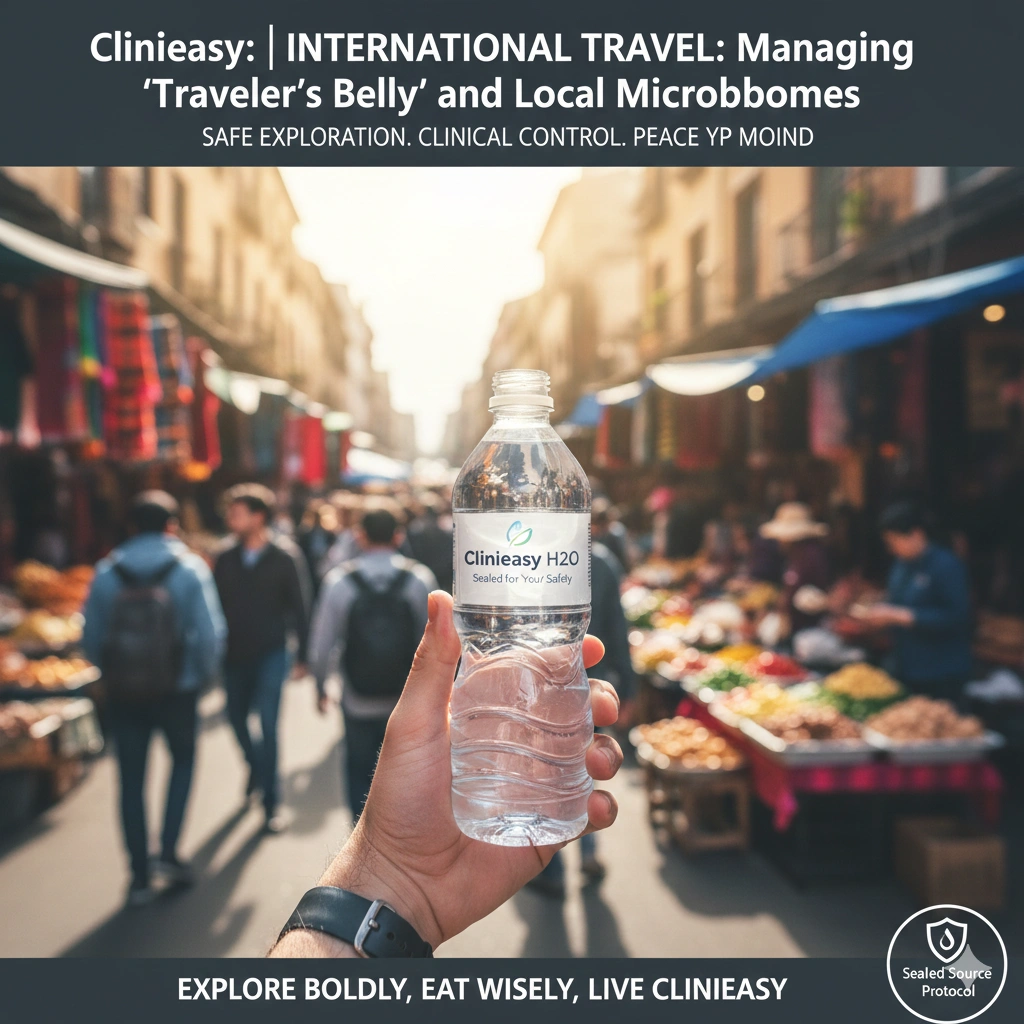
- The Protocol: 1. Seal Check: Drink only bottled water with an intact factory seal.
2. No Ice: Refuse ice in all drinks, including alcoholic beverages (alcohol does not “disinfect” the ice quickly enough).
3. The “Dry Rim”: Ensure the rim of your bottle or glass is dry before drinking. If it was sitting in an ice bucket, the exterior of the bottle is contaminated.
4. Toothbrush Hygiene: The “Sink Trap”
The most overlooked source of contamination is the bathroom sink.
- The Hazard: We instinctively rinse our toothbrushes under the tap. In many regions, this introduces a small but potent dose of local bacteria directly into your mouth and gums.
- The Fix: Use bottled water for brushing your teeth. Keep your toothbrush in a travel case that allows for airflow but protects it from splashes in the hotel bathroom.
5. Managing the “Post-Meal” Reset
If you suspect you have consumed something “borderline,” your immediate actions can mitigate the impact.
- The Strategy: Carry Oral Rehydration Salts (ORS) and Bismuth Subsalicylate. Bismuth has mild antimicrobial properties and can act as a “prophylactic” (preventative) when taken in moderate doses, as it coats the stomach lining and inhibits the attachment of certain bacteria.
- The Clinical Warning: Avoid “Anti-motility” drugs (like Imodium) if you have a fever or bloody stools, as these can trap dangerous bacteria in your system. Seek medical attention if symptoms are severe.
The Clinieasy “Global Traveler” Checklist
- Probiotic Prime: Start S. boulardii 14 days before departure.
- The Seal Audit: Only drink from factory-sealed bottles.
- No-Ice Policy: Decline ice in all environments in high-risk zones.
- Bottled Brushing: Use bottled water for all dental hygiene.
- Peel-Only Fruit: Only consume raw produce that requires peeling.
Conclusion: Global Exploration with Integrity
Traveling abroad is an investment in your soul; don’t let a microbial mismatch ruin the experience. By applying these clinical “filters” to your food and water intake, you allow your body to adjust to new environments safely. You can embrace the culture while protecting your “Internal Frontier.”
Explore boldly, eat wisely, and keep it Clinieasy.
Disclaimer: This protocol is a general guideline. Consult a travel clinic 6–8 weeks before departure to discuss specific vaccinations and prescription medications (like “standby” antibiotics) for your specific destination.
Why this fits Article #88:
- High E-E-A-T: Uses specific scientific terms like Saccharomyces boulardii and “Bismuth Subsalicylate.”
- Actionable & Practical: Provides a clear “how-to” for dental hygiene and food selection.
- Product-Rich: Directly supports ads for probiotics, water filters, and rehydration salts.