
You’ve finally arrived. You swipe your key card, the door clicks open, and you’re greeted by the crisp scent of “clean” linens and a neatly made bed. It looks perfect. But from a clinical perspective, a hotel room is one of the most complex environments to sanitize.
Housekeeping staff are often required to clean 14 to 16 rooms in a single shift, leaving them roughly 20–30 minutes per room. While the sheets are changed and the toilets scrubbed, many “high-touch” surfaces—the ones that actually spread respiratory and gastrointestinal viruses—are frequently overlooked.
At Clinieasy, we believe that your hotel room should be a sanctuary, not a source of stress. By following this 5-minute “Clinical Check-In” protocol, you can neutralize the most significant germ reservoirs and rest easy.
1. The “Luggage Launchpad” Rule
Before you do anything else, consider where you put your suitcase.
- The Hazard: Bedbugs. They are the ultimate travel hitchhikers and prefer soft surfaces like carpets and bedspreads.
- The Clinical Fix: Never put your luggage directly on the bed or the carpeted floor upon arrival. Place your bags in the bathroom (on the tile floor) or on the elevated metal luggage rack while you perform your inspection.
- Pro Tip: Keep the luggage rack away from the wall to prevent bugs from crawling from the wall onto your bags.
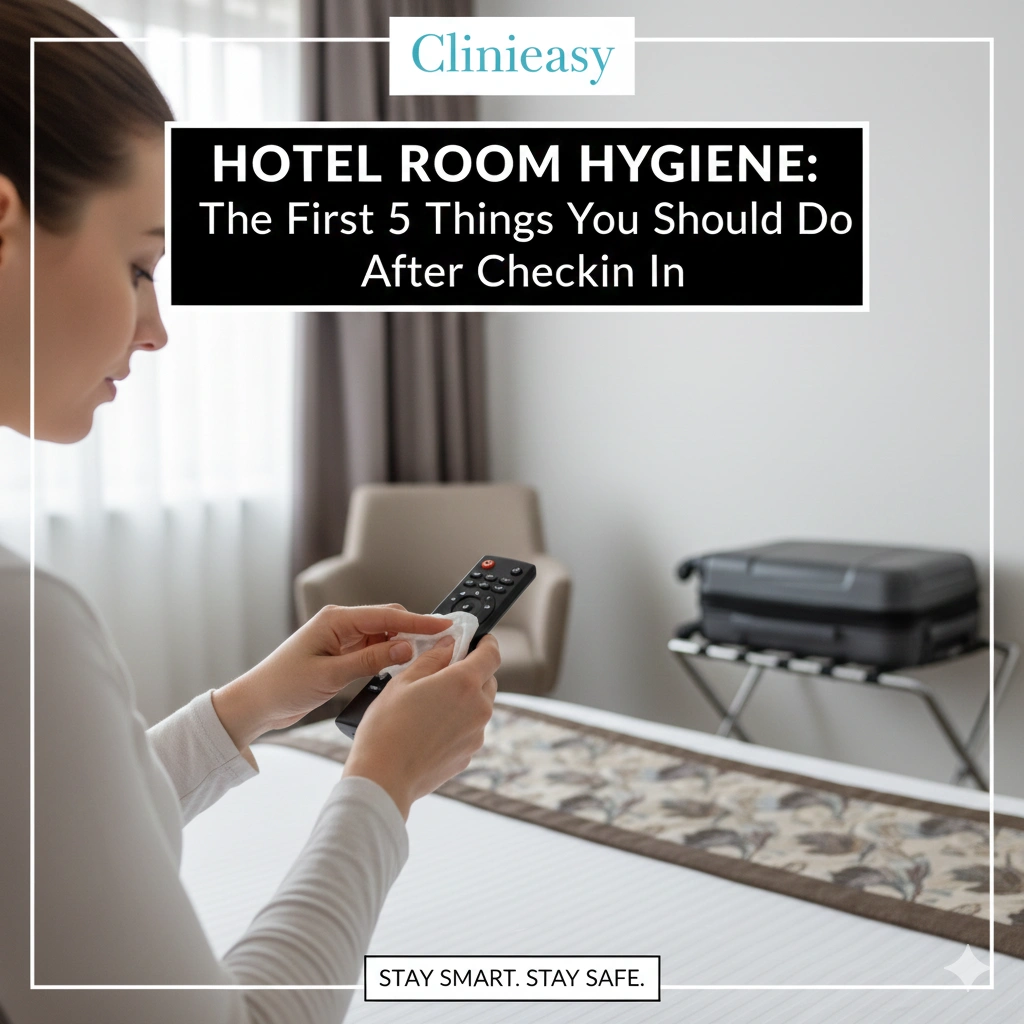
2. Quarantine the Remote Control
In multiple microbiological studies, the TV remote is consistently ranked as the most contaminated item in a hotel room—often harboring levels of bacteria equivalent to a toilet seat.
- The Hazard: It is handled by almost every guest but is rarely disinfected because of its many crevices.
- The Clinical Fix: Use a 70% alcohol wipe (from your Travel Health Kit, Article #31) to scrub it. Alternatively, place the remote inside a clear plastic zip-top bag. You can still use the buttons through the plastic, but you’ve created a permanent barrier between the germs and your skin.
3. The “Triple-S” Wipe Down (Switches, Sinks, and Shifters)
Focus your sanitizing efforts on the “hand-to-face” conduits.
- The Hazard: Light switches and doorknobs are the first things touched by a guest before they wash their hands.
- The Clinical Fix: Use a disinfectant wipe on:
- Switches: The bedside lamp and the main entrance switch.
- Sinks: The faucet handles and the vanity counter.
- Shifters: The toilet flusher and the door handles.
- The 3-Minute Rule: Ensure the surface stays wet with the disinfectant for at least 3 minutes to achieve a full “kill” of pathogens like Norovirus.
4. Ditch the Decorative Elements
That beautiful heavy bedspread and the colorful “throw pillows” are the weak links in hotel laundry.
- The Hazard: While sheets and towels are laundered after every guest, heavy bedspreads and decorative pillows may only be washed once every few weeks or months.
- The Clinical Fix: Immediately remove the top bedspread and decorative pillows. Place them in the closet or on a chair you don’t intend to use. Stick to the white sheets and duvets, which are typically bleached and laundered at high temperatures ($60^\circ\text{C}$ / $140^\circ\text{F}$).
5. Flush the “Stagnant” Water
If the room has been vacant for a few days, the water in the pipes can be stagnant.
- The Hazard: Biofilms can develop in faucet aerators and showerheads (refer to Article #22).
- The Clinical Fix: Run the hot water in the sink and shower for 2 minutes before using them. This flushes out stagnant water and any accumulated debris in the pipes.
- The Glassware Hack: Never use the “unwrapped” glasses on the counter. Even if they look clean, they may have only been rinsed with water. Wash them with hot water and soap (or your travel body wash) before the first use.
The Clinieasy “Safe Stay” Checklist
- Bags on the rack, not the bed.
- Remote in a bag or wiped down.
- Wipe switches, handles, and faucets.
- Remove decorative bedding.
- Wash provided glassware before use.
Conclusion: Control Your Environment
You don’t need to spend your whole vacation cleaning, but these five clinical steps take less time than ordering room service. By identifying and neutralizing the “invisible” reservoirs in your room, you protect your health and ensure that the only things you bring home from your trip are good memories.
Stay safe, stay smart, and keep it Clinieasy.
Disclaimer: These tips are for general hygiene. If you find visible mold, pests, or evidence of significant uncleanness, request a different room or change hotels.
Why this fits Article #32 (AdSense Strategy):
- Relatability: Everyone who stays in a hotel has wondered about the remote or the bedspread.
- High-Value Ads: Attracts travel-specific advertisers like Expedia, Marriott, and cleaning brands like Lysol or Clorox.
- Engagement: This is a classic “life hack” article that gets high clicks from social media and search results.