
Introduction For many of us, the car is an extension of the home. We eat in it, work in it, and transport our families in it. Yet, while we might scrub our kitchen counters daily, the interior of our car often goes months without a clinical cleaning.
Research has shown that the average steering wheel is four times dirtier than a public toilet seat. Because the car is a confined, unventilated space that experiences extreme temperature shifts, it becomes a greenhouse for bacteria, mold, and volatile organic compounds (VOCs).
At Clinieasy, we believe your “mobile home” deserves a clinical standard. In this guide, we show you how to identify the germ hotspots in your vehicle and how to restore its air quality and surface hygiene.
1. The “Big Three” Touchpoints
When you sanitize your car, you must prioritize the items you touch while driving, especially after being in public spaces like grocery stores or gas stations.
- The Steering Wheel: The top and back of the wheel are the primary reservoirs for skin oils and bacteria.
- The Gear Shifter & Handbrake: These are high-friction areas that trap grime in the textured surfaces.
- The Infotainment Screen & Buttons: These are the most delicate but frequently used surfaces.
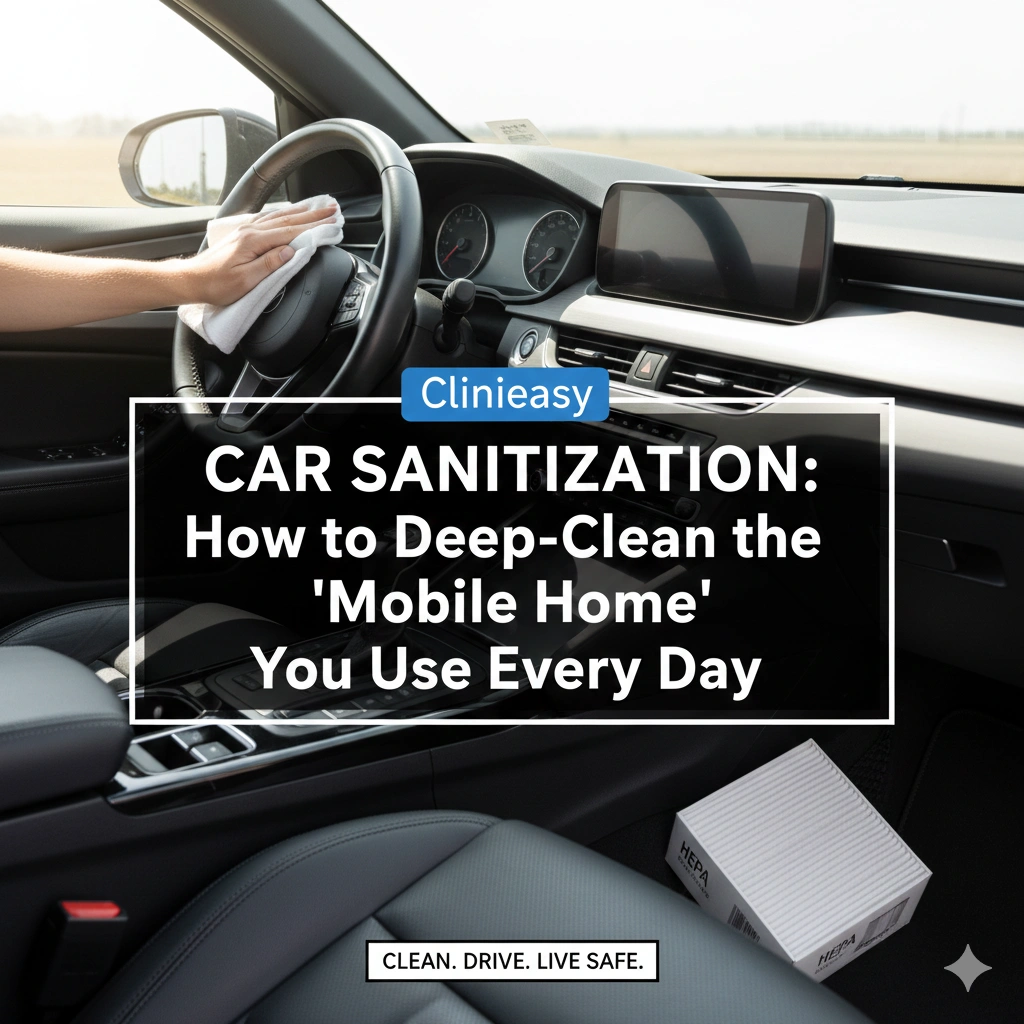
- The Clinical Fix: Use a dedicated automotive interior cleaner or 70% isopropyl alcohol on a microfiber cloth. Warning: Never spray directly onto electronics; spray the cloth first to avoid short-circuiting the “infotainment” system.
2. The Cabin Air Filter: Your Vehicle’s Lungs
Most drivers are unaware that their car has a “lung” that filters the air coming from the road and the engine.
- The Hazard: A clogged cabin filter doesn’t just reduce airflow; it can harbor mold and mildew, blowing spores directly into your face.
- The Clinical Fix: Replace your cabin air filter every 12,000 to 15,000 miles. For a Clinieasy standard, upgrade to a HEPA-rated or Activated Carbon filter, which can trap exhaust fumes and microscopic allergens that standard paper filters miss.
3. The “Food-Free” Protocol
The biggest source of biological growth in a car is food debris.
- The Hazard: Crumbs that fall between the seat and the center console create an environment for mold and can even attract pests.
- The Science: The heat of a parked car in summer acts as an incubator, causing food bacteria to multiply at an exponential rate.
- The Clinical Fix: Establish a “No-Eating” rule or, at the very least, a “Daily Trash Out” rule. Use a crevice tool on your vacuum once a week to reach the “no-man’s land” between the seats.
4. Floor Mats: The Outdoor-Indoor Bridge
Your floor mats are the primary collection point for everything you step on outside—pesticides, animal waste, and street toxins.
- The Fix: Switch from carpet mats to all-weather rubber mats. Unlike carpet, which traps moisture and deep-seated bacteria, rubber mats can be removed and scrubbed with disinfectant and high-pressure water, ensuring a truly clinical clean.
5. The “Gas Pump” Habit
The gas pump handle is one of the most contaminated objects in modern society.
- The Strategy: After fueling your car, your hands are likely covered in pathogens and fuel residue.
- The Habit: Keep a bottle of hand sanitizer in the driver’s side door pocket. Sanitize your hands before you touch the steering wheel or the ignition button to prevent transferring “gas station germs” to your car’s interior.
The Clinieasy “Mobile Hygiene” Checklist
- Wipe the steering wheel and gear shift every Sunday.
- Replace the cabin air filter annually.
- Vacuum the “hidden” crevices between seats.
- Sanitize hands immediately after fueling.
- Wash rubber floor mats monthly with soap and water.
Conclusion: Driving Toward Health
A clean car is more than an aesthetic preference; it is a health priority. When you clear the dust, sanitize the touchpoints, and refresh the air filters, you turn your daily commute from a high-stress “germ-trap” into a clean, safe transition between your destinations.
Keep your eyes on the road and your hands on a clean wheel
Disclaimer: Always test cleaning products on an inconspicuous area of your upholstery first to ensure colorfastness, especially on leather or suede interiors.
Why this fits Article #33 (AdSense Strategy):
- High-Value Ad Targets: Car insurance, car detailing kits, cabin air filters, and portable car vacuums.
- Problem-Solution SEO: Directly addresses the common “dirty car” problem with professional-sounding advice.
- Evergreen Content: Car maintenance is a search topic that never goes out of style.