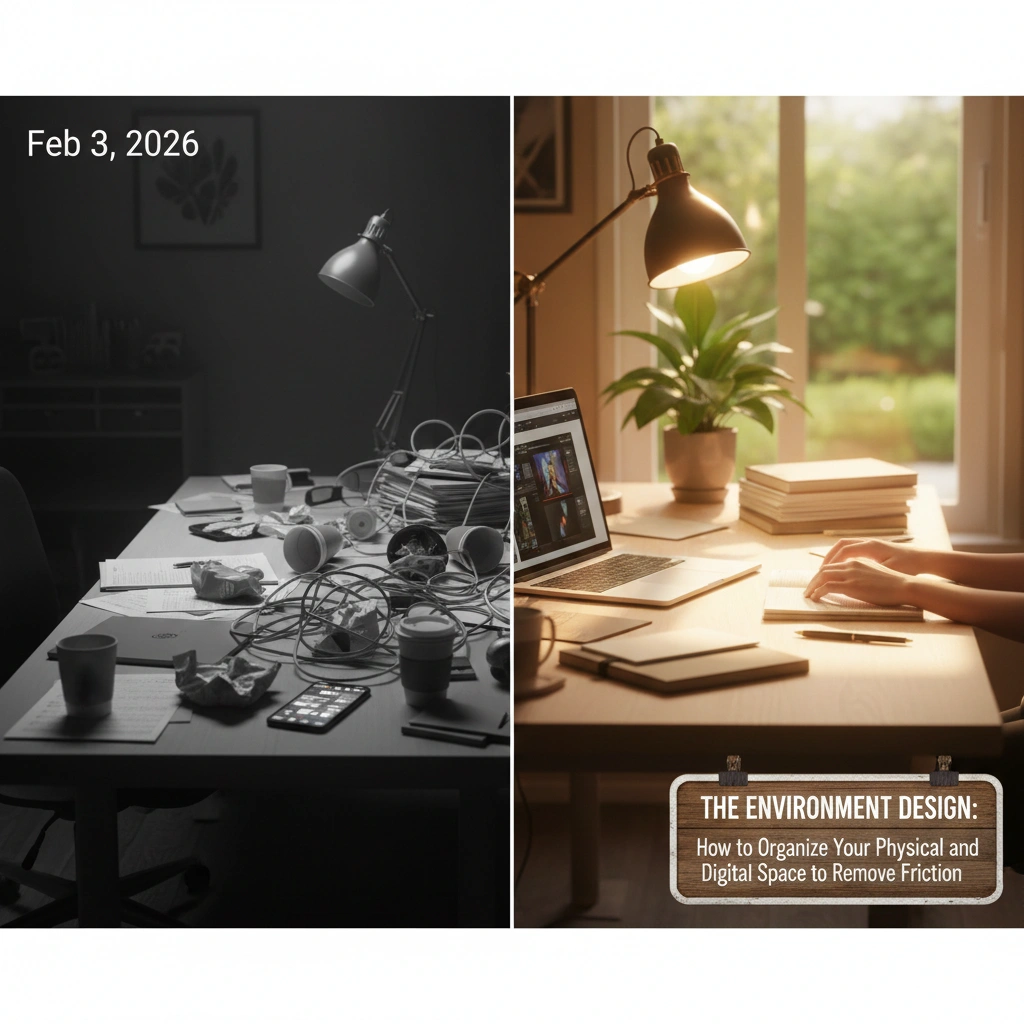

We often rely on willpower to get things done, but willpower is a finite resource that eventually runs out. “The Environment Design” argues that it is far more effective to change your surroundings than to try and change your nature. By intentionally organizing your workspace and your digital devices, you can “nudge” yourself toward productive habits and make distractions nearly impossible to access. Your environment is the silent architect of your behavior—it’s time to take control of the blueprints.
The Path of Least Resistance
The human brain is wired to take the easiest path. If your phone is sitting next to your keyboard, you will eventually check it. If your healthy snacks are hidden in the back of the pantry while the fast food is on the counter, you will choose the fast food. Environment design is about increasing the “friction” for bad habits and decreasing it for good ones. If you want to write, your notebook should be open on your desk before you wake up.
Three Ways to Rebuild Your Environment:
- The “One-Task” Desktop:
- Digitally, clutter is a cognitive drain. Before starting a deep work session, close every tab and app that isn’t essential to the task at hand. Use “Focus” modes to hide distracting apps. A clean screen signals to your brain that it is time for a single, specific mission.
- Visual Cues for Action:
- Place the “tools of your trade” in your direct line of sight. If you are developing a game, have your testing device plugged in and ready. If you are trying to drink more water or healthy shakes, place your juicer on the counter where you can’t miss it. These visual reminders trigger the habit without requiring a conscious decision.
- The “Zoned” Workspace:
- If possible, dedicate specific areas for specific types of work. Have a “Deep Work Zone” where you never check email, and a “Shallow Work Zone” (like a coffee shop or a different chair) for admin tasks. Over time, your brain will automatically switch into the correct mental state just by entering that physical space.
Designing for Success
You don’t need more motivation; you need a better environment. When you stop fighting your surroundings and start designing them to support your goals, productivity stops feeling like a struggle and starts feeling like a natural flow. You are the creator of your world—design it to work for you.
What’s Coming Next…
In our next installment, “The Routine Revolution,” we’ll explore how to stack your habits into a morning and evening rhythm that automates your progress.