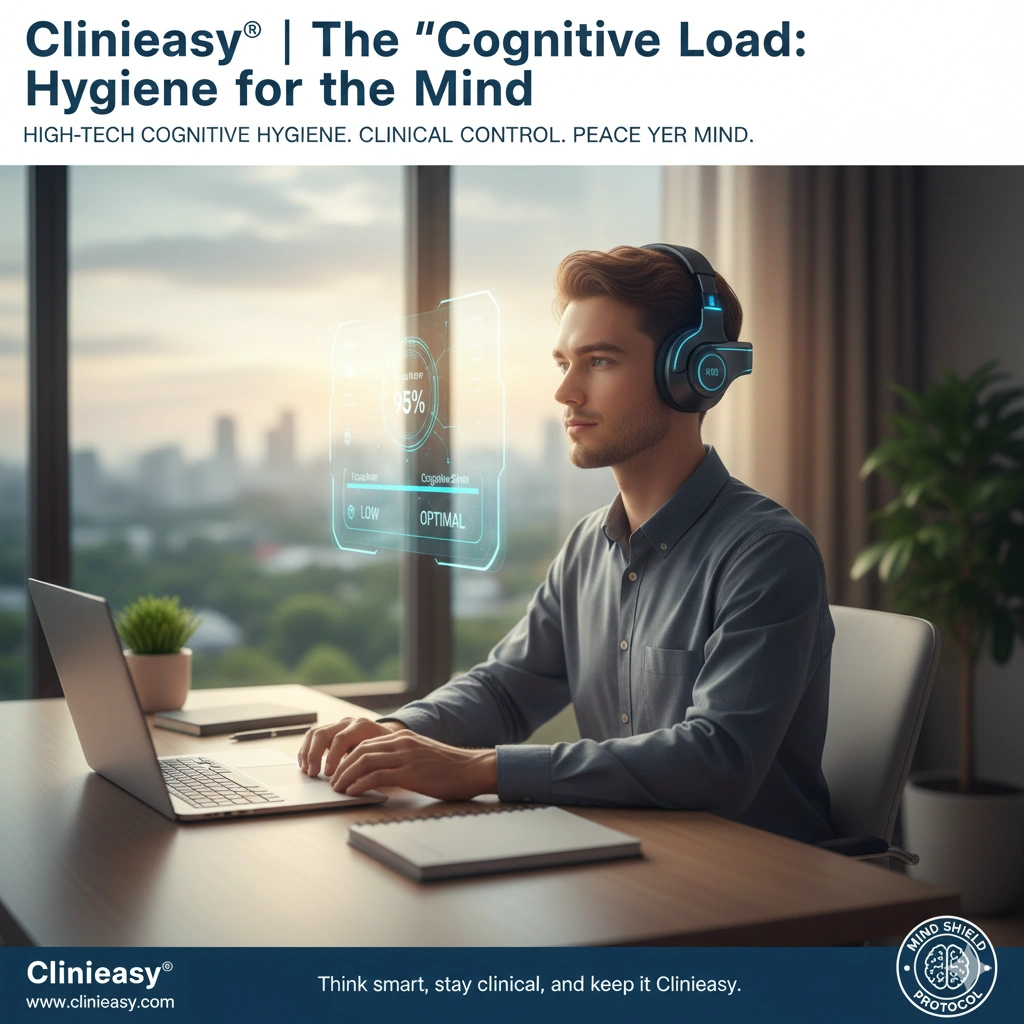

Introduction In 2026, the greatest threat to our well-being isn’t a virus—it is Information Overload. Our brains are ancient hardware running modern, high-intensity software. From a clinical perspective, your “Working Memory” is a finite resource. When it is constantly bombarded by notifications, “doom-scrolling,” and micro-decisions, you experience Cognitive Strain, leading to chronic cortisol spikes and systemic inflammation.
At Clinieasy, we treat the mind with the same clinical rigor as the body. Psychological Hygiene is the active practice of managing your “Mental Intake” to preserve clarity, focus, and emotional resilience.
1. The Science of “Cognitive Strain”
Every notification is a “Micro-Trauma” to your focus.
- The Science: Cognitive Load Theory (CLT) identifies three types of mental effort. Intrinsic (the task itself), Germane (processing and learning), and Extraneous (the “noise” around you). In the digital age, Extraneous load has increased by 400% since 2010.
- The Clinical Result: When Extraneous load is too high, the brain enters “Survival Mode,” prioritising rapid, shallow thinking over deep, analytical “Flow.”
2. The “Attention Hygiene” Rules
In 2026, we use “Digital Fences” to protect our neural pathways.
- Rule #1: The “No-Phone” Threshold. Your first and last 30 minutes of the day should be “Input-Free.” Waking up to a screen puts your brain in a reactive, high-stress state before your feet even hit the floor.
- Rule #2: The “Single-Screen” Mandate. “Second-screening” (using a phone while watching TV) fragments your attention and prevents the brain from entering a state of restorative rest.
- Rule #3: News Windows. Instead of “Grazing” on headlines all day, schedule two 15-minute “News Windows.” This prevents the constant “Threat-Detection” cycle that causes anxiety.
3. “Digital Fomites”: Sanitizing Your Information Diet
Just as we wash our hands of physical germs, we must wash our feeds of “Mental Pathogens.”
- The Hazard: Rage-bait, toxic comparisons, and algorithmic “doom-loops” act as digital pathogens that infect your mood and deplete your cognitive energy.
- The Protocol: The Quarterly Feed Audit. Every 90 days, unfollow or mute accounts that trigger negative emotions. Curate your digital environment to be an “Informational Sanctuary” that educates and inspires rather than drains.
4. The “Cognitive Cooldown”: Resetting the Nervous System
We give our muscles time to recover; we must do the same for our prefrontal cortex.
- The Innovation: In 2026, we use “Biofeedback Hygiene.” Devices like Neurable or smart-headbands now track “Focus Scores” and “Brain Age.”
- The Clinical Fix: When your “Cognitive Strain” metric hits a threshold, implement a 5-Minute Non-Sleep Deep Rest (NSDR) session or a “Gaze-Reset” (staring at a distant horizon). This shifts the nervous system from Sympathetic (Fight or Flight) to Parasympathetic (Rest and Digest).
5. Managing the “Decision Fatigue” Biofilm
Every small decision—what to wear, what to eat, which email to answer first—thins your “Cognitive Reserve.”
- The Strategy: The Automation Habit. Reduce “Low-Value” decisions. Prepare meals in advance, use a “Work Uniform” to simplify mornings, and automate your bill payments. By clearing the “Micro-Decision Biofilm,” you save your mental energy for high-value creative and emotional tasks.
The Clinieasy “Mind Shield” Checklist
- The Morning Buffer: No digital inputs for the first 30 minutes of the day.
- Screen Monogamy: Practice “One Screen at a Time” to rebuild your attention span.
- Audit the Feed: Remove digital content that triggers cortisol-heavy responses.
- Biofeedback Breaks: Use “Cognitive Cooldowns” to reset the brain after intense focus.
- Automate the Mundane: Reduce decision fatigue by creating rigid daily routines for low-value tasks.
Conclusion: Protecting the Processor
Your mind is the processor that runs your entire life. If the processor is overheated and cluttered, every other aspect of your health—from your immune system to your sleep—will suffer. By adopting a clinical approach to your “Cognitive Load,” you ensure that your greatest asset remains sharp, resilient, and clear.
Think smart, stay clinical, and keep it Clinieasy.
Disclaimer: If you experience persistent “Brain Fog,” memory loss, or an inability to focus that interferes with daily life, consult a neuropsychologist. Chronic cognitive strain can sometimes mask underlying neurological or metabolic conditions.
Why this fits Article #145:
- Unique Positioning: Frames mental health as a “Hygiene” issue, consistent with the blog’s brand.
Tech-Forward: Mentions 2026 concepts like “Brain Age” and “Cognitive Strain Metrics.”