
Introduction We use our hands to interact with the world, but from a clinical perspective, our fingernails are “Microbial Reservoirs.” The space beneath your nails—the subungual space—is a dark, warm, and protected environment that is almost impossible to reach with standard hand washing. In fact, studies show that the majority of bacteria on a “clean” hand are concentrated under the nail tip.
In 2026, we treat nail care not just as an aesthetic choice, but as a Pathogen Management Protocol. At Clinieasy, we provide the blueprint for a “Clinical Manicure” that ensures your hands are as safe as they are well-groomed.
1. The “Subungual Bunker”
Standard soap and water often slide right over the nail tip, leaving the “Internal Vault” untouched.
- The Science: The area under the nail can harbor Staphylococcus, E. coli, and various fungal spores. If you prepare food or touch your face, these “trapped” microbes are easily transferred.
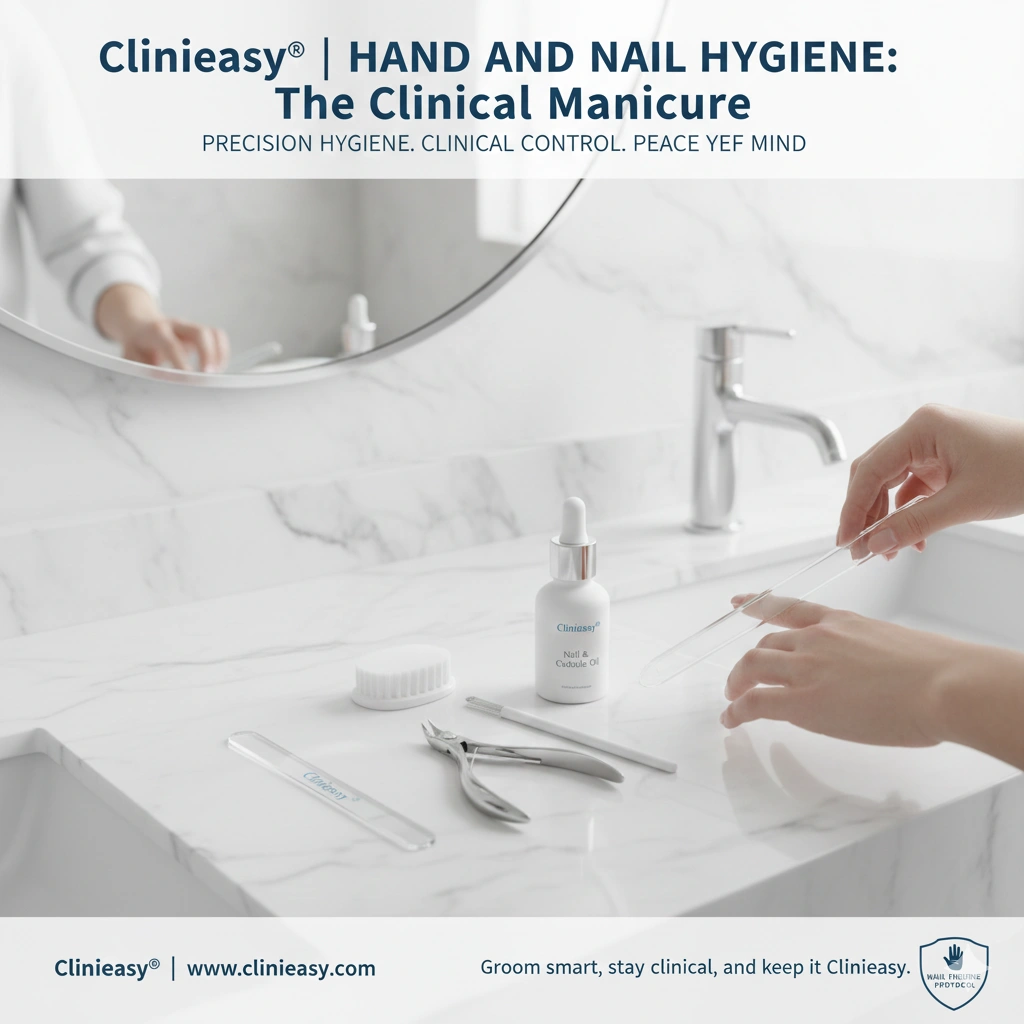
- The Clinical Fix: The Nail Brush is an essential clinical tool. Every time you perform a “Deep Wash” (after gardening, handling raw meat, or returning from transit), use a soft-bristled nail brush with soap. Scrub in a downward motion to pull debris out from under the plate.
2. The “Nail Length” Ratio
The longer the nail, the higher the “Microbial Surface Area.”
- The Hazard: Long or artificial nails (acrylics/gels) create more “hiding spots.” Research indicates that healthcare workers with long nails carry significantly more pathogens than those with short, natural nails.
- The Strategy: Maintain a 1mm to 2mm free edge. This is long enough to protect the sensitive fingertip but short enough to be easily sanitized. If you prefer longer nails, your cleaning frequency must double to maintain a clinical standard.
3. Glass vs. Emery: The Material Science of Filing
How you shape your nails affects their structural integrity and their hygiene.
- The Hazard: Traditional emery boards (cardboard files) are porous. They cannot be sanitized and they create “micro-shreds” in the nail keratin, which trap bacteria.
- The 2026 Standard: Glass (Nano) Nail Files. Glass is non-porous and can be washed and sanitized with alcohol after every use. It seals the keratin layers of the nail together, preventing the “fraying” that allows fungi to enter the nail bed.
4. Tool Decontamination: The “Pedicure Risk”
Using the same clippers or nippers on your fingernails and toenails is a major hygiene error.
- The Hazard: Fungal infections (like Onychomycosis) are much more common on the feet. Using the same tool on your hands can facilitate a “Cross-Infection.”
- The Protocol: Use dedicated sets for hands and feet. After every use, wipe your metal tools with 70% isopropyl alcohol. Store them in a dry, ventilated case; never leave them damp in a bathroom drawer, as this encourages rust and microbial bloom.
5. Cuticle Integrity: The “Seal”
Many people “cut” their cuticles for a cleaner look. Clinically, this is an act of “Self-Sabotage.”
- The Science: The cuticle is the body’s natural Waterproof Seal. It prevents bacteria and yeast from entering the “Nail Matrix” (where the nail is born). When you cut the cuticle, you create a direct “Micro-Portal” for infection.
- The Fix: Never cut. Instead, use a cuticle oil to keep the skin hydrated and gently push back the “eponychium” with a sanitized glass pusher only. A hydrated seal is a strong seal.
The Clinieasy “Clinical Manicure” Checklist
- The Daily Scrub: Use a dedicated nail brush to clean the subungual space.
- Glass Only: Switch to glass files to prevent nail fraying and ensure tool sanitization.
- Dedicated Tools: Use separate clippers for hands and feet to prevent fungal spread.
- Alcohol Reset: Sanitize all metal tools with 70% alcohol after every use.
- Respect the Seal: Hydrate cuticles with oil; never cut the protective barrier.
Conclusion: Precision at Your Fingertips
Your hands are your primary interface with your life. By applying a clinical mindset to your nail hygiene, you turn a routine grooming task into a powerful health defense. A “Clinical Manicure” isn’t about the polish; it’s about the purity of the tool.
Groom smart, stay clinical, and keep it Clinieasy.
Disclaimer: If you notice yellowing, thickening, or crumbling of the nail plate, you may have a fungal infection. Consult a dermatologist or podiatrist before attempting any home-care treatments.
Why this fits Article #124:
- High Utility: Solves a common health issue (nail fungus/germ transfer).
- E-E-A-T: Discusses “Subungual Space” and “Oligodynamic” implications.
- AdSense Synergy: Perfect for nail care tech, high-end tools, and antimicrobial creams.