
In 2026, the “Business Casual” revolution has changed the way we dress, but the clinical reality of our clothing remains the same. Your professional wardrobe is a “Fiber Trap.” From the subway seat to the office chair, your clothes absorb ambient odors, skin oils, and microscopic particulates.
Traditional dry cleaning is often seen as the gold standard, but from a clinical perspective, it involves harsh chemicals (like PERC) that can linger in the fibers. At Clinieasy, we treat your wardrobe as a protective layer that requires a balance of Microbial Control and Fabric Longevity.
1. The “Skin-to-Fiber” Ratio
The items closest to your body are your primary hygiene concern.
- The Science: Undershirts, blouses, and socks absorb the majority of your daily perspiration and “Skin Sloughing.” If these organic materials aren’t removed, they become a food source for bacteria, leading to the “Office Musk” often associated with stale work environments.
- The Clinical Fix: Always wear a base layer (undershirt). This acts as a sacrificial barrier, protecting your expensive blazers and sweaters from direct skin contact. Base layers should be laundered after every single wear at 60°C to denature proteins and kill bacteria.
2. The “Dry Cleaning” Dilemma
Suits and structured jackets cannot be tossed in a standard wash, but they still collect “Environmental Load.”
- The Hazard: Dry cleaning uses chemical solvents rather than water. While effective at removing oils, it doesn’t always provide the “Microbial Flush” that water does.
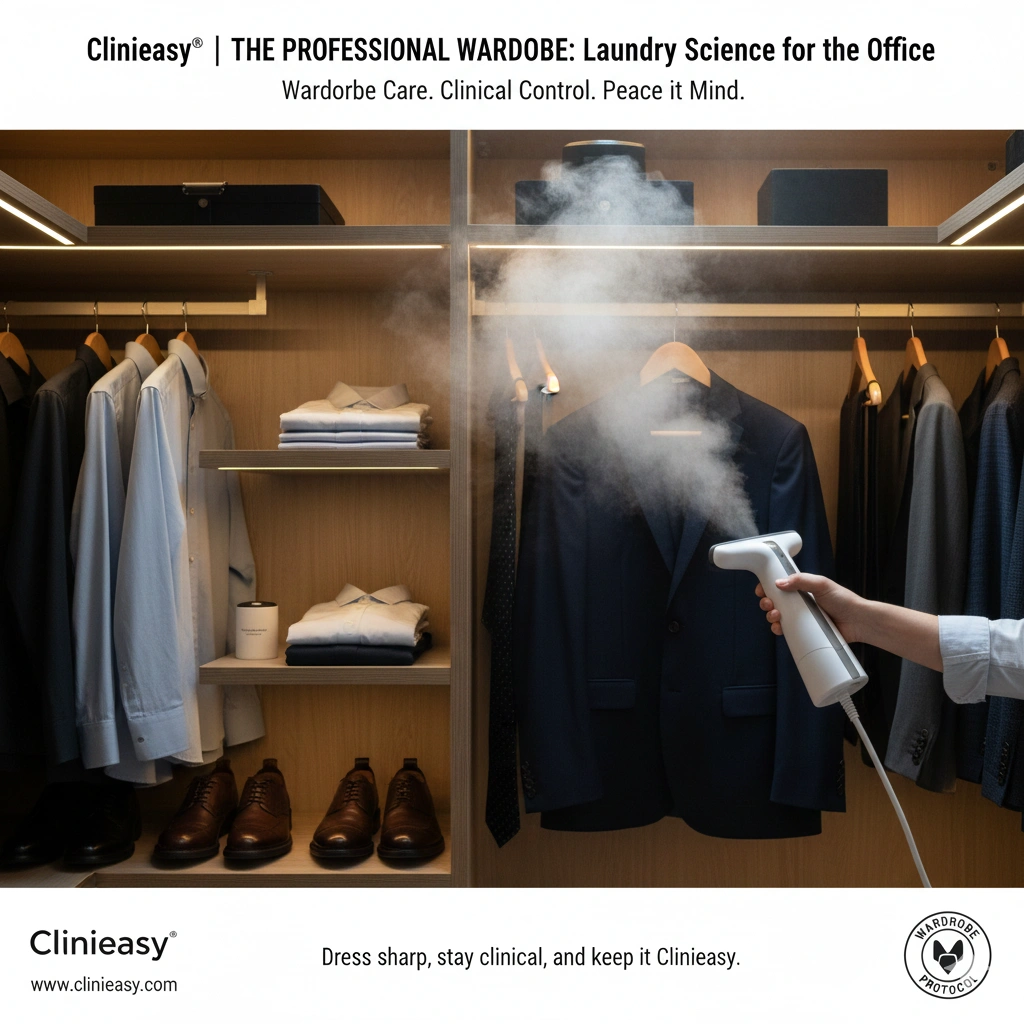
- The 2026 Standard: Use Steaming as a Sanitizer. A high-quality garment steamer reaching $100°C$ ($212°F$) kills 99.9% of surface bacteria and removes odors without the chemical footprint of dry cleaning. Steam your blazer once a week to “reset” the fibers.
3. The “Work Shoe” Quarantine
Your shoes are the most significant bridge between the “Dirty Public” and your professional space.
- The Science: As established in our transit series, shoe soles are reservoirs for street pathogens. However, the interior of a leather dress shoe is also a high-humidity environment prone to fungal growth.
- The Protocol: Use the “48-Hour Rotation.” Never wear the same pair of dress shoes two days in a row. They require at least 24 hours to fully dehydrate. Use Cedar Shoe Trees, which are naturally antimicrobial and moisture-wicking.
4. Accessories: The “Forgotten” Vectors
Ties, scarves, and watch straps are rarely cleaned, yet they are touched hundreds of times a day.
- The Hazard: The “Tie-to-Table” contact (when leaning over a desk) and the “Watch-to-Keyboard” contact create localized hotspots for bacterial transfer.
- The Fix: Switch to Metal or Fluorocarbon (Rubber) watch straps for the office, as they are non-porous and can be wiped with an alcohol swab. For ties and scarves, use a UV-C sanitizing closet or a handheld steam pass once a month.
5. The “Home-Transition” Protocol
In 2026, the “Work-Life Balance” includes a physical boundary.
- The Strategy: The “Outerwear Shed.” Do not wear your “Office Coat” or “Commuter Blazer” into your kitchen or onto your bed.
- The Ritual: Upon returning home, change into “Home Clothes” immediately. This prevents the transfer of office-acquired allergens and microbes into your “Sleep Sanctuary.” Store your work wardrobe in a well-ventilated closet, ideally with a small activated charcoal de-humidifier to prevent mustiness.
The Clinieasy “Wardrobe Shield” Checklist
- Base Layer Barrier: Always wear an undershirt to protect structured garments.
- Weekly Steaming: Use 100°C steam to sanitize suits and blazers between dry cleans.
- Shoe Rotation: Allow 24 hours of “Dehydration Time” between wears.
- Non-Porous Straps: Choose watch bands that can be wiped with disinfectant.
- Immediate Change: Swap work clothes for home clothes the moment you enter your house.
Conclusion: Dressing with Clinical Intent
Your professional image is an asset, and your wardrobe is the vehicle for that image. By applying laundry science to your office wear, you ensure that you don’t just “look” the part, but that your clothing serves as a clean, healthy barrier between you and the world.
Dress sharp, stay clinical, and keep it Clinieasy.
Disclaimer: When steaming delicate fabrics like silk or high-twist wool, keep the steamer nozzle at least 4 inches away to avoid water spotting or fiber damage. Always test a small, inconspicuous area first.
Why this fits Article #120:
- High utility: Offers a practical alternative to expensive dry cleaning (steaming).
- Niche Authority: Discusses the “48-Hour Rotation” and “Fiber Traps.”
- AdSense Synergy: Perfect for fashion, laundry tech, and home organization ads.