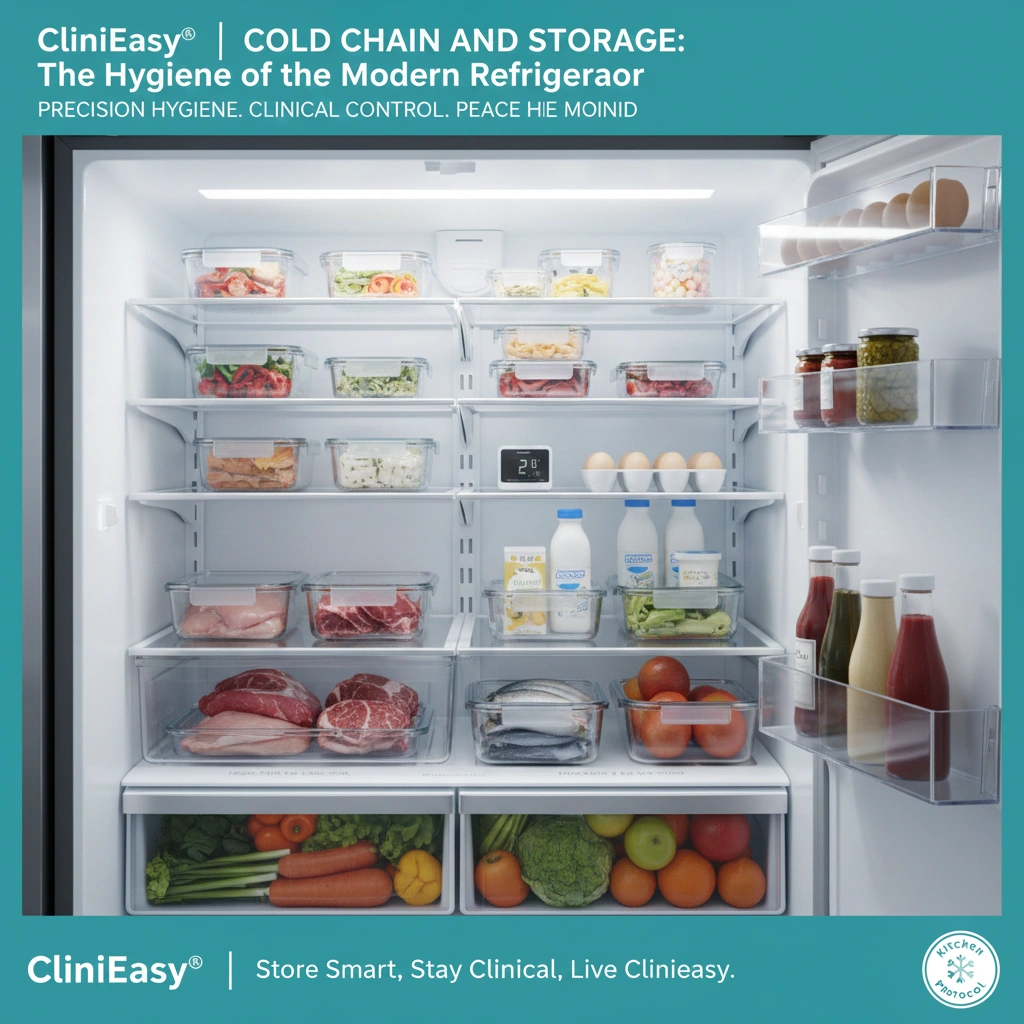

The refrigerator is the most misunderstood appliance in the modern home. Many see it as a “pause button” for bacterial growth, but from a clinical perspective, it is merely a “slow-motion” environment. Certain dangerous pathogens, such as Listeria monocytogenes, actually thrive in the cool, damp conditions of a fridge.
In 2026, with the rise of smart sensors and advanced preservation tech, we have the tools to maintain a perfect “Home Cold Chain.” At Clinieasy, we provide the protocol for transforming your refrigerator from a storage box into a clinical preservation chamber.
1. The “Safety Zone”: $0°C$ to $4°C$
Hygiene starts with the thermostat.
- The Science: The “Danger Zone” for food is between $5°C$ and $60°C$. In this range, bacteria can double every 20 minutes. Most home refrigerators are set too warm by default or fluctuate when the door is opened.
- The Clinical Fix: Set your refrigerator to $2°C$ ($35°F$). This provides a buffer. Use a standalone digital thermometer inside the fridge; do not rely solely on the appliance’s external display, which often measures the cooling element rather than the ambient air.
2. Vertical Stratification: The Gravity of Hygiene
How you stack your food is a matter of clinical safety, not just organization.
- The Hazard: “Drip Contamination.” If raw meat is on a top shelf and leaks, it creates a “Pathogen Waterfall” over everything below it.
- The Protocol:Store from “High Risk” to “Low Risk” (Top to Bottom):
- Top Shelves: Ready-to-eat foods, leftovers, and drinks.
- Middle Shelves: Dairy and eggs.
- Bottom Shelf: Raw meats and seafood (always kept in a secondary container or tray to catch leaks).
- Crisper Drawers: Vegetables and fruits (kept separate to prevent ethylene gas from rotting your greens).
3. The “Door” Myth
The door is the most thermally unstable part of the refrigerator.
- The Science: Every time the door opens, the temperature in the door bins spikes.
- The Strategy: Never store milk or eggs in the door. These items require a stable temperature to prevent protein degradation and microbial bloom. Reserve the door for “high-stability” items like condiments, vinegars, and sodas.
4. Airflow and “Overcrowding”
A crowded fridge is a dangerous fridge.
- The Hazard: Refrigerators cool by circulating air. When you overfill the shelves, you create “Cold Spots” and “Warm Pockets.” If air can’t circulate, the compressor works harder, but the center of your leftovers may remain in the “Danger Zone.”
- The Fix: Maintain a 20% air gap around all items. Use clear glass containers—not only are they easier to clean and non-porous, but they also allow you to see spoilage before you open the lid and release fungal spores into the air.
5. The “Quarterly Decon”
Spills in a fridge are more than an eyesore; they are a biological hazard. Dried milk or meat juices can harbor bacteria for months.
- The Protocol: Every three months, perform a “Total Empty.” Wipe the interior with a solution of warm water and white vinegar or a food-safe HOCl spray. Avoid heavy bleach, as the fumes can be absorbed by porous foods like butter or open containers. Don’t forget to vacuum the refrigerator coils (usually located at the bottom or back); dusty coils lead to temperature fluctuations and food spoilage.
The Clinieasy “Fridge Shield” Checklist
- Hard Target: Maintain exactly $2°C$ ($35°F$) for optimal safety.
- Bottom-Meat Policy: Raw proteins must always live on the lowest shelf.
- Stability First: Move eggs and milk out of the door and into the main body.
- The 20% Rule: Leave gaps between items to ensure proper HEPA air circulation.
- Coil Clean: Vacuum the fridge coils twice a year to ensure cooling efficiency.
Conclusion: Preservation as Prevention
A clean, organized refrigerator is your first line of defense against foodborne illness. By managing the “Cold Chain” with clinical precision, you ensure that the fresh, healthy food you buy stays that way until it reaches your plate.
Store smart, stay clinical, and keep it Clinieasy.
Disclaimer: If your refrigerator loses power for more than 4 hours, the USDA recommends discarding perishable items like meat, poultry, and dairy. When in doubt, throw it out.
Why this fits Article #112:
- High Utility: Provides immediate “life hacks” (like moving milk out of the door).
- Scientific Depth: Explains “Thermal Instability” and “Vertical Stratification.”
- AdSense Synergy: Connects to high-margin appliances and kitchen organization tech.