
Introduction For many, the workday begins and ends in a high-density, high-touch environment: public transit. Whether it is a packed subway car, a cross-city bus, or a commuter train, these spaces are “Microbial Melting Pots.” From a clinical perspective, transit systems are the primary veins of community disease transmission. The combination of recirculated air and “High-Frequency Touch Points” (poles, handles, buttons) makes your commute the most vulnerable part of your day.
In 2025, we view commuting hygiene as “The First and Last Mile” of personal defense. At Clinieasy, we provide a clinical protocol to help you navigate your daily transit without bringing the city’s pathogens home with you.
1. The “Vertical Pole” Strategy
Subway and bus poles are the most contaminated surfaces in any city.
- The Science: A single pole can be touched by thousands of individuals in a single shift, many of whom have not practiced hand hygiene. These surfaces are rarely cleaned during peak hours, allowing for a cumulative build-up of bacteria and viruses.
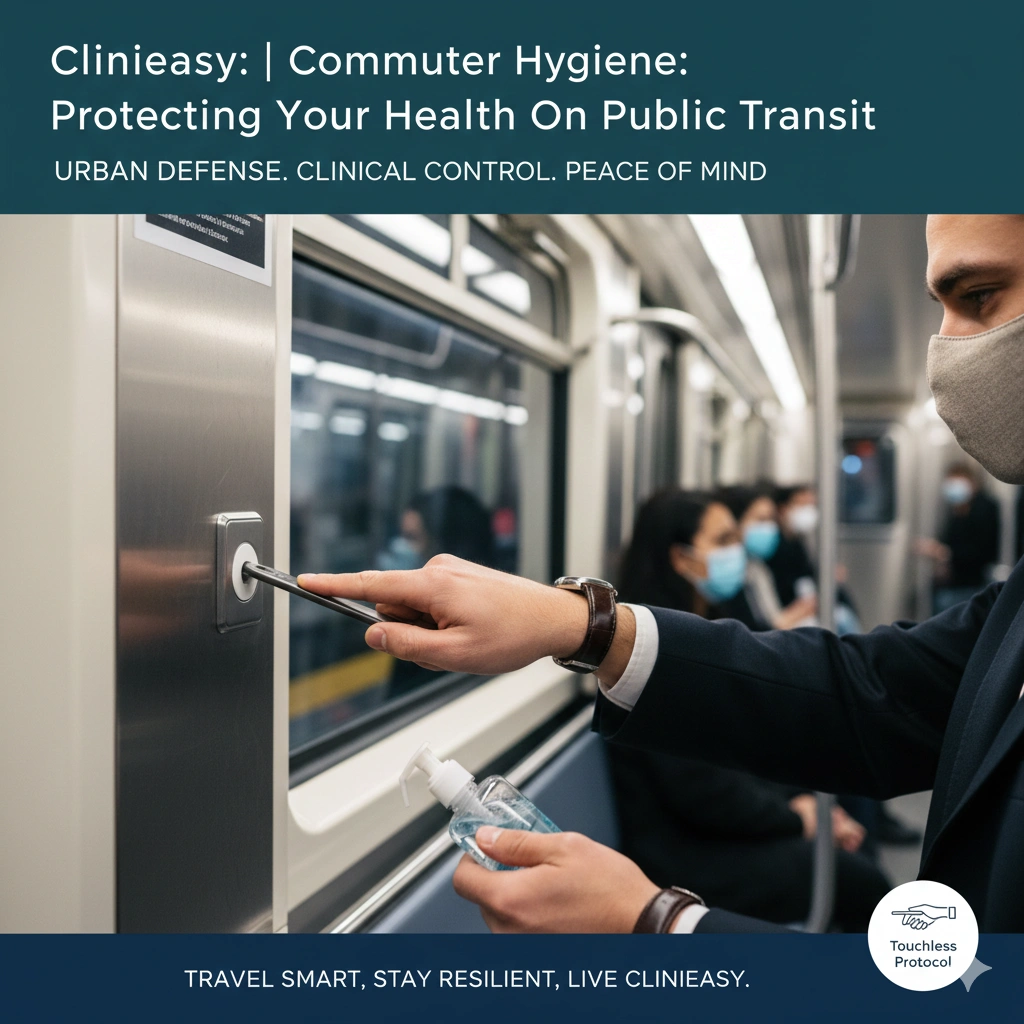
- The Clinical Fix: Use The Hook Technique. If you must hold on, use a “Knuckle Grip” or a hook-shaped touchless tool. Avoid using your full palm, which maximizes skin-to-surface contact. If seats are available, choose those made of non-porous materials (like hard plastic) over fabric, as fabric can harbor “Legacy Pathogens” deep within its fibers.
2. Respiratory “Dead Zones”
Crowded transit cars often suffer from “Stagnant Air Pockets,” especially during delays when the ventilation system may be running at a lower capacity.
- The Hazard: In 2025, aerosol transmission of respiratory illnesses remains a primary concern in confined spaces.
- The Strategy: Position yourself near the ventilation outflows or the doors (which offer a fresh air exchange at every stop). If you are in a high-transmission season (Flu/Cold season), an N95 or KF94 mask remains the “Gold Standard” for filtering out the micro-droplets of your fellow commuters.
3. The “Phone-in-Pocket” Rule
The most common mistake commuters make is using their smartphone while holding onto a transit pole.
- The Hazard: This is the “Bridge of Contamination.” Your hand touches a pole, then touches your screen. Even if you wash your hands at the office, the pathogens are now living on your phone, ready to be transferred to your face later.
- The Protocol: Your phone should remain stowed until you have exited the transit system and sanitized your hands. If you must use it, use one dedicated “clean hand” for the phone and one “dirty hand” for the transit handles—and never swap them.
4. Clothing as a “Primary Filter”
Your outer layers—coats, bags, and scarves—act as a physical filter for the transit environment.
- The Science: Porous fabrics catch dust, skin cells, and aerosolized droplets.
- The Strategy: Designate a “Transit Layer.” Wear a dedicated outer coat or jacket that you remove immediately upon entering your home or office. Never place your commuter bag on your desk or your kitchen counter; treat the bottom of your bag as “Clinically Hot” (highly contaminated) since it has likely sat on the floor of a bus or train.
5. The “Entry/Exit” Sanitization Loop
The timing of your hygiene is as important as the method.
- The Protocol: * Stage 1 (Entry): Do not touch your face or eyes during the commute.
- Stage 2 (Exit): Use a 60% alcohol-based gel the moment you step off the vehicle.
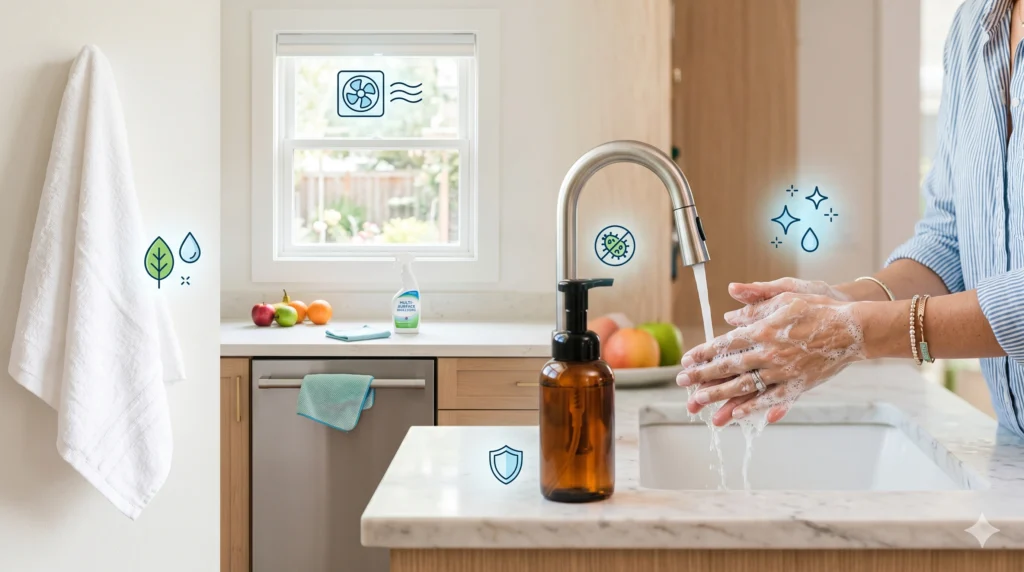
- Stage 3 (Destination): Perform a “Clinical Wash” (soap and water for 20 seconds) as soon as you reach your office or home. Gel is a bridge; soap is the solution.
The Clinieasy “Transit Shield” Checklist
- Limited Contact: Use knuckles or tools instead of palms on poles.
- Air Flow Positioning: Stay near doors or vents for better air exchange.
- Digital Lockdown: Keep your phone in your pocket while on the vehicle.
- Bag Protocol: Never place your commuter bag on “clean” surfaces like desks.
- Immediate Reset: Sanitize hands the second you step onto the platform.
Conclusion: Navigating the Urban Flow
Commuting is an unavoidable part of modern life, but it doesn’t have to be a health risk. By applying a clinical mindset to your daily travel, you create a buffer between yourself and the urban microbiome. You can move through the city with confidence, knowing your “Bio-Shield” is intact.
Travel smart, stay resilient, and keep it Clinieasy.
Disclaimer: If you are feeling unwell, the most “Clinically Responsible” act is to avoid public transit entirely. If you must travel, wear a high-filtration mask to protect your fellow commuters from your own respiratory droplets.
Why this fits Article #94:
- High Daily Relevance: Everyone who commutes has felt “unsanitary” at some point on a train or bus.
- Practical “Why”: Explains the phone-to-pole contamination bridge clearly.
- AdSense Revenue: Connects to durable goods (bags) and consumables (sanitizers).