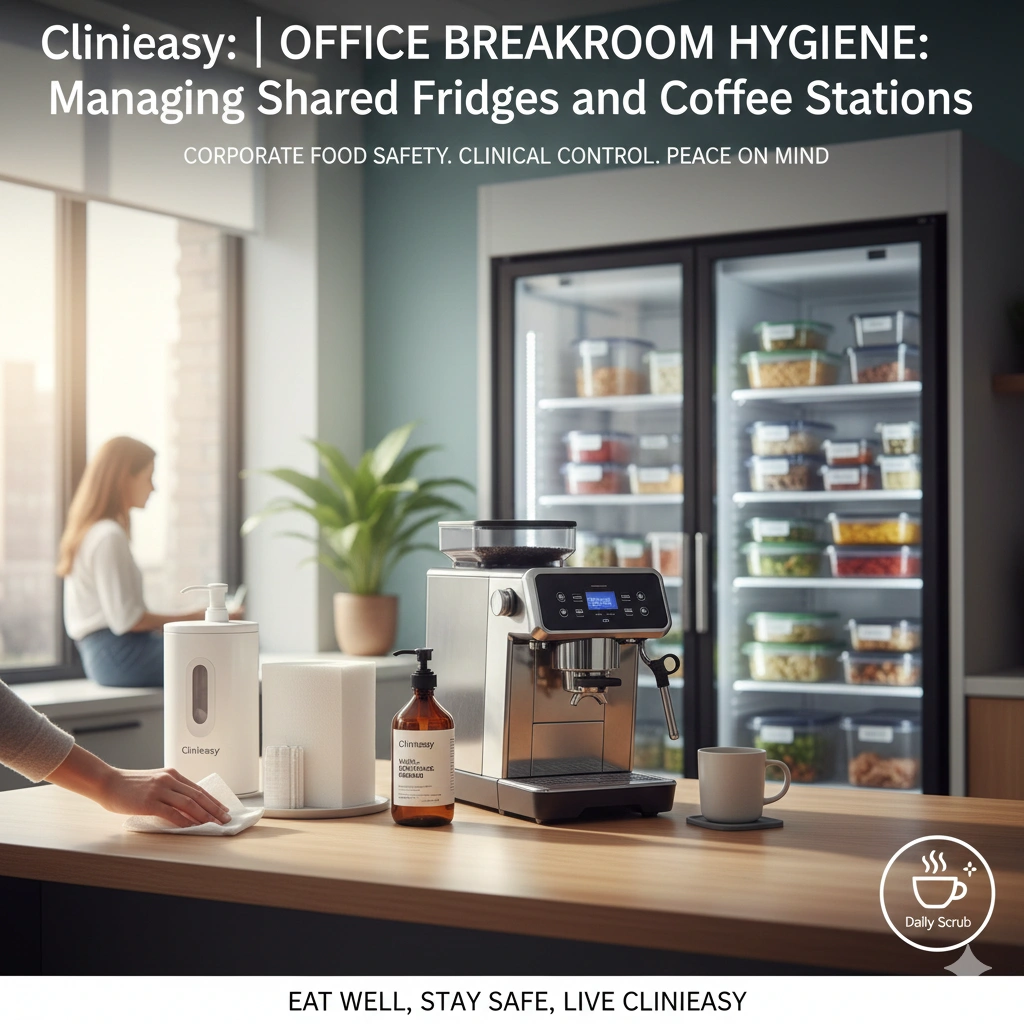

If the shared desk is the workspace’s primary touch-point, the breakroom is its primary “Bio-Hub.” In this small, high-traffic area, food preparation, communal dining, and waste disposal intersect. From a clinical perspective, the office breakroom is a case study in cross-contamination. Between the “Mystery Tupperware” in the back of the fridge and the community sponge by the sink, the risks range from simple spoilage to the spread of Norovirus and Salmonella.
In 2025, office wellness extends beyond ergonomic chairs; it encompasses the “Kitchen Ecology.” At Clinieasy, we provide the clinical guidelines to ensure the breakroom remains a place of restoration, not a source of infection.
1. The Shared Fridge: A “Cold-Chain” Challenge
An office refrigerator is often overcrowded, which restricts airflow and prevents the unit from maintaining a consistent “Safe Zone” temperature of $4^\circ\text{C}$ ($40^\circ\text{F}$) or below.
- The Science: When the fridge is packed, “hot spots” form where bacteria like Listeria can proliferate. Furthermore, leaked liquids from forgotten containers create a “Microbial Soup” on the shelves.
- The Clinical Fix: Implement a “Friday Purge” Policy. Every Friday at 4:00 PM, all unlabeled or expired items are discarded. This prevents the “Bio-Accumulation” of mold and bacteria. Store your own food in airtight, leak-proof glass containers to create a personal barrier against shelf contaminants.
2. The Coffee Station: The “Biofilm” Reservoir
The office coffee machine is arguably the most handled piece of equipment in the building.
- The Hazard: The water reservoir and the “drip tray” are constantly damp. Without daily drying, they develop a Biofilm—a slimy bacterial colony. Additionally, the buttons and handles are rarely sanitized between users.
- The Strategy: The “Paper-Towel Barrier.” Use a clean paper towel to handle the coffee pot or press the buttons. If you use a pod-based machine, ensure the spent pod is removed immediately, as the damp grounds are a magnet for fruit flies and mold.
3. The “Sponge Paradox”
The breakroom sponge is often the dirtiest object in the entire office building.
- The Science: Because they are porous and stay damp, sponges can harbor billions of bacteria, including E. coli. Using a “communal” sponge to wash your mug often adds more bacteria to the cup than it removes.
- The Protocol: Avoid the communal sponge entirely. Use paper towels and soap to wash your items, or bring your mug home daily for a high-heat dishwasher cycle. In a modern 2025 office, companies should transition to silicone scrubbers or disposable compostable cloths that are replaced daily.
4. The Microwave “Splash-Zone”
Microwaves heat food, but they don’t necessarily kill all bacteria on the interior surfaces, especially in “cold spots.”
- The Hazard: Food splatter from previous users can harbor bacteria that “re-activate” when the microwave is turned on.
- The Fix: Never heat food uncovered. Use a vented microwave cover. This protects your food from “Legacy Splatter” and keeps the microwave clean for the next person. Wipe the “Start” button—a high-touch surface—with a sanitizer wipe before use.
5. Communal Snacks and the “Open Bowl”
The “Open Bowl” of chips or nuts is a clinical “No-Go.”
- The Science: Hand-to-bowl-to-mouth transmission is a primary vector for respiratory and gastrointestinal illness.
- The Rule: Only consume communal snacks that are individually wrapped. If the office provides bulk snacks, ensure they are in a gravity-fed dispenser that doesn’t require hand contact with the food.
The Clinieasy “Breakroom Safety” Checklist
- Friday Purge: Clear the fridge weekly to prevent mold accumulation.
- The Sponge Skip: Use paper towels or bring your mug home for cleaning.
- Lid Up: Always cover food in the microwave to prevent cross-contamination.
- Button Barrier: Use a sleeve or towel to touch coffee machine buttons.
- Airtight Storage: Use glass containers for your own food to shield it from fridge spills.
Conclusion: Dining with Clinical Confidence
The breakroom is essential for morale and mental breaks. By applying these simple clinical guardrails, you ensure that your lunch hour supports your health. Hygiene in the kitchen is a shared responsibility, but your personal “Protocol” is your best defense.
Eat well, stay safe, and keep it Clinieasy.
Disclaimer: If you notice a foul odor or visible mold in the office fridge, notify facility management immediately. Fungal spores can be distributed through the fridge’s internal fan system, contaminating all uncovered food.
Why this fits Article #78:
- High Relatability: The “office fridge” is a universal workplace trope.
- Actionable Steps: The “Friday Purge” and “Sponge Skip” are easy for readers to adopt.
- Product Opportunities: Great for promoting glass containers, silicone scrubbers, and office coffee tech.