
Introduction The modern office has undergone a structural revolution. The days of the “personal cubicle” are largely gone, replaced by Hot-Desking—a system where a single workstation might be used by three different employees in a single week. From a clinical perspective, this creates a high-velocity “Microbial Relay.”
Studies have shown that a standard office desk can harbor 400 times more bacteria than a toilet seat, primarily because desks are rarely sanitized with the same frequency or rigor. In a shared environment, you aren’t just touching your own keyboard; you are interacting with the “biological legacy” of everyone who sat there before you. At Clinieasy, we provide the clinical framework for navigating the flexible workspace with total confidence.
1. The “First 60 Seconds” Protocol
When you arrive at a shared desk, your first minute determines your health for the rest of the day.
- The Science: Bacteria like Staphylococcus and viruses like Rhinovirus can persist on hard surfaces (laminate desks, plastic mice) for several days.
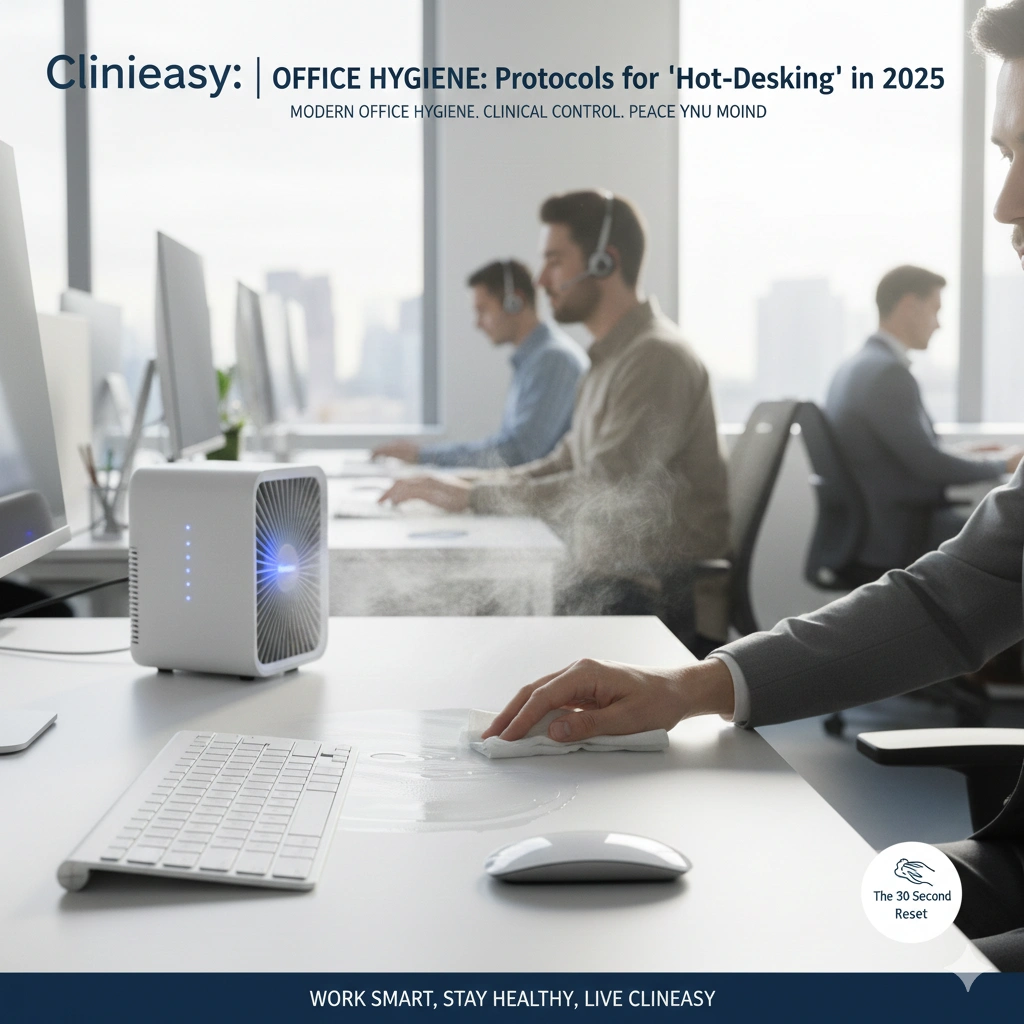
- The Clinical Fix: Perform a “Surface Reset.” Use a broad-spectrum disinfectant wipe to clean the “High-Touch Triangle”: the desk surface where your forearms rest, the mouse, and the keyboard. Do not forget the underside of the desk edge where people often grip to pull themselves forward.
2. The Keyboard: A Deep-Tissue Biohazard
The keyboard is the most complex surface in the office. The gaps between keys act as “micro-canyons” that trap skin cells, food particles, and dust.
- The Hazard: If you eat at a shared desk, you are providing a nutrient source for the bacteria living beneath the keys.
- The Strategy: Use Compressed Air followed by an alcohol-based wipe. Better yet, in 2025, many “Hot-Deskers” are carrying their own Ultra-Slim Portable Keyboard and Mouse. This is the ultimate clinical barrier, ensuring that the primary surfaces you touch for 8 hours a day are yours alone.
3. The “Mug-to-Desk” Contamination
Office kitchens are often the source of cross-contamination that ends up at the desk.
- The Science: Sponges in office breakrooms are notorious for harboring Coliform bacteria. If you wash your mug with a communal sponge and place it on a shared desk, you are completing a circuit of contamination.
- The Fix: Use a dishwasher on a high-heat “Sanitize” cycle if available. At your desk, use a silicone coaster. This acts as a “Clean Island” for your drink, preventing the bottom of your mug from touching a potentially contaminated shared surface.
4. Personal Air Space in Open Offices
In a hot-desking hub, you are often seated less than six feet from colleagues, with no physical barriers to intercept respiratory droplets.
- The 2025 Solution: Portable HEPA “Desktop” Purifiers. These small, USB-powered devices create a “Laminar Flow” of filtered air around your immediate breathing zone. While they don’t clean the whole room, they significantly reduce the concentration of particulates in your “Micro-Environment.”
5. The Phone/Tech Sanitization
We often clean the desk but forget the “Shared Tech,” like the office phone or the adjustment levers on the ergonomic chair.
- The Protocol: Treat the Chair Adjustment Levers as a high-touch point. These are handled by everyone but cleaned by no one. Give them a quick swipe during your “First 60 Seconds” reset.
The Clinieasy “Shared Space” Checklist
- The Surface Reset: Wipe the desk, mouse, and keyboard immediately upon arrival.
- BYO-Peripherals: Use your own portable mouse and keyboard if possible.
- The Coaster Barrier: Never place your drink directly on a shared desk surface.
- Desktop Air Flow: Use a personal HEPA filter in high-density hubs.
- No-Food Zone: Avoid eating at the desk to prevent fueling “Keyboard Biofilms.”
Conclusion: Professionalism Through Hygiene
Hot-desking is a tool for collaboration, but it shouldn’t be a vector for illness. By taking control of your immediate square meter of workspace, you maintain your health and your productivity. A clean desk isn’t just an organized one—it’s a clinically sound one.
Work smart, stay healthy, and keep it Clinieasy.
Disclaimer: If your office uses “UV-C Sanitization Boxes” for tech, ensure they are used according to manufacturer safety guidelines to avoid direct skin or eye exposure to UV-C light.
Why this fits Article #77:
- High Trend Potential: Hot-desking is a major 2025 corporate theme.
- Product-Heavy: Directly encourages the use of portable tech, wipes, and air purifiers.
- Clinical Authority: Uses the “High-Touch Triangle” and “Laminar Flow” concepts to elevate the advice.