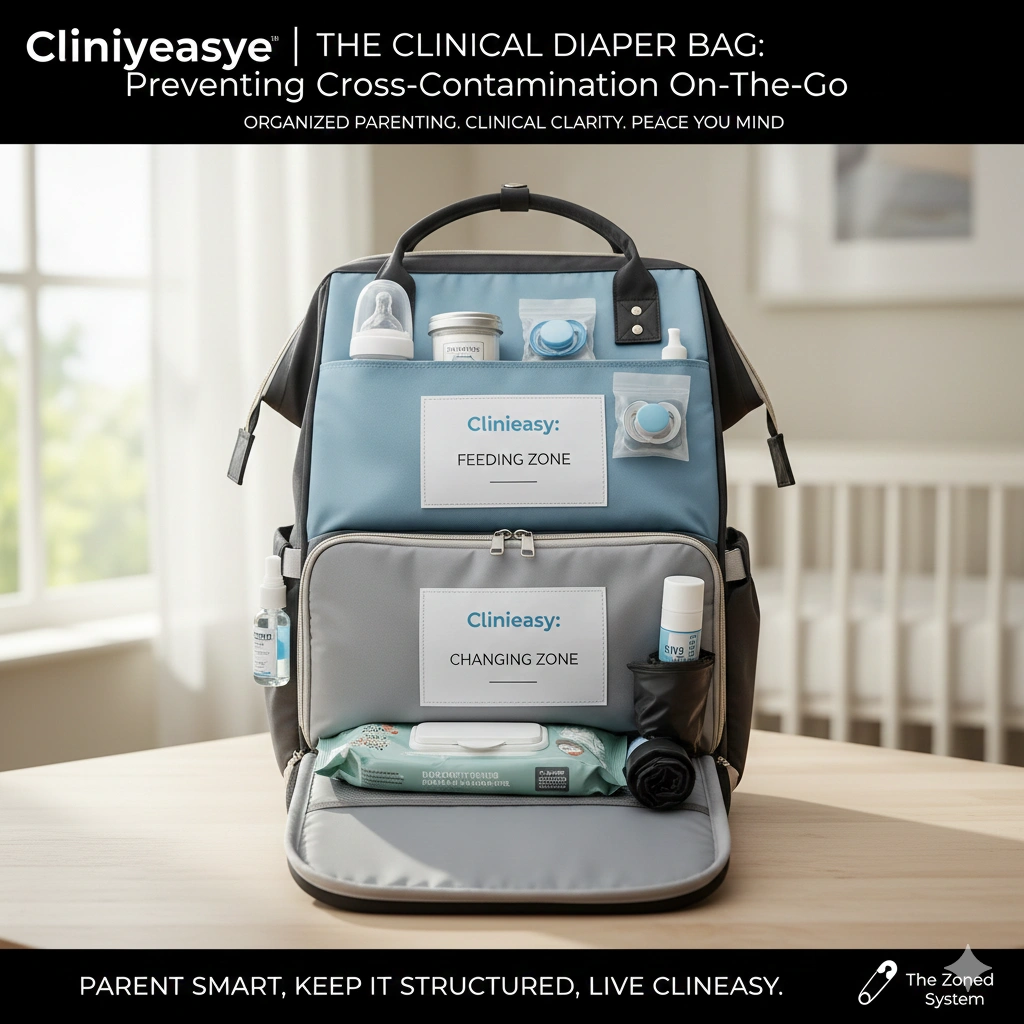

For a parent, the diaper bag is a mobile command center. It holds everything from life-sustaining nutrition to the tools for managing biological waste. However, from a clinical perspective, the diaper bag is a high-risk “mixing zone.” When clean pacifiers and bottles occupy the same dark, fabric compartments as used wipes or soiled clothing, the risk of cross-contamination is significant.
In 2025, with a heightened focus on pediatric health and the rise of antibiotic-resistant bacteria, “Diaper Bag Management” is more than just an organizational task—it’s a protocol for keeping your child’s environment sterile. At Clinieasy, we apply clinical storage principles to your daily parenting gear.
1. The “Zoned” Storage Strategy
The primary flaw in most diaper bags is the “dump and go” method. To prevent the migration of enteric (intestinal) bacteria, you must establish a “Clean Zone” and a “Dirty Zone.”
- The Clean Zone: Reserved exclusively for bottles, formula, pacifiers, and clean clothes. These should ideally be stored in the exterior or upper pockets.
- The Dirty Zone: Usually the main, deep compartment. This is where the changing mat and diaper supplies live.
- The Clinical Fix: Use color-coded dry bags or clear packing cubes inside your diaper bag. Store “feeding” items in one color and “changing” items in another. This creates a physical barrier that prevents accidental contact between a bottle and a used diaper mat.
2. The Portable Changing Mat: The “Contact Surface”
Public changing tables—whether in a mall or an airplane—are among the most microbially diverse surfaces in the world.
- The Hazard: You lay your clean mat on a contaminated table, change the baby, and then fold the mat back up. The “dirty” side of the mat (which touched the public table) is now pressed against the “clean” side where your baby lies.
- The Clinical Protocol: Always use a disposable liner on top of your portable mat, or sanitize the “public-facing” side of the mat with a disinfectant wipe before folding it back into your bag.
3. The “Three-Hand” Technique
A common contamination point occurs during the change itself. You touch the baby’s soiled area, then reach into your bag for a fresh diaper or a toy to distract them.
- The Fix: Before you start the change, “stage” your equipment. Lay out the fresh diaper, the open wipes, and the cream. Once the “dirty” phase begins, your hands are considered contaminated. Do not reach back into the main bag until you have used a hand sanitizer or wipe.
4. The Pacifier “Micro-Environment”
Pacifiers are frequently dropped and quickly shoved back into a pocket.
- The Science: The dark, slightly damp interior of a diaper bag pocket is a breeding ground for Candida albicans (thrush) and other oral pathogens.
- The Fix: Never store a pacifier “loose” in a pocket. Use a hard-shell pacifier case that can be boiled or sanitized. If a pacifier hits the floor in public, it is clinically contaminated. Unless you can wash it with soap and hot water, switch to a backup from your “Clean Zone.”
5. Managing the “Blowout” Bag
When a “blowout” occurs, the soiled clothing is a biohazard.
- The Hazard: Stashing soiled clothes in a mesh pocket allows odors and bacteria to aerosolize within the bag.
- The Fix: Carry a roll of scented, biodegradable “wet bags” (similar to pet waste bags). Seal the soiled item immediately. This contains the bacteria and moisture until you can launder the item at $60^\circ\text{C}$ ($140^\circ\text{F}$) at home.
The Clinieasy “Diaper Bag Integrity” Checklist
- Cube It: Use separate packing cubes for “Feeding” vs. “Cleaning.”
- Stage the Change: Open all supplies before you touch the baby.
- The Mat Wipe: Sanitize the bottom of your changing mat before folding.
- Hard-Case Storage: Never leave pacifiers or bottle nipples exposed to the bag’s interior.
- The Weekly Purge: Empty the bag entirely once a week and wipe the interior with a 70% alcohol solution to prevent “bio-accumulation.”
Conclusion: Parenting with Clinical Clarity
A diaper bag shouldn’t be a source of stress. By treating it as a structured clinical environment, you ensure that your child’s most intimate supplies remain untainted. High-level hygiene isn’t about being perfect; it’s about building a system that works even when you’re tired and on the move.
Parent smart, keep it structured, and keep it Clinieasy.
Disclaimer: Hand sanitizers used in the diaper bag should be alcohol-based (60%+) for the parent’s hands, but ensure your baby’s skin is not in direct contact with wet sanitizer, as their skin barrier is thinner and more prone to irritation.
Why this fits Article #66:
- High ROI: Parents are the highest-spending consumer group for hygiene products.
- Practical Advice: The “Packing Cube” and “Stage the Change” tips are highly actionable.
- Visual Potential: Great opportunities for “Organization” style imagery which performs well on Pinterest/Instagram.