
Introduction Flying is a feat of engineering, but for the health-conscious traveler, it’s a marathon of microbial endurance. You are suspended at 35,000 feet in a pressurized tube with up to 300 strangers. While the “stale air” myth is a common fear, the real clinical risks are much closer to home—specifically, the six square feet of your seat and the tray table in front of you.
In 2025, cabin hygiene has become a competitive metric for airlines. With the integration of advanced filtration and antimicrobial surfaces, the cabin is safer than ever, yet it remains a high-density “Bio-Exchange.” At Clinieasy, we break down the fluid dynamics and surface science of flight to help you land as healthy as when you took off.
1. The HEPA Shield: Debunking the “Shared Air” Myth
The most common concern on a plane is breathing the same air as a sick passenger ten rows back.
- The Science: Modern aircraft air is refreshed every 2–3 minutes. It is a 50/50 mix of fresh outside air and recirculated air that has passed through HEPA (High-Efficiency Particulate Air) filters, which remove 99.97% of bacteria and viral carriers.
- The Clinical Reality: The air above you is cleaner than the air in most office buildings. The risk isn’t the ventilation system; it’s the localized “plume” if someone directly next to you coughs or sneezes.
- The Clinieasy Tip: Turn on your overhead air vent and point it directly downward toward your lap. This creates a vertical “curtain” of filtered air that helps push away any lateral particulates from your neighbors.
2. The Tray Table: The “High-Load” Surface
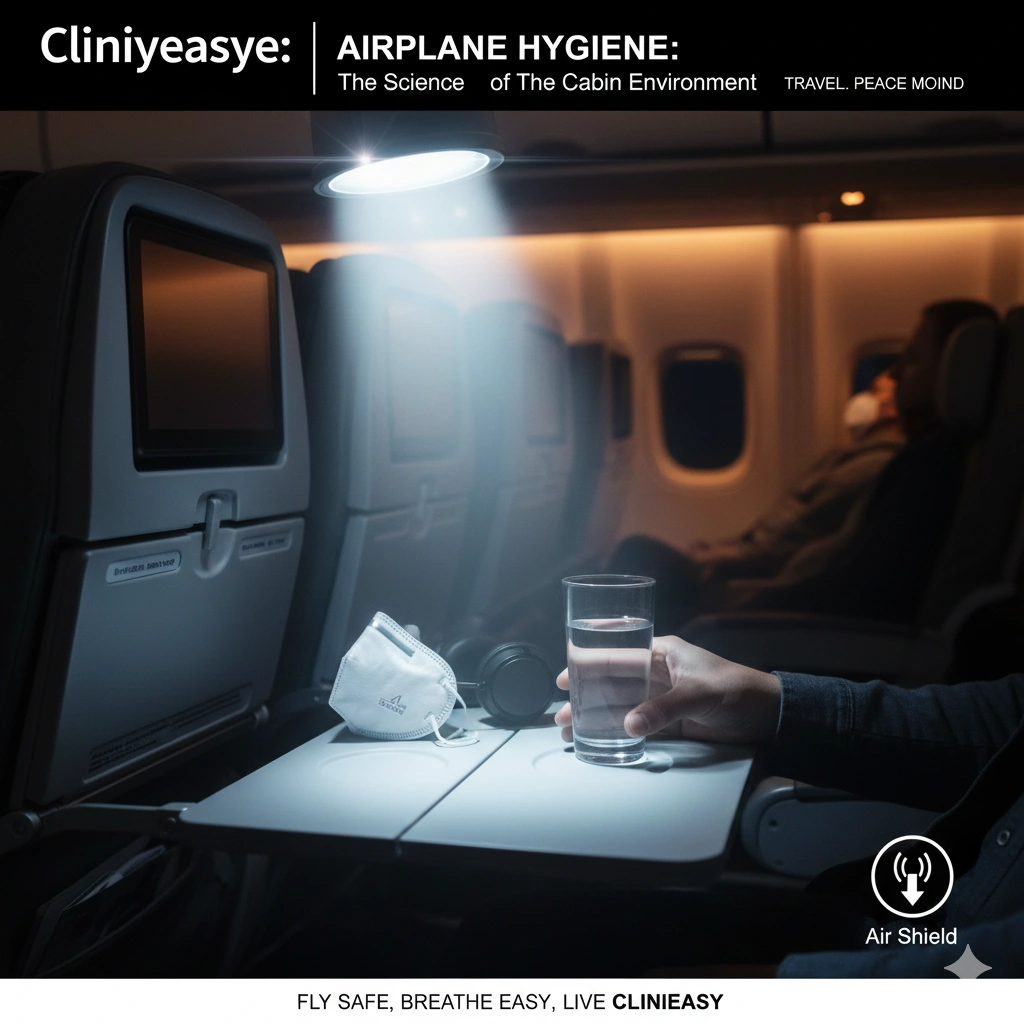
Studies, including those by Travelmath, consistently find that the tray table is the dirtiest surface on an airplane—often harboring more colony-forming units (CFUs) than the overhead air vent or even the bathroom flush button.
- The Hazard: Flight attendants have limited time to clean between legs. Tray tables are used for laptops, changing diapers, and resting heads.
- The Clinical Fix: Never let your food or silverware touch the tray table directly. Sanitize the table with an alcohol wipe as soon as you board. Ensure the table is completely dry before you place your items on it.
3. The Seatback Pocket: The “Biological Waste” Bin
From a hygiene perspective, the seatback pocket is a “No-Go Zone.”
- The Science: Pockets are porous, difficult to clean, and are used by passengers to stash everything from used tissues to half-eaten food and dirty wipes.
- The Rule: Avoid putting your phone, glasses, or e-readers in the seatback pocket. If you must use it, keep your items inside a small, dedicated “In-Flight Bag” that acts as a barrier.
4. Humidity and the “Nasal Defense”
Airplane cabins are notoriously dry, often with humidity levels below 10% (drier than the Sahara Desert).
- The Hazard: When your nasal membranes dry out, they become less effective at trapping and flushing out pathogens. This is why people often get sick after a flight.
- The Fix: Hydration is a clinical necessity. Drink 250ml of water for every hour of flight. Use a simple saline nasal spray every two hours to keep your “Mucosal Shield” active and functional.
5. The Lavatory Logic
The airplane bathroom is a small, high-use space where the “Toilet Plume” (see Article #61) is exacerbated by tight quarters.
- The Strategy: Avoid the bathroom during “Peak Times” (immediately after meal service). Use a paper towel to handle the door lock and the faucet. Most importantly, sanitize your hands after returning to your seat, as you likely touched the overhead bin or seat handles on your way back.
The Clinieasy “Flight Protocol” Checklist
- Vent Positioning: Point the overhead air vent straight down to create an air curtain.
- The Tray Wipe: Sanitize your tray table and armrests immediately upon boarding.
- Nasal Hydration: Use saline spray to keep your primary defense active.
- Avoid the Pocket: Treat the seatback pocket as a contaminated area.
- Window over Aisle: Statistically, window seat passengers have fewer “contacts” with people moving through the aisle, reducing overall exposure.
Conclusion: Navigating the Skies with Integrity
Flying doesn’t have to result in a “post-holiday cold.” By understanding the difference between the high-quality filtered air and the high-density contact surfaces, you can fly with clinical confidence. Your seat is your sanctuary; keep it clean, stay hydrated, and land ready for your destination.
Fly safe, breathe easy, and keep it Clinieasy.
Disclaimer: If you are traveling during peak flu or respiratory virus seasons, wearing a high-quality (N95/FFP2) mask provides an additional physical barrier against localized droplets that the HEPA system hasn’t yet filtered.
Why this fits Article #65:
- High-Intent Keywords: Targets “Flying safely” and “Airplane germs,” which spike during travel seasons.
- Technical Depth: Explains HEPA filtration and mucosal defenses, building high E-E-A-T.
- Shareability: The “Air Vent Curtain” tip is a highly shared travel hack.