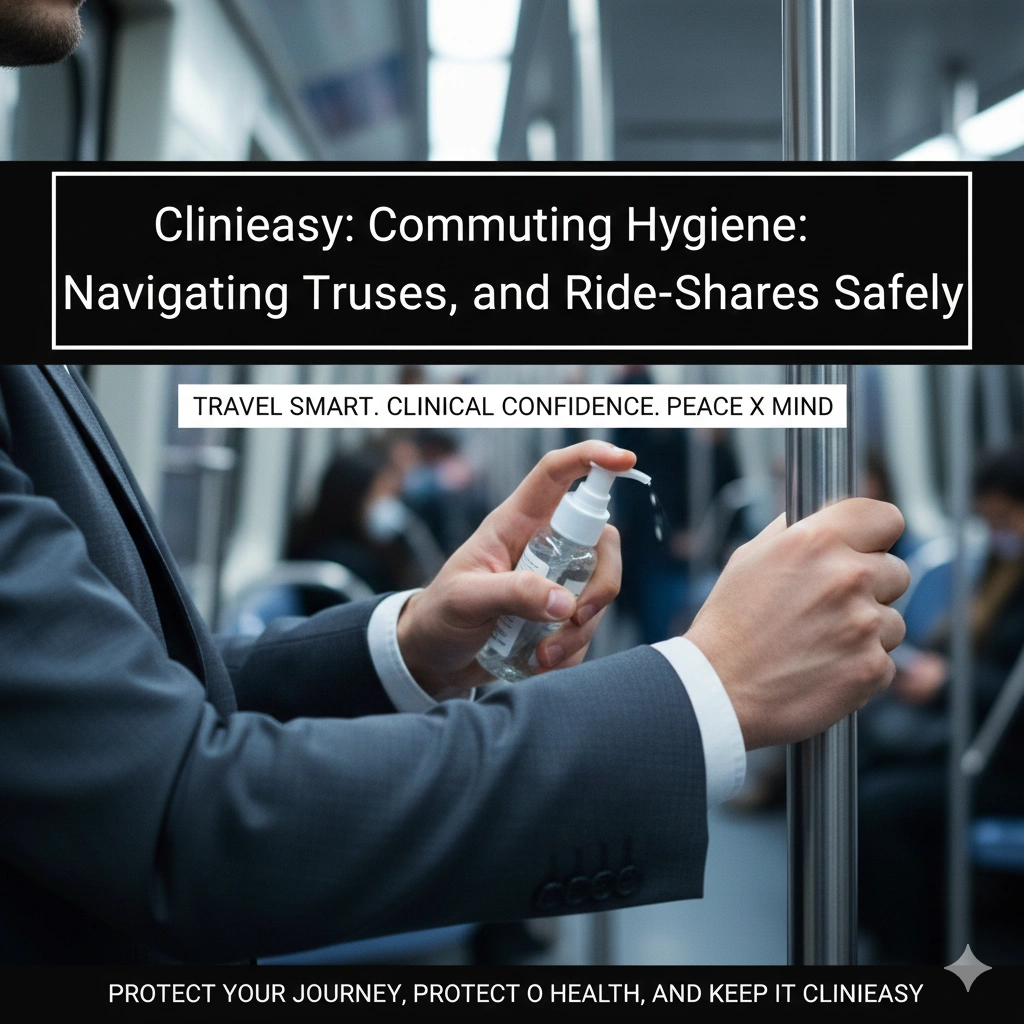

Introduction The daily commute is the primary “biological exchange” of the modern world. Whether you are gripping a subway pole in New York, a handrail on a London bus, or the door handle of an Uber in Tokyo, you are engaging with surfaces touched by thousands of people every hour.
A study conducted by the University of Westminster found that a single handrail on a busy transit line can host a diverse ecosystem of over 10,000 individual bacteria per square inch, including antibiotic-resistant strains. While public transport is essential for a sustainable city, it is also a high-traffic “germ highway” that leads directly into your office and your home.
At Clinieasy, we believe you don’t have to fear the commute—you just have to outsmart it. In this guide, we provide a clinical protocol for maintaining your “Personal Hygiene Barrier” while on the move.
1. The “High-Touch” Transit Map
In any transit vehicle, there is a hierarchy of contamination.
- The Top Offenders: Vertical poles, overhead grab-handles, and stop buttons.
- The Hazard: These surfaces are rarely cleaned during the day, meaning they accumulate a “bio-layer” of sweat, skin oils, and respiratory droplets from hundreds of consecutive passengers.
- The Clinical Fix: Whenever possible, practice the “Hands-Free Stand.” Use your core balance or lean with your shoulder (covered by clothing) rather than gripping a pole. If you must hold on, use your non-dominant hand. Most people instinctively touch their face with their dominant hand; using the other for transit reduces the risk of self-inoculation.
2. The Ride-Share Reality: The 1-on-1 Risk
Ride-shares (Uber/Lyft) may feel cleaner than a bus, but they present a different clinical challenge: enclosed, small-volume air.
- The Hazard: If the previous passenger was sneezing or coughing, the viral particles remain suspended in the stagnant air of the backseat for several minutes.
- The Clinical Fix:
- The “Two-Window” Rule: Ask the driver to crack two windows (diagonally across from each other) just an inch. This creates a high-velocity air exchange that flushes out aerosolized particles within seconds.
- The Handle Wipe: Door handles and seatbelt buckles are the highest-touch points. Carrying a small pack of 70% alcohol wipes allows you to sanitize these “last-mile” touchpoints.
3. The “Commuter’s Transition” (The Gateway Rule)
The most critical moment of your hygiene day is the 60 seconds after you step off the train or bus.
- The Hazard: Your hands are now “hot.” If you enter your office and immediately touch your keyboard, or enter your home and touch your light switches, you have successfully “imported” the transit germs.
- The Clinical Fix: Use a 60%+ alcohol hand sanitizer the moment you exit the vehicle. This “de-activates” the transit bacteria before you reach your next destination. This is your “Personal Firewall.”
4. Clothing as a Filter
Your clothes act as a physical shield between communal seating and your skin.
- The Science: Porous fabrics like wool and denim can trap viral particles, but they are less effective at transferring them than smooth surfaces like skin.
- The Strategy: Avoid wearing shorts or short-sleeved shirts on public transit where your bare skin will touch the seats. When you get home, change out of your “commuter clothes” immediately. Do not sit on your bed or sofa in the clothes you wore on the subway.
5. Digital Commuting: The Smartphone Trap
Many commuters spend their entire journey on their phones.
- The Hazard: You touch the subway pole, then you scroll through your feed. You have just transferred transit bacteria onto a device you will later hold to your face or use while eating lunch.
- The Fix: If you use your phone on transit, it must be sanitized with a 70% isopropyl wipe as soon as you arrive at your destination. See Article #24 for the full smartphone protocol.
The Clinieasy “Commuter Defense” Checklist
- Non-Dominant Grip: Use your “off-hand” for poles and handles.
- The Exit Sanitize: Use hand gel immediately upon stepping onto the platform or sidewalk.
- Window Ventilation: Crack windows in ride-shares for a 10-second “air flush.”
- No-Face Zone: Consciously avoid touching eyes, nose, or mouth until hands are washed.
- Bag Hygiene: Never place your briefcase or backpack on the floor of a bus or train.
Conclusion: Navigating the Urban Ecosystem
The commute is a shared experience, but your hygiene is personal. By implementing these clinical boundaries, you break the chain of transmission between the city and your private life. You can travel with confidence, knowing that your “Personal Firewall” is intact.
Travel smart, stay protected, and keep it Clinieasy.
Disclaimer: Hand sanitizer is an excellent bridge, but it does not replace the efficacy of thorough hand washing with soap and water once you reach a restroom. Always prioritize a 20-second scrub whenever possible.
Why this fits Article #52 (AdSense Strategy):
- High Relevance: This is a daily pain point for millions of urban professionals.
- Ad-Friendly: Triggers ads for Purell, Dettol, commuting gear (anti-theft bags), and health insurance.
- SEO Potential: “How to avoid germs on subway” and “ride-share safety tips” are high-intent search terms during peak flu and cold seasons.