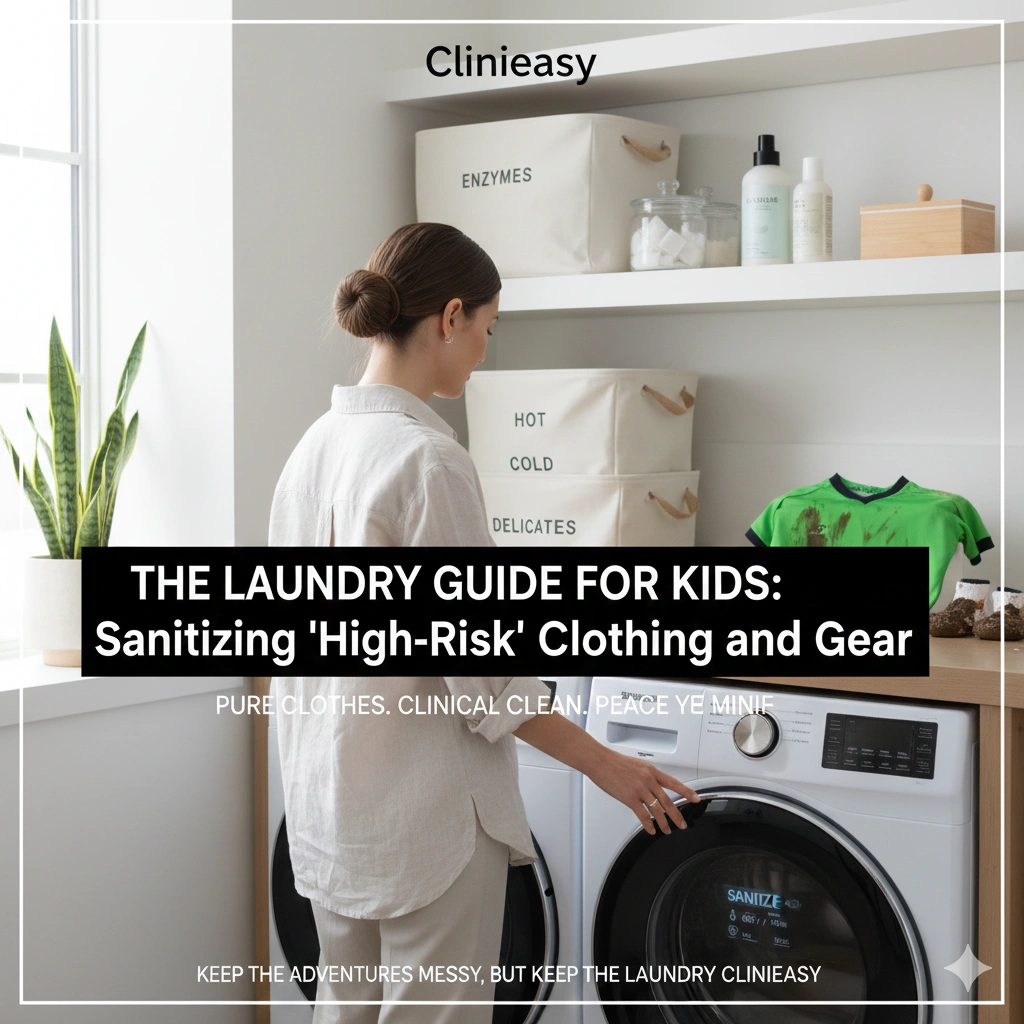

In a household with children, the laundry basket is more than a chore—it is a map of their daily adventures. It contains grass-stained knees, mud-caked socks, and the remnants of school lunches. However, from a clinical standpoint, children’s laundry often carries a higher “pathogen load” than adult clothing.
Between playground soil (which can harbor parasites), daycare viruses, and the inevitable “accidents,” standard quick-wash cycles often fail to reach the level of sanitation required. To keep your family healthy, you must look beyond the stains and address the microscopic reality of the fibers.
At Clinieasy, we believe clean clothes should be clinically safe. In this guide, we reveal the science of sanitizing “high-risk” kids’ gear without damaging the fabrics they love.
1. The Temperature Threshold: $60^\circ\text{C}$ is the Magic Number
Many parents use cold water to prevent shrinking or to be eco-friendly. While cold water is great for delicate colors, it is not a disinfectant.
- The Clinical Reality: Most household bacteria and dust mites are only neutralized at temperatures of $60^\circ\text{C}$ ($140^\circ\text{F}$) or higher.
- The Clinieasy Protocol: Reserve the “Hot Cycle” for high-risk items: underwear, socks, bedding, and towels. For daily play clothes, a warm wash with a high-quality surfactant (detergent) is usually sufficient, provided the items are dried thoroughly.
2. Mud, Grass, and Soil: The Biological Risk
Playing in the dirt is essential for a child’s development, but soil is a complex biological medium.
- The Hazard: Outdoor soil can contain animal waste, fertilizers, and fungal spores. If left in the hamper for too long, these can migrate to other “cleaner” clothes.
- The Clinical Fix: Never mix heavily soiled outdoor gear with “indoor” items like pajamas. Treat mud and grass stains immediately with an enzymatic cleaner. Enzymes are biological catalysts that “eat” the organic proteins in the stain, breaking down the bacteria’s food source.
3. Sanitizing the “Accident” Gear
Whether it’s potty training or a stomach bug, some laundry requires an “Intervention Level” clean.
- The Method: If an item is contaminated with bodily fluids, do not wash it with the regular load.
- Step 1: Pre-rinse in a utility sink or toilet.
- Step 2: Run a “Sanitize” cycle on your machine (which uses extra-high heat).
- Step 3: Use an oxygen-based bleach (Sodium Percarbonate). It provides the disinfecting power of chlorine bleach but is safer for colors and gentler on sensitive young skin.
4. The “Drying” Defense
The dryer is one of your best clinical tools.
- The Science: The sustained high heat of a dryer acts as a secondary sterilization phase. It is particularly effective at killing lingering dust mites and certain viral strains.
- The Clinieasy Tip: Avoid “line drying” high-risk items like underwear or socks outdoors if you live in a high-pollen or high-pollution area, as the wet fibers will trap environmental allergens.
5. Cleaning the Machine (The “Laundry Loop”)
If your washing machine smells “musty,” your kids’ clothes aren’t getting clean—they are just getting “perfumed” bacteria.
- The Hazard: Fabric softeners and low-temp washes create a “scrud” (waxy buildup) in the drum that harbors mold.
- The Fix: Once a month, run an empty “Clean Washer” cycle with specialized descaler or two cups of white vinegar. Always leave the door open between loads to allow the drum to dry—this is the #1 way to prevent mold in front-loading machines.
The Clinieasy “High-Risk” Laundry Checklist
- Separate play clothes from “clean” indoor wear.
- Use Enzymes for organic stains (grass, food, blood).
- Wash at $60^\circ\text{C}$ for towels, bedding, and underwear.
- Dry on High Heat for 30+ minutes for maximum sanitization.
- Clean the Drum monthly to break the “mold loop.”
Conclusion: Freshness with Clinical Integrity
Laundry isn’t just about looking good in school photos; it’s about maintaining the “first line of defense” for your child’s skin. By understanding the relationship between heat, enzymes, and machine maintenance, you turn a daily chore into a clinical health practice.
Keep the adventures messy, but keep the laundry Clinieasy.
Disclaimer: Always check the care label on children’s sleepwear; many are treated with flame retardants that can be compromised by certain detergents or high-heat drying.
Why this fits Article #41 (AdSense Strategy):
- High Search Volume: “How to sanitize baby clothes” and “removing grass stains” are evergreen SEO pillars.
- High-Value Ad Targets: Tide, Persil, Seventh Generation, and appliance giants like Whirlpool or LG.
- E-E-A-T Building: Providing specific temperature data ($60^\circ\text{C}$) and explaining enzyme science builds clinical authority.