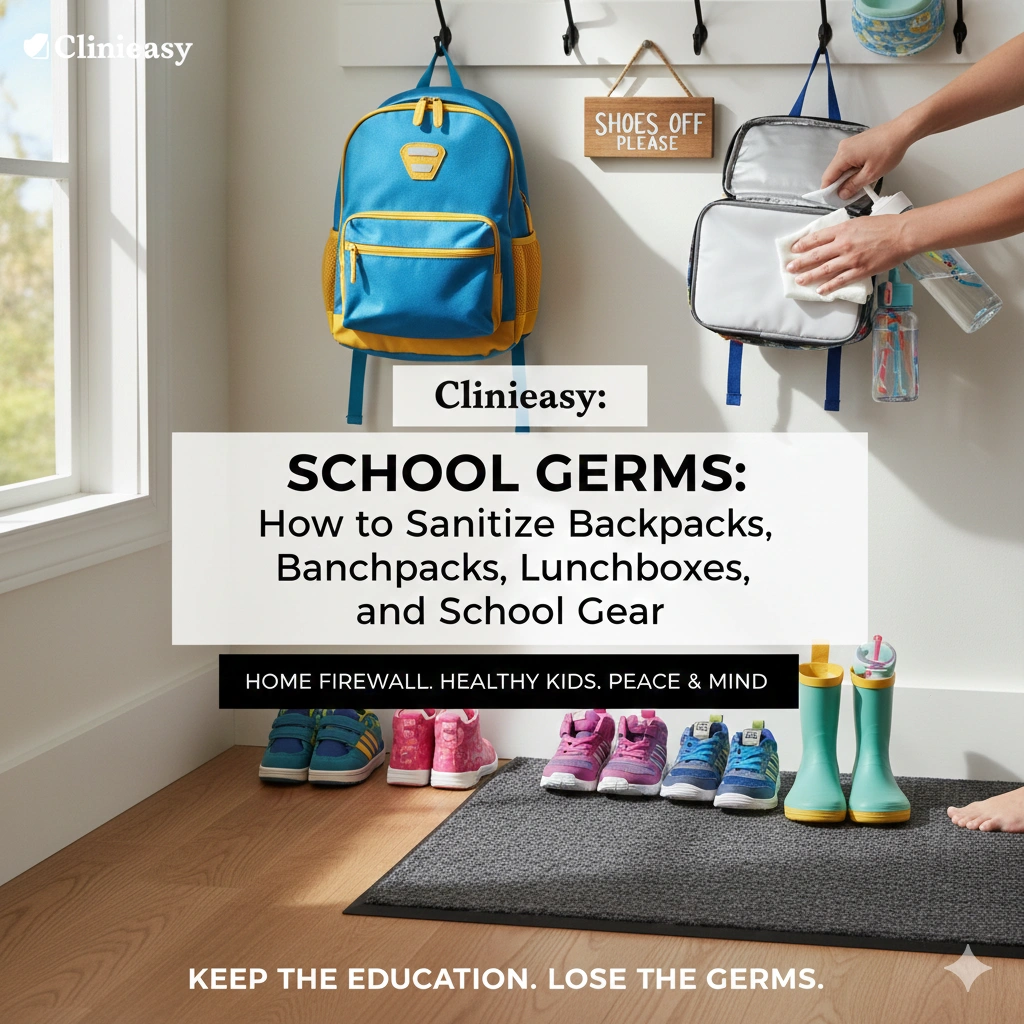

Introduction The school day is a marathon of exposure. From the floor of the school bus to the cafeteria table and the shared playground equipment, your child’s gear acts as a “shuttle” for pathogens. When that backpack is dropped on the kitchen island or the lunchbox is opened on the counter, those outside germs officially enter your home’s “inner circle.”
A study by the American Journal of Infection Control found that backpacks are often more contaminated than cell phones, harboring everything from E. coli to the common cold virus. To stop the cycle of “one kid gets sick, then the whole house gets sick,” you need a clinical “Decontamination Zone” for school gear.
At Clinieasy, we show you how to treat school equipment with the same rigor as professional gear, keeping the learning in and the germs out.
1. The Backpack: The “Floor-to-Home” Conduit
Backpacks spend most of their day on the floor—in classrooms, bathrooms, and buses.
- The Hazard: Fabric is porous. It absorbs bacteria from floors and then transfers it to your sofas and tables.
- The Clinical Fix: * The Weekly Wash: Most canvas and nylon backpacks are machine-washable. Turn them inside out, place them in a mesh laundry bag, and wash on a cold, gentle cycle. Air dry completely—never put them in the dryer, as high heat can damage the waterproof linings.
- The “No-Counter” Rule: Designate a specific hook or cubby near the door for backpacks. Never allow them on surfaces where food is prepared or eaten.
2. The Lunchbox: The Bio-Hazard in the Bag
Warm, dark, and often containing traces of spilled yogurt or fruit juice—an uncleaned lunchbox is a breeding ground for mold.
- The Hazard: Moisture trapped in the corners of insulated linings leads to fungal growth that you can’t always see but can certainly smell.
- The Clinical Fix: * Daily: Wipe the interior with a 70% alcohol wipe or a cloth dipped in white vinegar.
- The Deep Clean: Once a week, flip the lining inside out (if possible) and scrub the seams with a toothbrush and baking soda paste to remove trapped food particles. Leave it open overnight to dry completely.
3. Water Bottles: The “Backwash” Problem
Reusable water bottles are eco-friendly but biologically demanding.
- The Hazard: Bacteria from the mouth travel into the straw and the “bite valve,” forming a biofilm.
- The Clinical Fix: * Daily: These must be washed in hot, soapy water every single day.
- The Detail: Use a “straw brush” to clean the internal straw. If the bottle has a rubber O-ring in the lid, remove it once a week; mold often hides behind the seal where it is protected from standard rinsing.
4. Tech & Calculators: The High-Touch Zones
School tablets, laptops, and calculators are rarely cleaned by schools and are touched by multiple students.
- The Fix: Follow the protocol from Article #34. Use a 70% isopropyl alcohol wipe on the keyboard and screen every Friday evening. This ensures the “tech” is reset for the following week.
5. Shoes: The “Outdoor-Indoor” Barrier
While not technically “gear,” school shoes are the primary way pathogens enter the home.
- The Strategy: Implement a strict “Shoes Off” policy at the door.
- The Clinical Reasoning: Up to 90% of the bacteria on the bottom of shoes is transferred to tile or carpet upon the first few steps. By leaving shoes at the door, you reduce the floor’s bacterial load by nearly 85% instantly.
The Clinieasy “Friday Reset” Checklist
- Empty the backpack and check for forgotten food or damp papers.
- Launder the backpack (bi-weekly) or wipe the bottom with disinfectant (daily).
- Scrub the lunchbox seams with a toothbrush.
- Sanitize the “Bite Valves” of all water bottles.
- Wipe the tablet screen and protective case.
Conclusion: Breaking the School Cold Cycle
You cannot control the environment of the school, but you can control what crosses your threshold. By establishing a clinical routine for school gear, you create a “firewall” that protects your home’s hygiene.
A little bit of Friday maintenance can prevent a whole week of sick days. Keep the education, lose the germs, and keep it Clinieasy.
Disclaimer: Always check the manufacturer’s label on backpacks and lunchboxes. Some high-end “technical” fabrics require specific cleaning agents to maintain their fire-retardant or waterproof properties.
Why this fits Article #40 (AdSense Strategy):
- High Utility: A universal problem for parents globally.
- Ad-Friendly: Triggers ads for Clorox, Lysol, Jansport, Pottery Barn Kids (lunchboxes), and vitamins/supplements.
- SEO Potential: “How to wash a backpack” and “cleaning moldy lunchbox” are high-intent search terms.