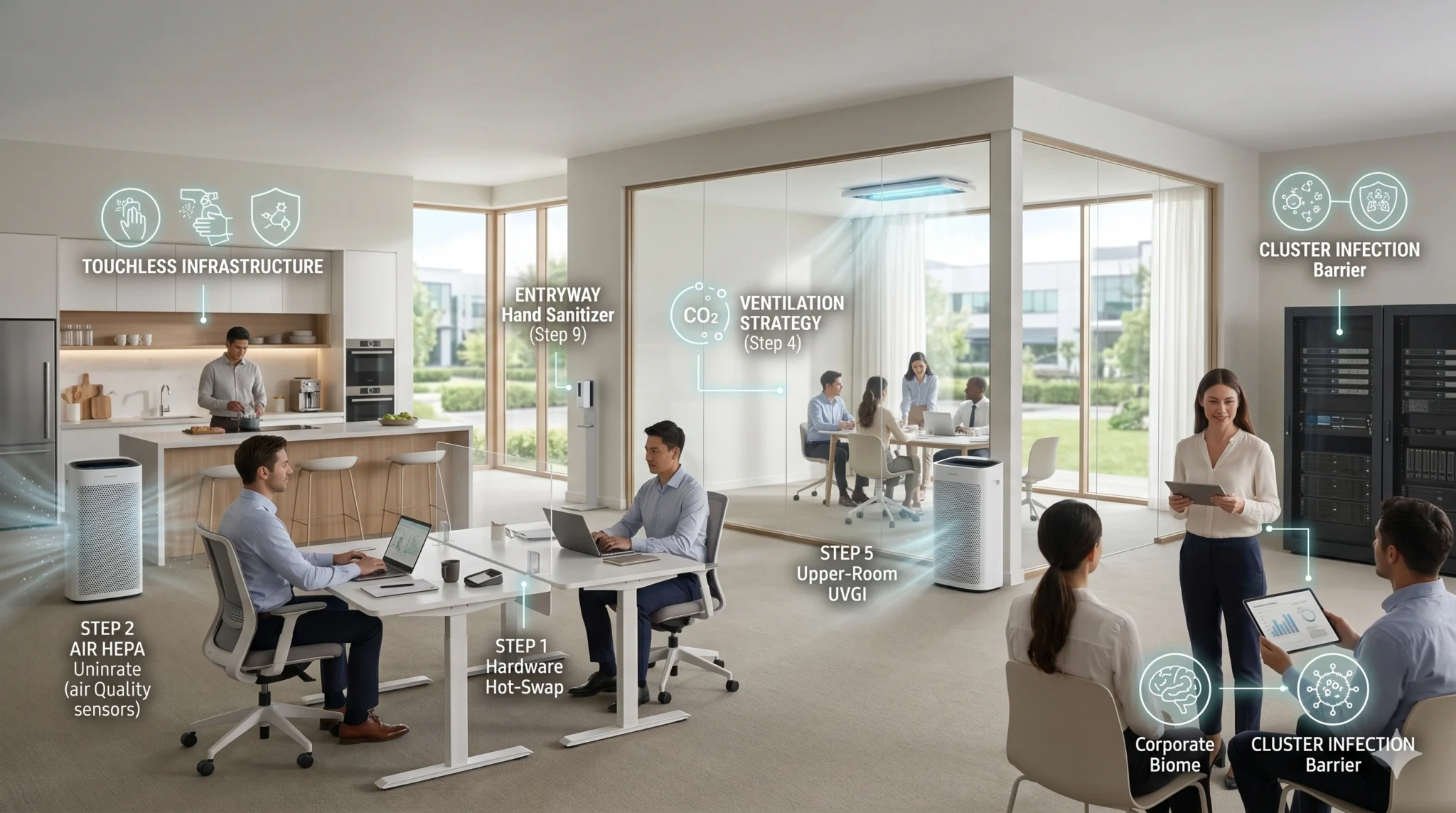

For the entrepreneur and studio owner, the workspace is a theater of high-stakes collaboration. However, high-traffic professional environments—like computer coaching centers or game development studios—are unique biological challenges. When multiple individuals share hardware, air, and communal surfaces for $8–12$ hours a day, the risk of “cluster infections” and productivity-killing outbreaks increases exponentially.
Mastering the “Corporate Biome” is about transitioning from janitorial cleaning to professional bio-security. By engineering a workspace that prioritizes infection control, you protect your team’s health and your company’s bottom line. Here are ten high-quality pillars for high-traffic workspace hygiene.
1. The Hardware “Hot-Swap” Protocol
In a coaching center or shared studio, keyboards and mice are the primary vectors for contact transmission.
- The Individual Kit: If possible, provide employees with their own peripherals (mouse/keyboard) that they store in personal lockers.
- The Sanitization Nudge: Place 70% Isopropyl Alcohol wipes at every workstation. Make it a “startup ritual” for the incoming user to wipe the touch-surfaces before beginning their shift.
2. High-Capacity Air Scouring (CADR)
In crowded offices, the “viral load” in the air can build up quickly. Standard HVAC systems often lack the filtration required to clear respiratory aerosols.
- The Clean Air Delivery Rate (CADR): Deploy industrial-grade HEPA purifiers with a high CADR. You should aim for at least 5 Air Changes per Hour (ACH) in shared zones to ensure that exhaled aerosols are captured before they can be inhaled by others.
3. The Communal Kitchen “Bio-Barrier”
The office breakroom is often the most contaminated area in a professional building.
- Touchless Infrastructure: Replace pump-style soap and paper towel dispensers with motion-activated units.
- The Coffee Station: Provide individual stirrers rather than a communal spoon. Use a stabilized hydrogen peroxide spray to disinfect high-touch handles (fridge, microwave, coffee machine) every two hours.
4. Meeting Room Ventilation Strategy
Small, enclosed conference rooms are high-risk zones for “superspreader” events due to poor air exchange and proximity.
- The $CO_2$ Proxy: Use a $CO_2$ monitor as a proxy for ventilation. If levels cross 800 ppm, it indicates that exhaled air is building up.
- The Open-Door Policy: Keep doors open during meetings to encourage cross-ventilation, and run a dedicated air purifier on “High” for the duration of the session.
5. Upper-Room UVGI for High-Traffic Corridors
For lobbies and narrow hallways where people pass frequently, upper-room Ultraviolet Germicidal Irradiation (UVGI) is a clinical-grade solution.
- The Science: UV-C light deactivates the DNA of pathogens as air naturally circulates through the upper third of the room. This provides continuous, “invisible” protection without disrupting the workflow.
6. The “Sick-Leave” Cultural Reset
Productivity is not measured by physical presence, but by output. A “presenteeism” culture—where sick employees feel pressured to come to work—is a bio-security failure.
- The Policy: Implement a “Hard Stop” for symptomatic employees. If an individual has a cough or fever, they must work from home or take leave. This prevents a single person from taking down an entire development team.
7. Desk-to-Desk Distance and Shielding
While “open-plan” offices encourage collaboration, they also encourage the spread of droplets.
- Physical Baffles: Use acoustic panels or glass dividers between desks. These serve a dual purpose: reducing noise for deep-focus work and acting as a physical barrier for respiratory droplets during conversations.
8. Managing “Bio-Debris” in IT Equipment
Computer towers and server racks act as massive “vacuum cleaners,” pulling dust, dander, and microbes deep into their fans.
- The Filter Audit: In high-traffic centers, clean the intake filters of all PCs monthly. Dust buildup doesn’t just cause thermal throttling; it acts as a reservoir for environmental allergens that get exhausted back into the room.
9. Hand Hygiene Stations: The Entryway Anchor
Don’t rely on the restroom for hand hygiene.
- The Placement: Place high-quality, non-drying hand sanitizer stations at every entrance and exit.
- The Psychological Nudge: When hand sanitizer is visible at the “transition points” of a building, compliance increases by over $60\%$.
10. The Professional Cleaning Audit
Traditional office cleaning often focuses on emptying bins and vacuuming floors while ignoring biological “hot spots.”
- The Scope: Ensure your cleaning contract includes a daily disinfection sweep of light switches, elevator buttons, door handles, and shared printer touchscreens using an EPA-registered disinfectant.
Conclusion: Bio-Security as Business Intelligence
A high-performance workspace is a resilient one. By implementing these ten pillars of corporate hygiene, you create a professional environment that respects the biological reality of human collaboration. Infection control is not an “extra”—it is a core component of your operational excellence.