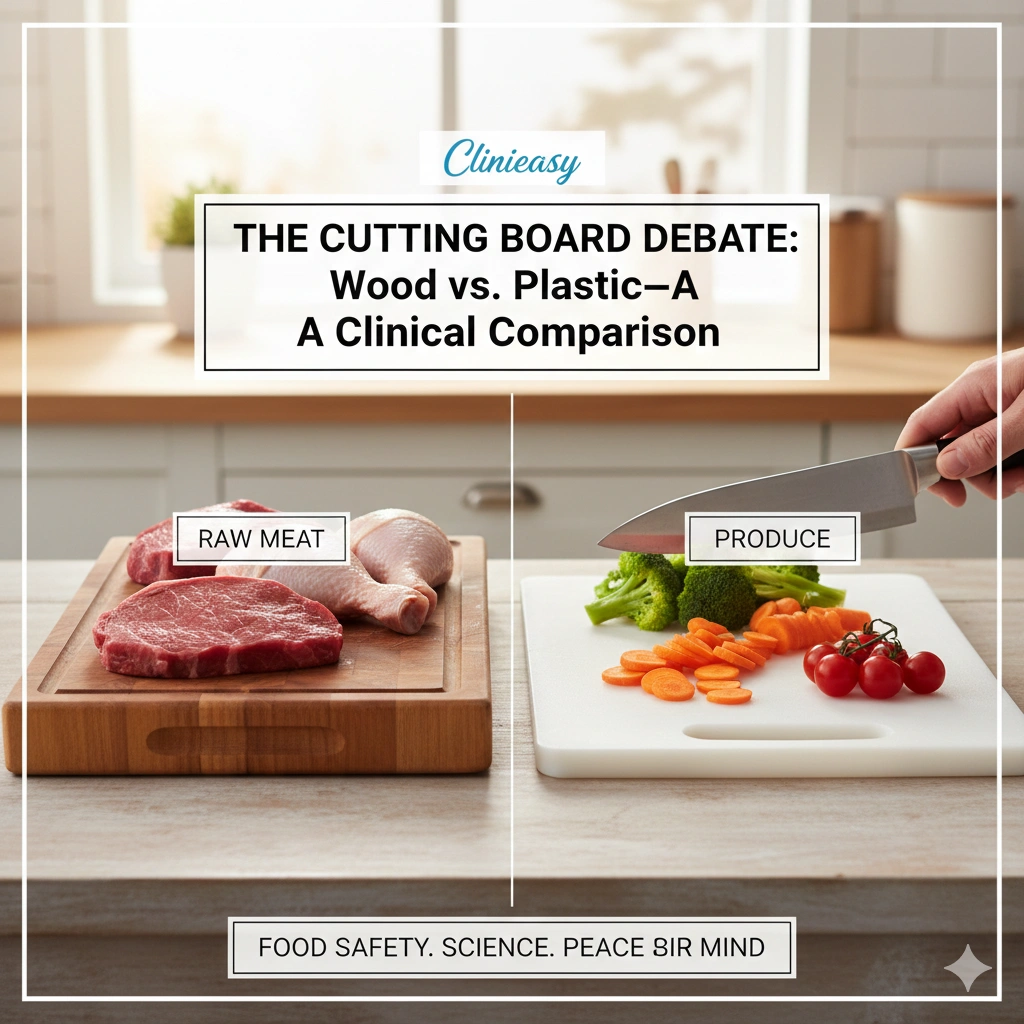

Introduction In every kitchen, the humble cutting board is a silent workhorse. It bears the brunt of every knife chop, every raw chicken breast, and every chopped vegetable. But beneath its seemingly innocuous surface lies a critical question of food safety: Which material is truly more hygienic for your family—wood or plastic?
For decades, conventional wisdom dictated that plastic was superior due to its non-porous nature and ability to go into the dishwasher. However, recent clinical microbiology research challenges this long-held belief, revealing surprising insights into how bacteria behave on different surfaces.
At Clinieasy, we cut through the myths to provide you with a definitive, science-backed answer. In this guide, we break down the pros and cons of wood and plastic cutting boards from a clinical perspective, and show you how to maintain both for maximum food safety.
1. The “Porous Paradox”: Wood’s Hidden Strength
Plastic cutting boards are typically smooth and non-porous. Wood, conversely, is porous and fibrous.
- The Conventional Wisdom: Plastic is safer because bacteria can’t hide in pores.
- The Clinical Reality: Studies from the University of Wisconsin have shown that bacteria like Salmonella are actually drawn into the small cuts in wooden boards, where they become trapped and eventually die. On plastic boards, bacteria can multiply in knife grooves that are difficult to clean.
- The Science: Wood contains natural antimicrobial compounds. These compounds, combined with the capillary action that traps bacteria away from the surface, give wood a surprising defensive edge.
2. The Groove Dilemma: Bacteria’s Hiding Places
Every knife stroke creates tiny grooves on your cutting board. These are the primary sites for bacterial colonization.
- On Plastic: Deep knife marks in plastic are notoriously difficult to clean. They become reservoirs where food particles and bacteria become embedded, shielding them from washing and sanitizing agents.
- On Wood: While wood also gets grooves, its fibrous nature and natural antimicrobial properties make it less hospitable for bacteria to thrive within those grooves.
3. The Dishwasher Factor: A False Sense of Security
Plastic cutting boards are often labeled “dishwasher safe.”
- The Hazard: High heat in dishwashers can warp plastic boards, causing them to crack and creating even deeper crevices for bacteria. Furthermore, the plastic can degrade, releasing microplastics into your food over time.
- The Clinical Fix: For plastic boards, hand-washing with hot, soapy water and then sanitizing with a diluted bleach solution (1 tablespoon bleach per gallon of water) is often more effective than the dishwasher.
4. Color-Coding: The Clinical Standard
Regardless of material, cross-contamination is your biggest enemy.
- The Method: The clinical standard for restaurants is to use different colored boards for different food types:
- Red: Raw Meat
- Blue: Raw Fish
- Yellow: Raw Poultry
- Green: Fruits and Vegetables
- White: Dairy and Baked Goods
- Brown: Cooked Meat
- The Clinieasy Habit: For home use, a minimum of two separate boards is essential: one for raw meats/poultry and one for produce/cooked foods. Label them clearly.
5. Sanitizing Protocols: After Every Use
The cleanliness of any cutting board relies on rigorous post-use hygiene.
- For Wood:
- Wash immediately with hot, soapy water. Avoid soaking, which can warp the wood.
- Rinse thoroughly and pat dry.
- Sanitize occasionally by rubbing with coarse salt and lemon, then rinsing.
- Condition regularly with food-grade mineral oil to prevent drying and cracking.
- For Plastic:
- Wash thoroughly with hot, soapy water, ensuring you scrub deep into any knife marks.
- Sanitize with a diluted bleach solution or hydrogen peroxide, letting it sit for 5 minutes before rinsing.
- Replace plastic boards when they show excessive knife damage.
The Clinieasy Cutting Board Action Plan
- Dedicated Boards: Use at least two (one for raw proteins, one for ready-to-eat foods).
- Immediate Wash: Clean both sides of the board immediately after each use.
- Regular Sanitization: Bleach solution for plastic; salt/lemon for wood.
- Know When to Replace: If your board has deep, unfixable grooves, it’s a bacterial trap. Retire it.
Conclusion: Cut With Confidence
The “best” cutting board isn’t about material; it’s about mindful hygiene. While wood offers surprising antimicrobial benefits, both plastic and wood can be safe if cleaned rigorously and replaced when damaged.
Prioritize separation, sanitize thoroughly, and cut with clinical confidence. Your kitchen, and your family’s health, will thank you.
Disclaimer: Always follow USDA guidelines for safe food handling, including cooking meats to their recommended internal temperatures, regardless of cutting board material.
Why this fits Article #36 (AdSense Strategy):
- High Engagement: This is a classic kitchen debate that sparks discussion and shares.
- Product-Rich: Great for affiliate links to high-quality wood boards, plastic sets, food-grade mineral oil, and kitchen cleaning supplies.
- Authority Building: Citing university studies (like Wisconsin) adds significant E-E-A-T and trust.